
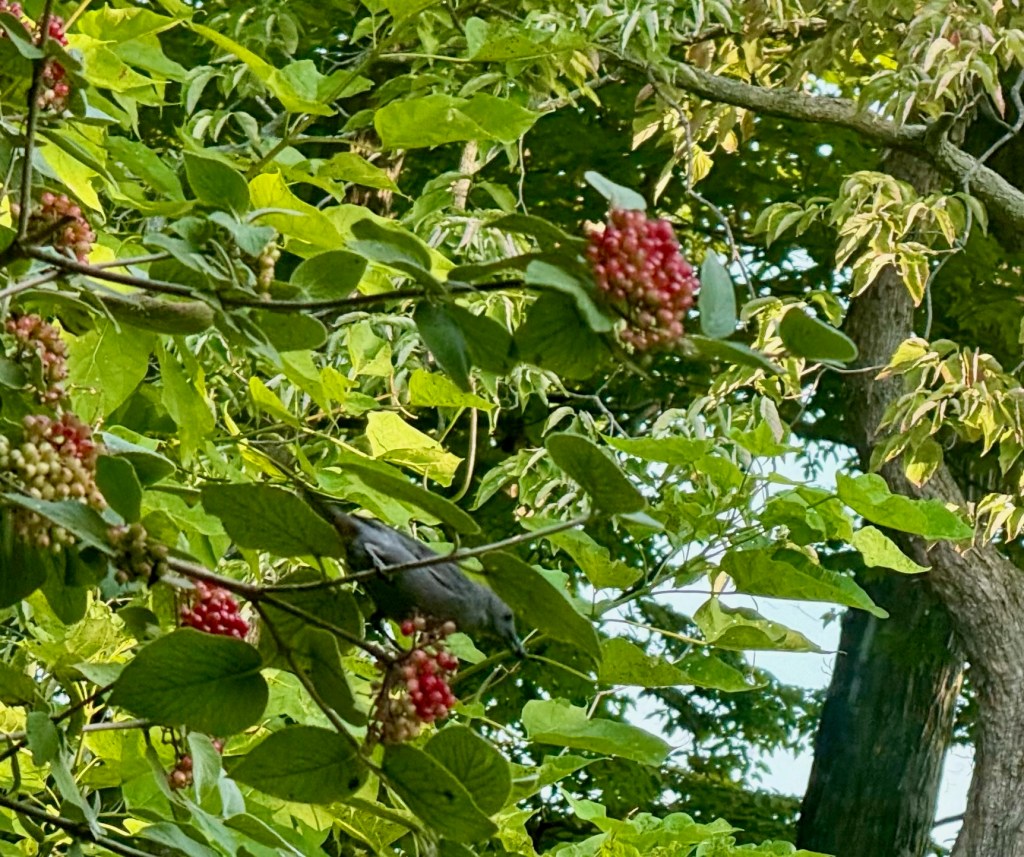
Early on this beautiful July morning, while we sipped our coffee in bed, a groundhog munched her way across the yard and gray catbirds flew sorties to feed on the bright red drupes on the viburnum outside our window. For those few moments in the early morning quiet, the problems of the world were far away. Nothing in that unmowed lawn exactly recreated the Matthew Arnold moment, but I could not the avoid the sense, shared with many I believe, that the world is careening away toward a disaster of unimaginable magnitude. Measure it by MAGAturd if you like, though the bathos of Trump, the ignorance, demagoguery, greed, and elite empowerment it embraces, can’t compare to the real issues facing humankind.
Creating an exhaustive list of ongoing and future disasters would easily fill a page, but I can list my favorites, just as Brassens could sing about his favorite war. Of the issues that worry me the most are: climate change, still denied by many, unabated manmade pollution, invisible and insidious, mass extinction on a scale and in a time frame only equaled by that caused by the Chicxulub meteorite, nuclear proliferation, unreal for Americans who have never suffered the war-made destruction of Europe and Japan, widening inequality and hunger in an age of tremendous wealth and plenty, growing religious intolerance across the world, and crass, abhorrent and ultimately immoral use of military force, for questionable ends and without regard to the enormous suffering of innocents.
Arnold bemoaned the retreat of faith and sought solace in love, and nothing wrong in that, but Arnold, despite his pessimism, lived in an age of optimism when progress had come to be accepted and expected as part of the future. For me, though, the retreat I hear, the shingles on my beach, is one of faith in reason. I recently finished Stacy Schiff’s A Great Improvisation, an account of the period of Benjamin Franklin’s life as a commissioner for the American colonies in France, doing his best to secure financial and military assistance from the government of Louis XVI. Franklin’s time in Paris marked the very end of the Age of Reason, to be quickly followed by a revolution that spawned a new religion: nationalism.
Since Franklin’s time, nationalism and traditional religions have competed with reason for the minds and hearts of men. One can only hope–and pray–that the actions of men will be tempered by a proper mixture of the two, and guided by some power higher than artificial intelligence. Internationalism is a powerful antidote to nationalism. Unfortunately, Americans, who have spread their culture around the globe, tend to have one of the most insular of cultural viewpoints. Xenophobia and isolationism have been with this country since its inception. Only imminent and existential threats seem to generate American involvement abroad, yet today, by any standard, Americans faced by many such threats, are remarkably complacent. Besotted by multimedia, many have lost the art of reflection.
The viburnum in my yard is native to the Northern Hemisphere including the Atlas Mountains of Morocco, and often planted in gardens in the US. The red berries are edible, but they taste bad. Some are mildly poisonous. The brillant red color is attractive, however, and the plant has a special place and meaning in Ukrainian culture.
The Russians celebrate it, too, and a popular 19th century Russian song, Kalinka, is dedicated to it. When I studied Russian in high school, the instructor used song to teach pronunciation and vocabulary as well as to break the monotonous learning of conjugations and declensions. Years later, when I have forgotten much, I still remember the verse, В саду́ я́года-мали́нка, мали́нка моя́, My beautiful berries in my garden.
Beautiful though they are, the catbird and the berries can’t keep the images of dead and starving innocents long out of my mind. My old college friend, Jim A, thinks that a consensus on climate change might help humanity share the important values that everyone has in common, and, perhaps it will as the effects of climate change become undeniable in spite of the misinformation spread for years by the fossil fuel industries. I hope so.

 Morocco That Was