
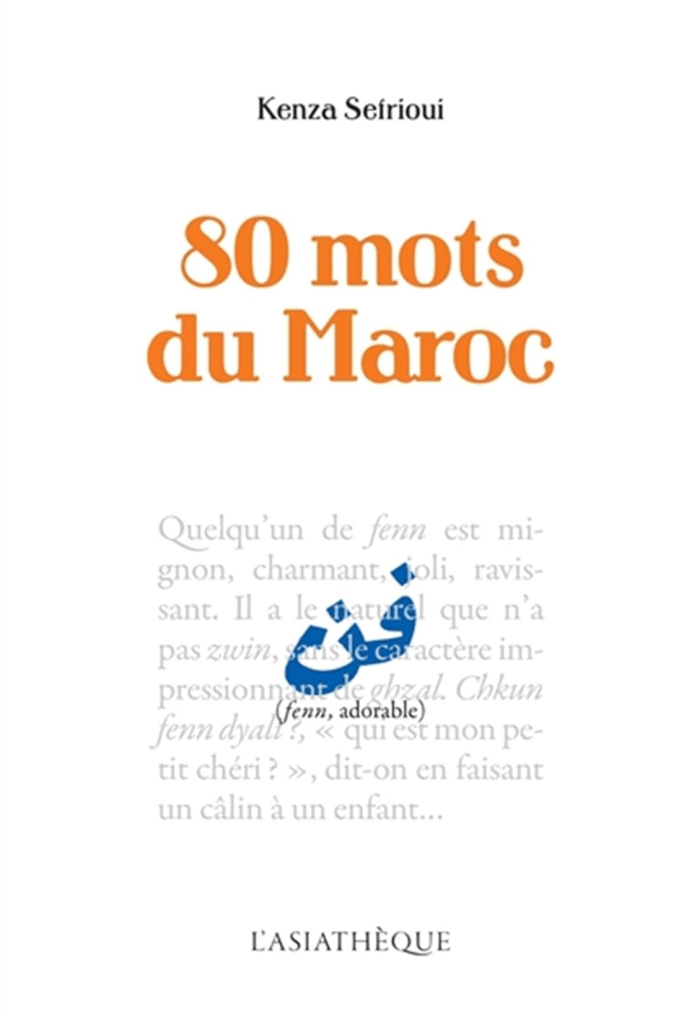
The word “mot” has a couple of meanings in French and is used in multiple idiomatic expressions, just like its English counterpart “word”, and it is so common and significant that it is among the first words a non-French speaker learns.
The number 80 in mainstream French is quatre-vingts, of course. It is a survival of the 20-based counting system used by the Gauls. Called the vigesimal system, the usage became standardized in the 19th century replacing the older word “octante.” Today, in parts of Switzerland, “huitante” is used, but only in informal speech. For anyone interested, the Internet site Français de nos régions has articles on the use of older forms of numbers as well as other regional variations of French.
As for the number 80, Wikipedia makes note of some of its properties, mostly of interest to mathematicians. Jules Verne chose it for Phileas Fogg’s trip around the world race deadline because the duration made for an interesting challenge, given the means of transportation available at the time.
In the recent book by journalist, Kenza Sefrioui, the number 80 is nothing more than the sum of a compilation which she no doubt rounded up or down to fit the series which includes other “80 Mots de …” titles. The words are in Darija, Moroccan vernacular, and Ms. Sefrioui, who writes about cultural topics, explains why they illustrate important aspects of Moroccan culture. She culled them from the popular Moroccan music that began with the group Nass el ghiouane in the 1970s, which began a trend that includes many groups and that continues to this day. At the end of each entry Ms. Sefroui notes the song and group from which the word was chosen.
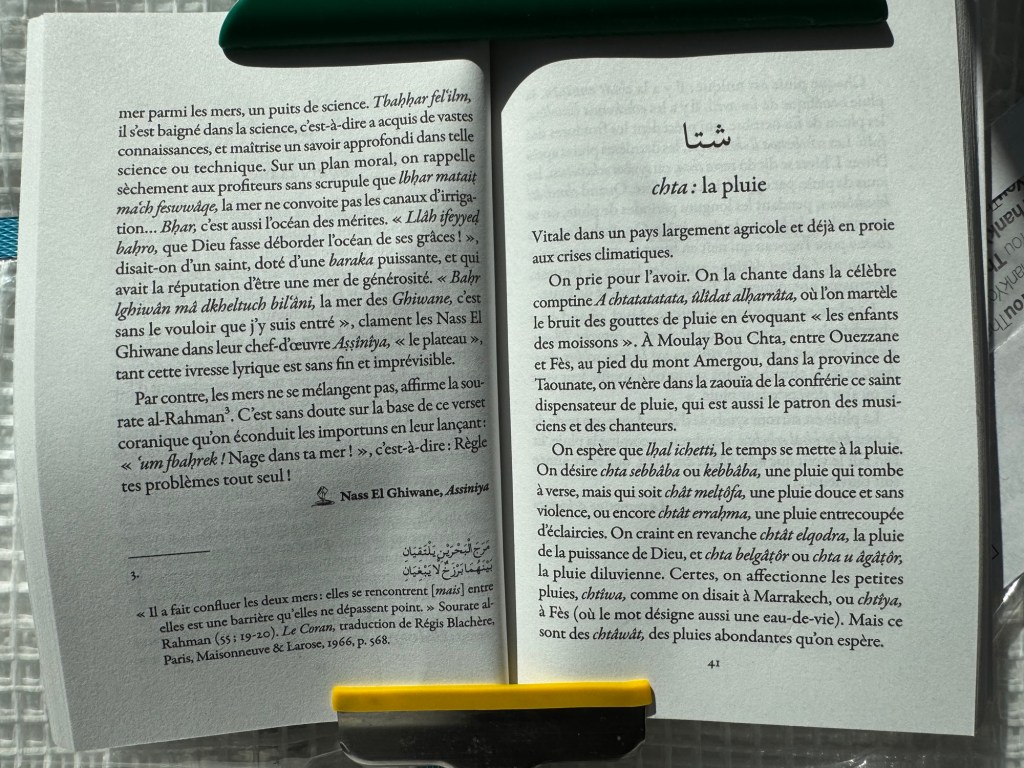
If you are one of the many Peace Corps volunteers who learned Moroccan Arabic, you will find the words in the collection familiar and the insights into them that Ms. Sefrioui provides interesting and illuminating. Perhaps, as in my case, they will bring back a flood of memories. How many times did I hear my housekeeper, Khadija, utter “wîli, wîli, wîli” in reference to some unfortunate event.
In the first decade of the Peace Corps, North African vernaculars, like those in the rest of the Arab world, were looked down upon. Pan-Arabism was strong and the language bound Arabs together. Indeed, the best definition of an Arab remains, to this day, someone who speaks Arabic. But pan-Arabism was an intellectual and international political movement where communication was through the written language. For speakers across the Arab world, the vernaculars were natural, comfortable, the language one spoke at home and on the street, but without prestige and unsuitable for important business. Arabic is one of several languages that exhibit the sociolinguistic phenomena, diglossia, where two dialects exist alongside each other, one written, formal, often associated with and supported by religion, the other spoken and never written, used in daily life. Modern Standard Arabic became the official written language of Morocco in 1962, but I never heard anyone speak it except on the radio abd TV. MSA does not have the sanctity of Koranic Arabic, but it has been adapted to modern life and purged of archaic terms.
The linguistic landscape of Morocco has changed significantly since the 1960s with Moroccan Berber being recognized and institutionalized as an official language. The languages of the elites remain Modern Standard Arabic and French, but Darija is spoken by virtually everyone.
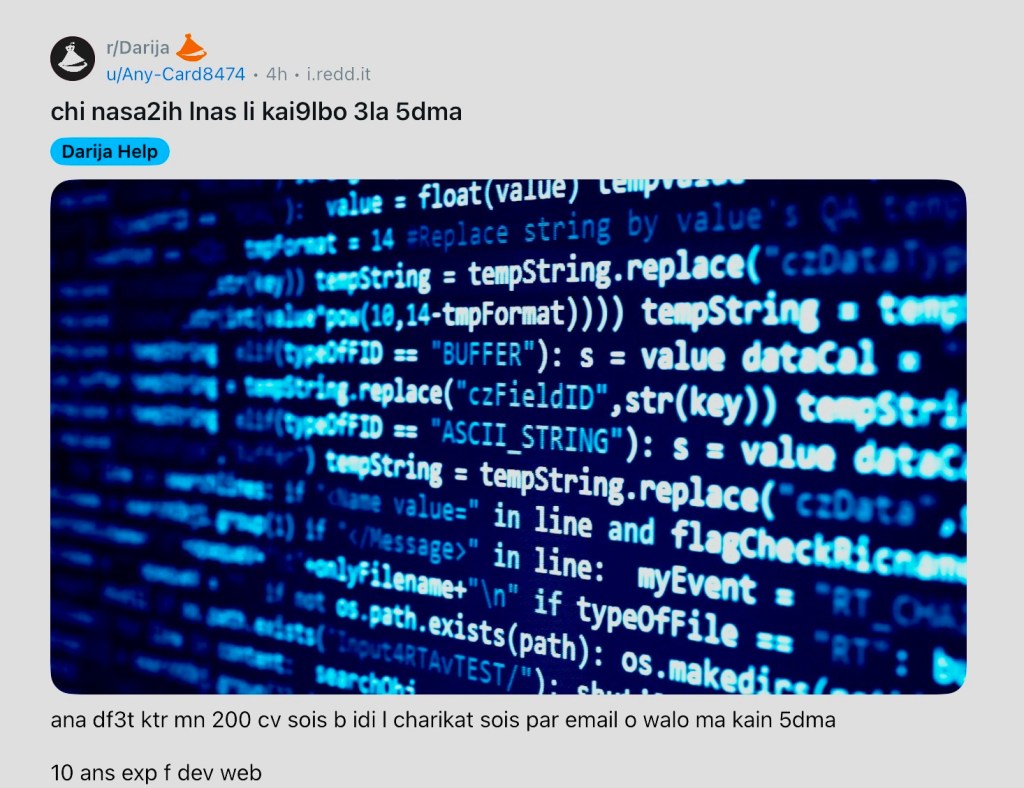
One linguistic change that I have found interesting is the online use of Darija, usually written the Roman alphabet, which is well known through familiarity with colonial languages and English. Numbers or Arabic script are added to provide the sounds missing from English and French, and it is common in the Reddit conversations to see the writers mix in English, French, or MSA. Asked about that, an old Moroccan friend, university educated and an accomplished polyglot, sounded a bit dismissive when he told me that Darija was written because the writers didn’t know how to write in Modern Standard Arabic or other languages. On reflection, I think he was simply being direct and honest, but his assessment misses the thought that I was mulling, that the Internet may be a real crucible for the standardization of a common vernacular. Darija varies in vocabulary and pronunciation from region to region, though never so much as to lack mutual intelligibility.
Before Independace in 1956, all studies of Darija and Berber dialects, indeed, all serious studies of anything Moroccan, had been carried out by French researchers. Today, Moroccans at home and abroad have taken up where French linguists and ethnographers left off, and Moroccan vernaculars have become topics of serious study by Moroccans themselves.
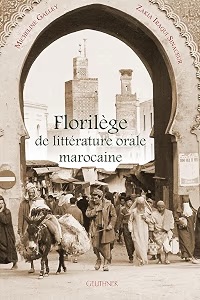
In any case, for most Moroccans and some volunteers, Darija will always remain the language of family and hearth, familiar and evocative. For former Peace Corps volunteers, Ms. Sefrioui’s 80 Mots may bring back poignant memories.


