
Moroccans used the term harka (حركة) to describe the military expeditions that sultans led to extract taxes from tribal areas and to force tribes into submission when necessary. Walter Harris, in Morocco That Was, describes a harka during the reign of the Sultan Moulay AbdelAziz, as does Gavin Maxwell in his book, Lords of the Atlas.

Why Moroccan Peace Corps volunteers chose the word as a title for their volunteer newsletter in 1963 is a mystery. Perhaps the first issue explained their choice. In any case, volunteers, with Peace Corps office support, published the Harka at irregular intervals during the first 10 years of the Peace Corps.
Electronic copy machines such as those made by Zerox were just appearing in the mid nineteen sixties. I still remember my cousin Irene’s husband, John Maroney, proudly showing one to me in his Union Carbide offices in Manhattan in 1964. The Peace Corps administration in Morocco still did not yet have one when I arrived in 1968. All cheap reproduction was still done by mimeograph from copy prepared on typewriters. The process required a special machine and produced copies relatively slowly.
As the contributions to the Harka came from volunteers spread over a large country, the editing and assembly of each issue demanded time and patience from the editors, who presumably lived near Rabat. Depending upon who typed up the manuscript, some strange errors crept in. How many editions of the Harka appeared and when the newsletter ceased publication in its paper form are unknown to me. Perhaps one of this blog’s readers can enlighten us about the publication’s origins, history, and demise. There is little question in my mind that the Peace Corps administration looked upon the free expression of volunteer views with a bit of trepidation.
I have at least four copies of the Harka, two generously furnished by Don Brown. The four date from 1966 to 1968. I will post them on the blog as an incipient archive, hoping that readers may have additional issues to share.
The articles in the Harka present insight into what volunteers were thinking in the late nineteen sixties, not only about voluntary service abroad and all that it entails, but also contemporary cultural issues such as the draft and marijuana use.
The March 1968 issue contained an article by Bob Draper that was particularly of interest to me. Draper crossed the Sahara by the central western Saharan route, south to north beginning in GAO and ending in Oran after traveling on the Niger River through Mopti to Timbuktu. What a great journey! Draper led the way for other volunteers, demonstrating that one could reach West Africa overland from Morocco, and do it on a small budget to boot. If Draper could do it, some of us reckoned, we could do it, too, and so a few of us did.
Draper found the desert scenery uninteresting, but enjoyed his river travel and some of the people he met in West Africa. His brief cultural observations were similar to mine though his style and tone are not. Traveling the westernmost route, by way of contrast, I saw some spectacular scenery and visited more of West Africa, but missed out on the wildlife and the fabled Timbuktu.
Today the trip is mostly made by migrants trying to make their way to Europe at great risk to themselves, as Islamic and ethnic insurgencies plague the western Sahel.
Draper’s account of his trip follows, with typos and original grammar mostly left uncorrected:
DRAPER IN AFRICA (March 1968)
I must begin every letter nowadays with “Sorry to have been out of touch for so long but there was too much sun and too much newness and no motivation whatsoever to put pen to paper, beggin’ your pardon.” The jungle, the savannah, the steppe country. And the Sahara, which had filled my mind for two years, always the Big Thing, which turned out to be a flat lot of sand, the only interesting part being the people—the Touaregs and the Arab truckers who pilot 20-ton snarling hunks of metal through a country still staggering in its huge emptiness, and have pieces of infinity in their eyes. But it’s true anywhere, that it’s the people in a country or town that are interesting, that the sperm and the egg that formed you in the U.S.A. would have been the seed of a savage had it developed in the rain forest, or that in the fishing village of the Niger, would have been shaped into something still different.
You tell more about the forest, get a better feel for it, by seeing the little
stocky guy trotting along with his machete and poison arrows than by looking at bone-white trees in the rank greenery. You see a piece of the Niger river, water and bank and hippos, but the Iong Bouzou, an intricately-worked black needle pirogue which seems an extension of his body, heavy with cargo, or used as a pointed mobile stage for the flinging of a circular net, is an intensification and quintessence of the river past and present, the distillate of the whole scene, what’s left in the bottom of the centrifuge tube after everything has been concentrated.
I was dead afraid when I bounced off the boat at Abidjan from Casa. The jungle and heat were overpowering, at that point mainly the heat. I gobbled a salt tablet. I couldn’t move or breathe. The animals and birds looked as if they had been assembled by an insane child, armed with an infinity of feathers, scales and colors. I was dizzied by the colors on the women’s dresses and by the fresh pineapple and mangos and birds. My toes rotted in my boots, had to buy sandals. Heard of some missionaries in town so I stayed with them, because I was afraid to put up the tent in the jungle and because there were no clearings there in the solid mass of green and thorns. I could see why authors call the jungle malignant. The green is too green, the animals are insane. God knows what could be lurking three feet away and who would know. Little guys with poison arrows. Man.
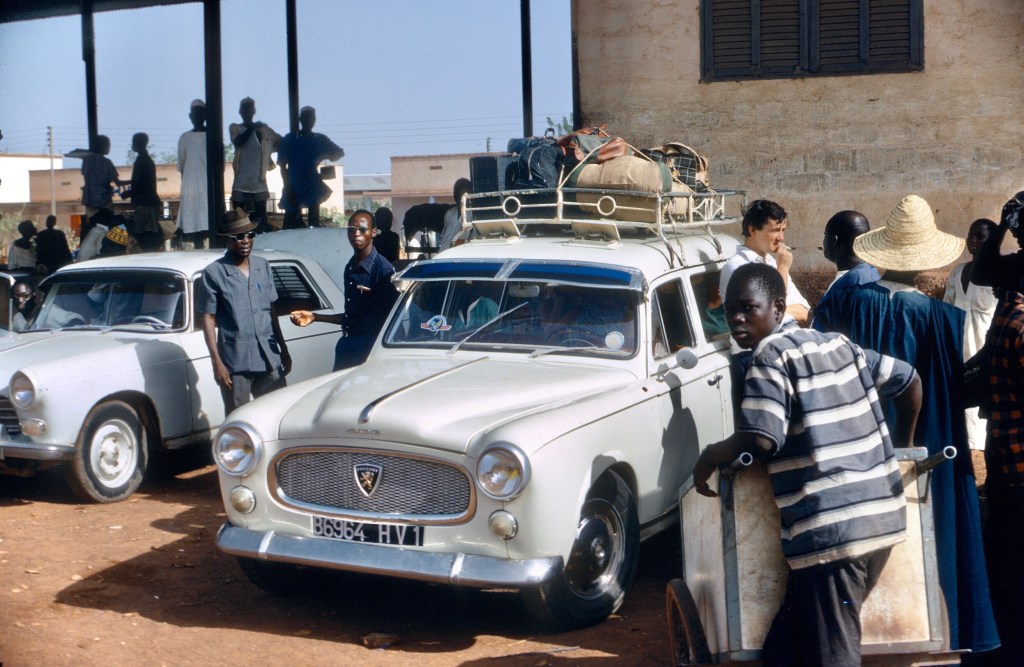
A devious route up to Bobo Dioulasso miles and days on “mille-kilos”
and Peugeot taxis to my rendez-vous at the big French research center with the tse-tse fly boys in Bobo. Plunged into a life of super-color for a couple of weeks, fantastic food served and prepared well, the first~class seats in the movie (second-class ? Oh, that’s for them…) really an evil sort of unhappiness for most of the French there: the middle class, always the source of racism, always searching for reasons for their miserable lot, weaving “C’est ca, les Africains”, incredible looms of boredom. Bobo, in the savannah, not so overpowering as the forest or the desert, because there’s neither the absolute closeness nor the too openness.
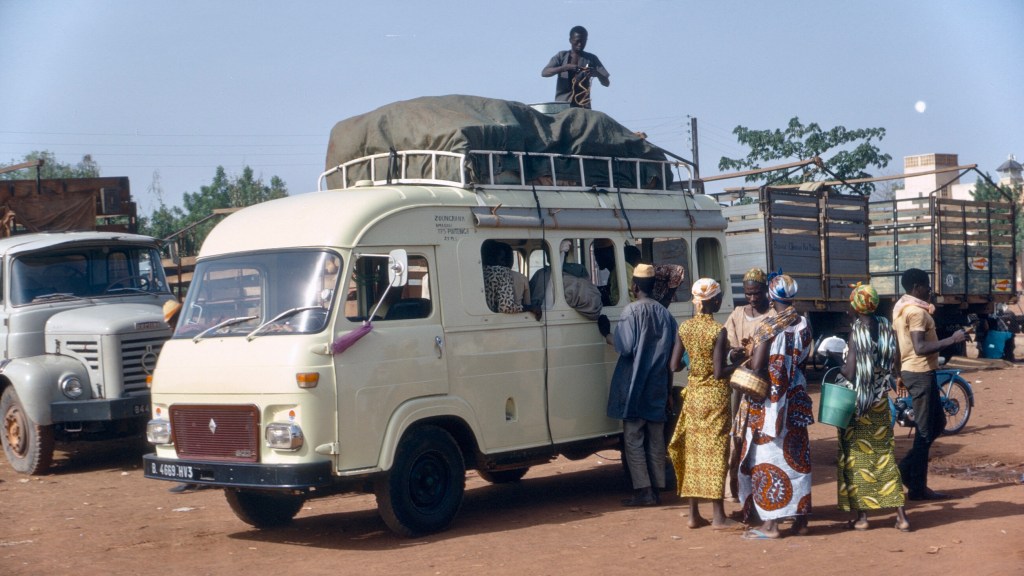
It’s just when you get upon a hill and look out and see the same twisted thornbush and head-high grass stretching and rolling out to infinity that you say God, we’ll never get there, the truck will break and there is nothing here. You can’t eat these thorns and dry grass. Fear.
Then it happened, a flat and then another. No tire repair kit on a back
road, sun sucking the moisture out of every pore. The Africans? Nothing. The chauffeur takes a bicycle off the top of the truck, puts a boy on it, sends it off towards the south down the endless washboard. Two very tall men amble off into the brush with very big knives. The chauffeur takes out inner tubes, finds the hole, kind of primitively trial-and-error like, trying several ways of getting the tire off of the rim before succeeding. The two lanky guys get back dragging large branches which they lay beside the chauffeur; they sit under a shrub, cleaning their teeth with chunks of twigs, turning their eyes inward. The chauffeur takes an old inner tube, makes a patch, sticks it on with the sap from the hacked off branches, puts the tube in the tire, the kid shows up with a pump he borrowed from a village off the road somewhere, they pump up the tire, leave, after leading me to my seat because I was saying: “Wha?” and standing around with my mouth open.
After having gone through an hour of “I used to work in an American filling station, bums, want me to show you how?” the sight of a bouncy, healthy tire was too much: I have preserved dried leaves of the “tire-repair” tree.
Most of the nights I was lodged in with the Africans in whatever village we were at when night fell. Smetimes, though, I stayed with missionaries, who were more than glad to feed me and have me listen to them, satisfied with a sleepy nod now and then at random points in their monologue, breaking out dusty bottles of spirits hidden away for medicinal puposes. One good old boy was from Memphis, Tennessee, and after praying together, we threw place names at each other (we had no common acquaintances.) Grits and gravy for breakfast. “Bye, now, write us a letter…”. Teenage daughter looks like Candy, going to Bible College in Nashville, ministering to the pagans along with her father. Asking for the good Lord’s help in a heathen land.
Next random impressions: the sexual freedom of all the natives I saw outside of the Arabs. Many of the Europeans working in the African bush have mistresses supplied them by their villages with the understanding and maybe an occasional present is the only payment required. After dinner in one household three beautiful girls walked in, sat down, were greeted and started to Ieaf through magazines. Wild colored dressed. Chattering in a local language but quietly with grace. Equally as quietly going off with their men, one of whom, as I learned later, was soon going to marry his girl. The others would go off leaving presents and maybe a baby, of which the girl and the village would be proud.
I will write now of the two modes of transportation possibly the least used by most tourists in Africa and possibly the cheapest and most interesting.
- Boat on the Niger: bi-weekly Mopti-Timbuctoo-Gao. $25 2nd class, five days good food. Hippopatamuses and crocodiles. Fishermen and nomads at the stops. Old cities along the river, notably Timbuctoo, Gao, Djenne and Mopti. Beautiful people. Feels at times like the womb of the earth, the constant fertility in the middle of the desert. Traditional evening baths each evening in the shallows for everyone.
- Truck on the desert: Gao-Adrar (western trail) or In Salah-Tamanrasset-Agades (eastern trail). Western trail-constant traffic (dates and tobacco down, sheep up) never a wait of more than a few days for a truck. $16, 1500 km., 5-3 days, good food. Take a chapstick and a sleeping bag, cigarettes for trading with the Touaregs for milk or with the truckers for dates. Clean , dry air.
Enough, because if anyone is going there they’re welcome to get more information of general or specific nature by sitting down with me over a coffee somewhere, and those that aren’t, aren’t, regardless of how much is written. The important communication is that it’s no big thing, no pilgrimage to the wilderness, no ordeal, no masochism. The trip was a pleasure and not at all hard. No problems, Coca-Cola partout. Everyone everywhere loves tourists including in Mali and Algeria, even though the only books I saw in Mali were “Pensées de Mao” and slogans on schools, the usual thing, “Work hard you brats”—all had the little “Mao” underneath. Skinny Chinese cats nervously smiling and bowing to hotel clerks as they paid their bills. Worthy of note is a widely distributed poster in Algeria of the “watch out for deviationists and revisionists” ilk, on the bottom of which you see in boldface except, of course, for our tourists to whom we should extend the traditional warm welcome.
Surprisingly, the total trip Casa-Abidjan-Bobo Diolasso-Gao-Bechar-Oran-Oujda was cheap, $290~for 12,000 km. eating well, frequent beers, traveling slowly. The trick is to always to plead poverty and refuse to stay in the hotels, or at least the European ones, which are all $10 or so a night minimum. I stayed 1/3 of the time with Africans, some with European and American missionaries. (Only two small nonviolent cases of diarrhea the whole way—polymagma-controllable.)
The only bit of proselytizing I’ll do is to say that there’s a certain amount of value in exposing yourself to a third primitive culture (after American and Moroccan). I found I had made certain generalizations about underdeveloped countries which did not hold water outside the Arab world. And, on a much simpler level, I enjoyed the trip because I left the rain and cold and sinusity behind and swam and played in the sun, and lost (temporarily, to be sure) sight of the Peace Corps and the realization of selfless service and the lousy job and could just wonder a while. It’s kind of nice.
Bob Draper
The Harka March 1978


 Morocco That Was