
During the nineteen sixties, amid the turmoil and turbulence of an unpopular foreign war, a bitter struggle for civil rights, and a generational revolution, American university students discovered a British work of literature that had appeared in the 1950s without much critical acclaim in America.

Ballantine Books published the three paperback volumes of The Lord of the Rings trilogy with funky cover illustrations and a plea by the author for readers to buy only authorized versions of his work. Soon slogans such as “Frodo lives!” began appearing here and there to the mystification of those who had never heard of Tolkien, let alone Frodo.
I don’t remember if the Rings trilogy was included in the book lockers distributed in the early days of the Peace Corps, but there were certainly lots of copies circulating among volunteers.
I read the book for the first time in 1966 in a Canadian National Pullman car, somewhere between Vancouver and Toronto, while miles of mountains, prairies, and pine forests slid by my window. Everyone my age seemed to be reading it. Tolkien had created a fantasy world where one could lose oneself in an epic adventure, one replete with drama, action, and suspense. The Lord of the Rings relieved the tedium of travel and filled the day. The prairies and the boreal forests of Canada are beautiful, but they sometimes seem to go on forever, and are enjoyed best in glances.

I reread the trilogy again, a few years later as I traveled from Algeciras to Catalonia, on much less comfortable trains, and by bus into Andorra and France. Leaving Spain, Catalonia’s rugged mountain scenery provided a dramatic backdrop for the Concerto de Aranjuez playing through the vehicle’s overhead speakers. The trilogy made a wonderful travel companion, and seemed to fit in perfectly.
In 1967, training for Peace Corps service in Morocco in California, I had tried to imagine the new and exotic world to which I would soon travel. Having had a Moroccan friend who lived in the dorm room across from my own in my senior year in college, I was better informed than most of those in my group. Still, what I find today, looking back at the imagination of my youth, was something resembling Middle Earth.

There were no battles between good and evil, but Morocco was a land where the US kept secret military bases, and the Cold War was never far off. There were no imaginary creatures, but there were jinns and ghouls, no Shire except for douars dug into mountainsides, no elves and dwarves, but many forests and caverns where they would have made their homes.

There was no panoply of races and creatures, but there were Arabs and Berbers and Jews and those curious peoples from Europe, the French and the Spanish. There was no quest for us, just a two year stint of service, no fellowship except that of other volunteers, staff, and the Moroccans who befriended us, no band of hobbits, just 40 young Americans dropped into rural locations.

There was, of course, a history to the place extending back to antiquity, armed men on horseback, African animals, new foods, expansive views, walled cities and veiled women, palace intrigue, secret police, and coup attempts.
Morocco was a land where oleanders bloomed all summer in dried up water courses, and black tents surrounded cold, clean lakes that had no visible sources.

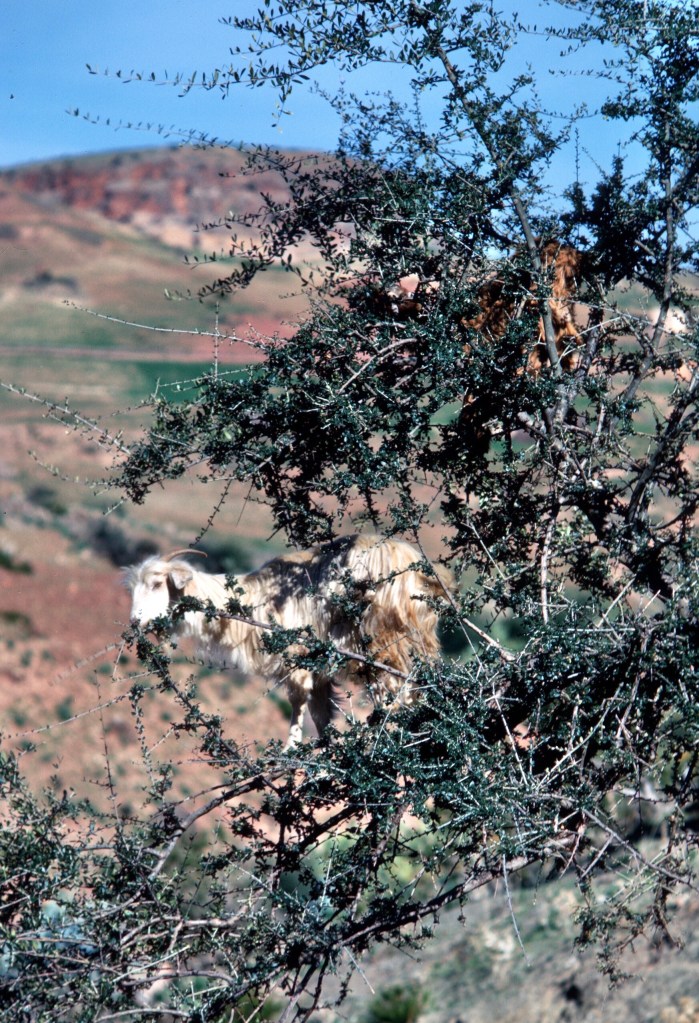
Goats climbed trees, porters worked themselves to death for a few dirhams a day, and some Moroccans lived in caves.
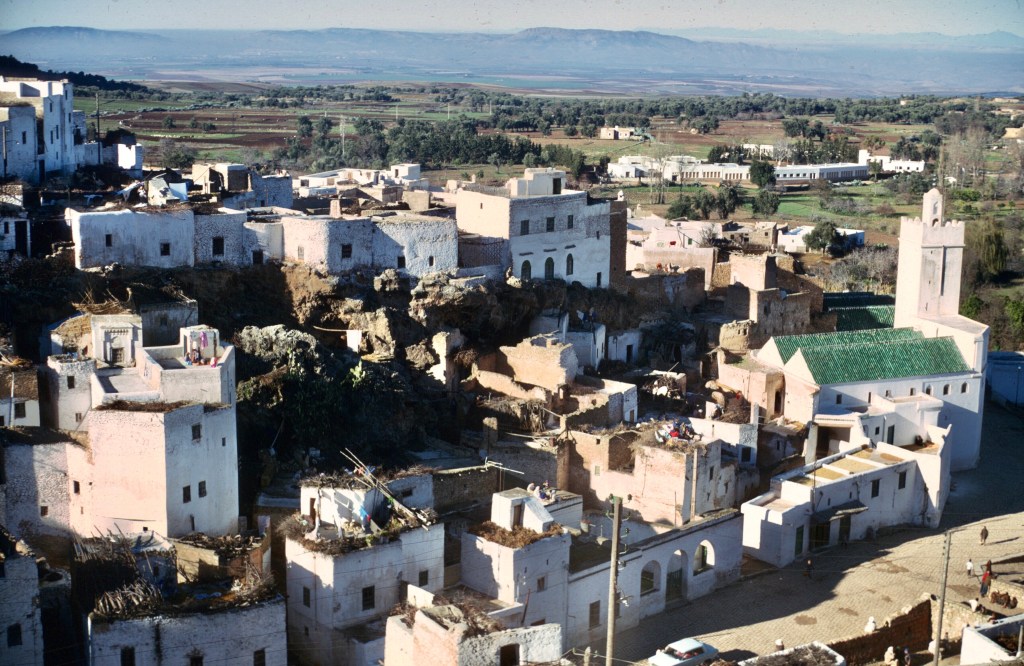
Morocco seemed old and timeless to our innocent eyes, both sadly poor and richly exotic. Moroccans in 1968 yearned for a brighter future, but were still shackled to the past.
Independence had brought pride and hope as they began to learn to live without the French and Spanish, but the real issue then was how Moroccans would live with each other once the foreigners had left.

None of our group died there, though at least a number of us came close. We willingly gave up many creature comforts as we worked in rural areas. Many of us lived without heat, hot water, and sit down toilets.
We finished our mission, as well as we could, before sailing off into the West on the wings of a Pan Am Boeing 707, “un Boeing bleu de mer” as Robert Charlevoix has described one. There we resumed our lives, continued our education, took jobs, married and had children, no longer worrying as much the war in Southeast Asia. Most of us had won the draft lottery or were fortunate to have local selective service boards that believed that we, though non-combatants, had served our country. Some of us even returned to Morocco and spent more time.
Middle Earth did not survive the wars and conflicts that finally led to the destruction of the one Ring. Change was in the air long before the trilogy’s protagonists set off for the Western Isles. And change was in the air in Morocco, too, even as we left.
Migrant workers were beginning to settle their families in Europe, rather than leaving them in Morocco and returning to them every summer as was customary. The population was growing rapidly and sprawling urbanization along with it. Cheap travel was bringing more and more foreign tourists. The revolution in transistors that led to the computer had just begun and eventually would provide much easier communications than the local PTT or rate hanout with a phone. Moroccan Jews as well as foreigners were leaving the country as the new Moroccan elites tightened their hold on the reins of power and began to enjoy the spoils of independence.
We never suspected that Berber would gain official recognition as a national language, and, more radical still, an attempt would even be made to write darija, the Arabic dialect almost everyone spoke, but never wrote. The colonial tongues would come under increasing pressure to the new international language, English, the language, of course, that many of us were teaching. Argan oil went from a prized element of Swasa cuisine to a Western cosmetic fad.
Today, PCVs in Moroccan still write home about the exotic, the romantic, and the quaint, just as we did, but now they do it on blogs. Cellphones and computers connect many of them in real-time with their friends and families back home. Many Moroccan students have now gone to the US for their studies. Moroccan restaurants are found in all the major America cities.
Morocco has established diplomatic relations with Israel, and Moroccan Jews and their descendants now return to Morocco as tourists.The populations of major urban centers have swelled and old provinces have been divided and subdivided into many newer ones.
Anthropologists, archeologists, and paleontologists make new discoveries daily that change the story of human prehistory as well as that of life from times far before humans walked the earth. Religious fundamentalism, not longer an artifact of the past, has become an active social force, not only in Morocco, but, to the amazement of some of us, in our native land.
I prefer to remember Morocco as a quiet postcolonial place, awaking after a long nap, refreshed and energized by independence and eager for a hopeful future. Was it a better time? Were problems more manageable then? The French poet and songwriter Georges Brassens who has written many songs about the passage of of time, reminds us that Time is a disquieting god, “un dieu fort inquiétant,” killing time in his own ways. Time blurs the memory and softens the hard edges of the past. For some of us Morocco still may seem the garden of the golden apples, but we should know better. We were guests, not true residents.
And though our Morocco, a Morocco that was, has given way to a newer age just as Middle Earth did, memories of its many enchantments still remain alive for us.
Today, as I read my alumni magazines, I reflect on Peace Corps times, when I had recently graduated and when the members of earlier graduating classes seemed so ancient. Now the alumni of those classes are long gone and my generation has assumed their place. Another voyage to the West approaches, an inevitable journey that require no special conveyance, just a divorce between my body and my soul, a metaphor I proudly steal from Brassens. He would approve, I am sure.

 Morocco That Was
Nice ruminations.
LikeLike
Just chewing the cud of memories.
LikeLike
Interesting to read about your experience in Morocco. Amazing to see someone else’s point of view of a place after growing in that place!
LikeLike
Thank you for your comment, Anass. Comments like yours are an encouragement to continue writing, because they show me that at least a few people are actually reading the blog and find interesting things in it.
LikeLike