Ayachi

جبل العياشي

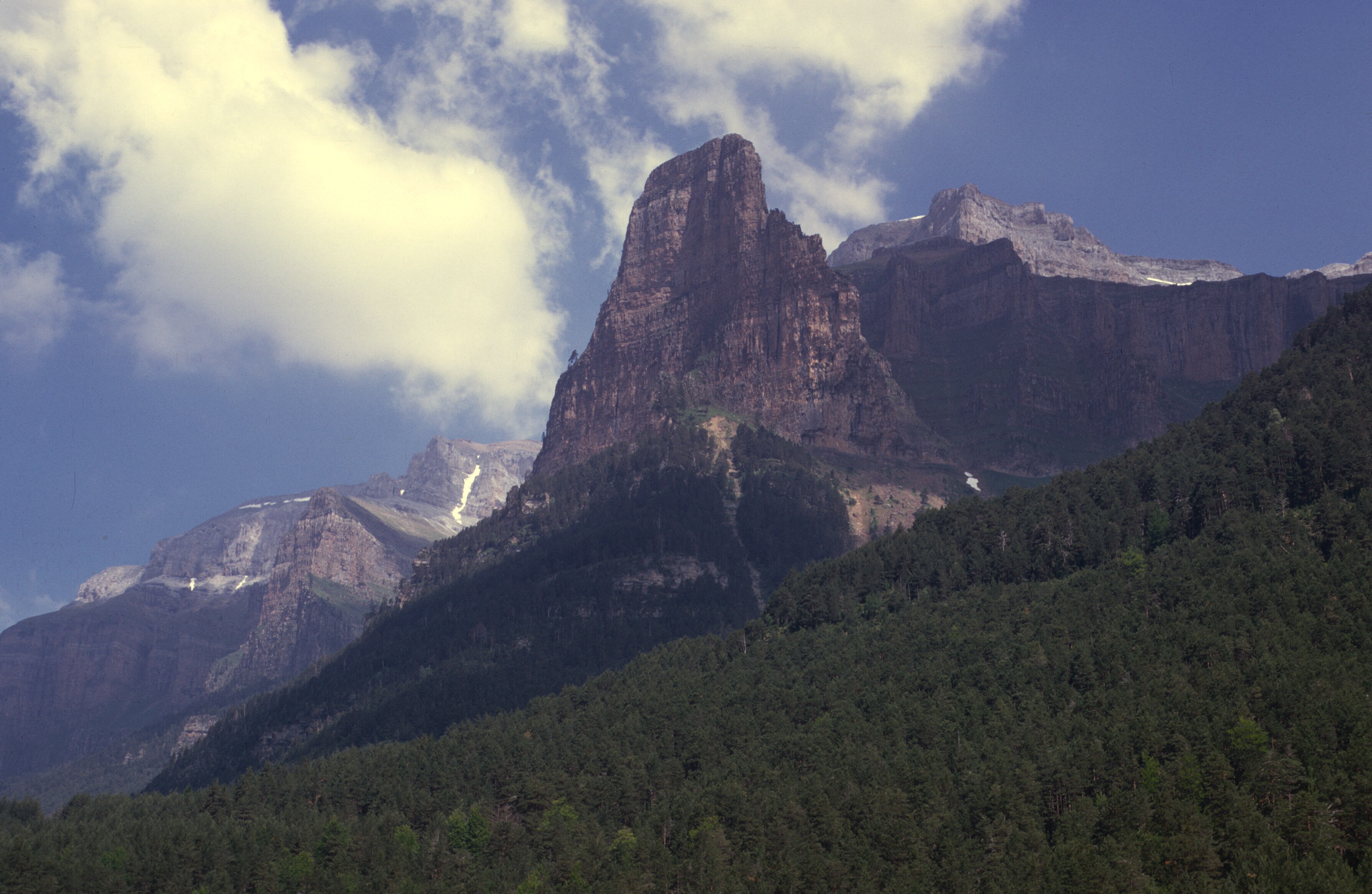
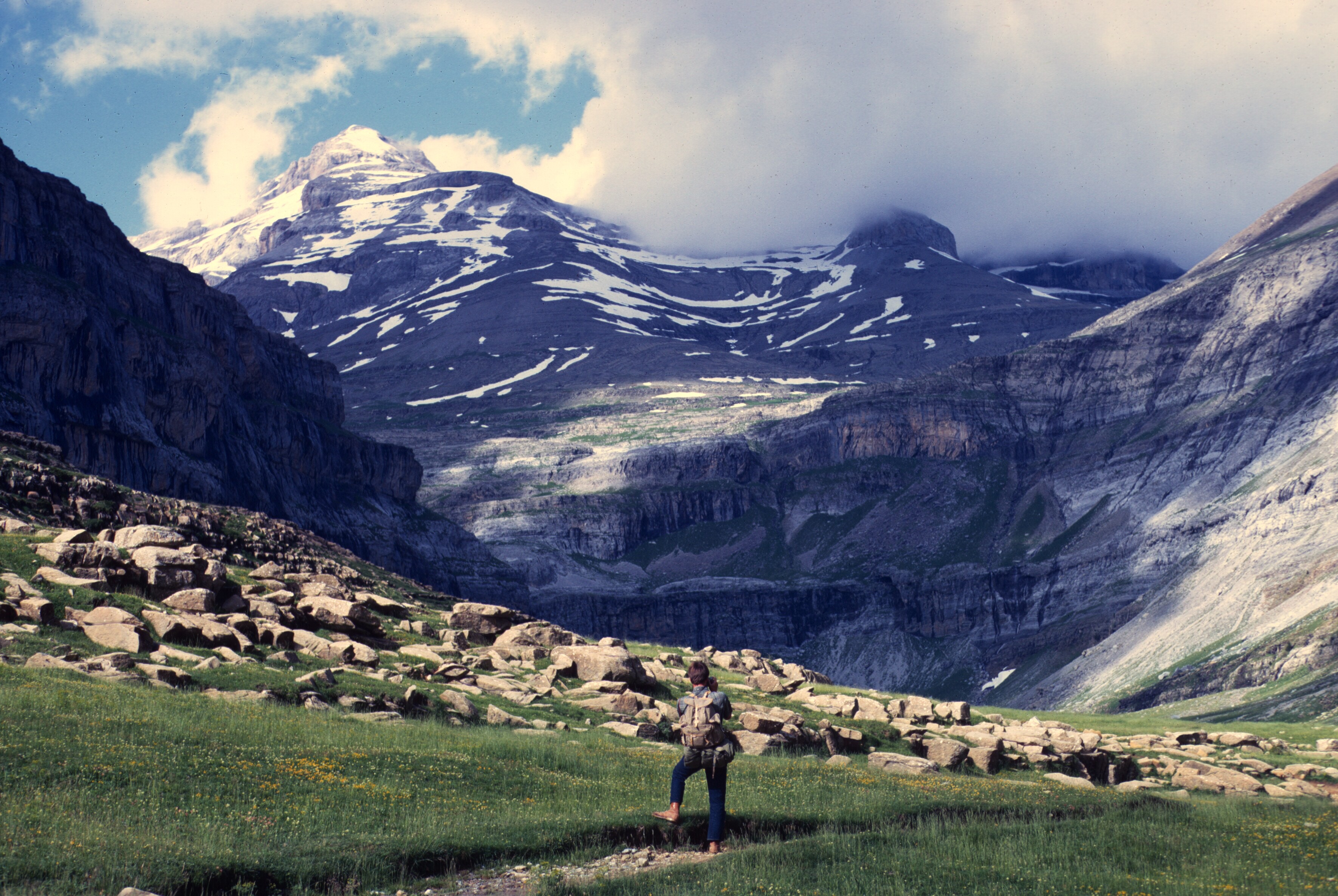
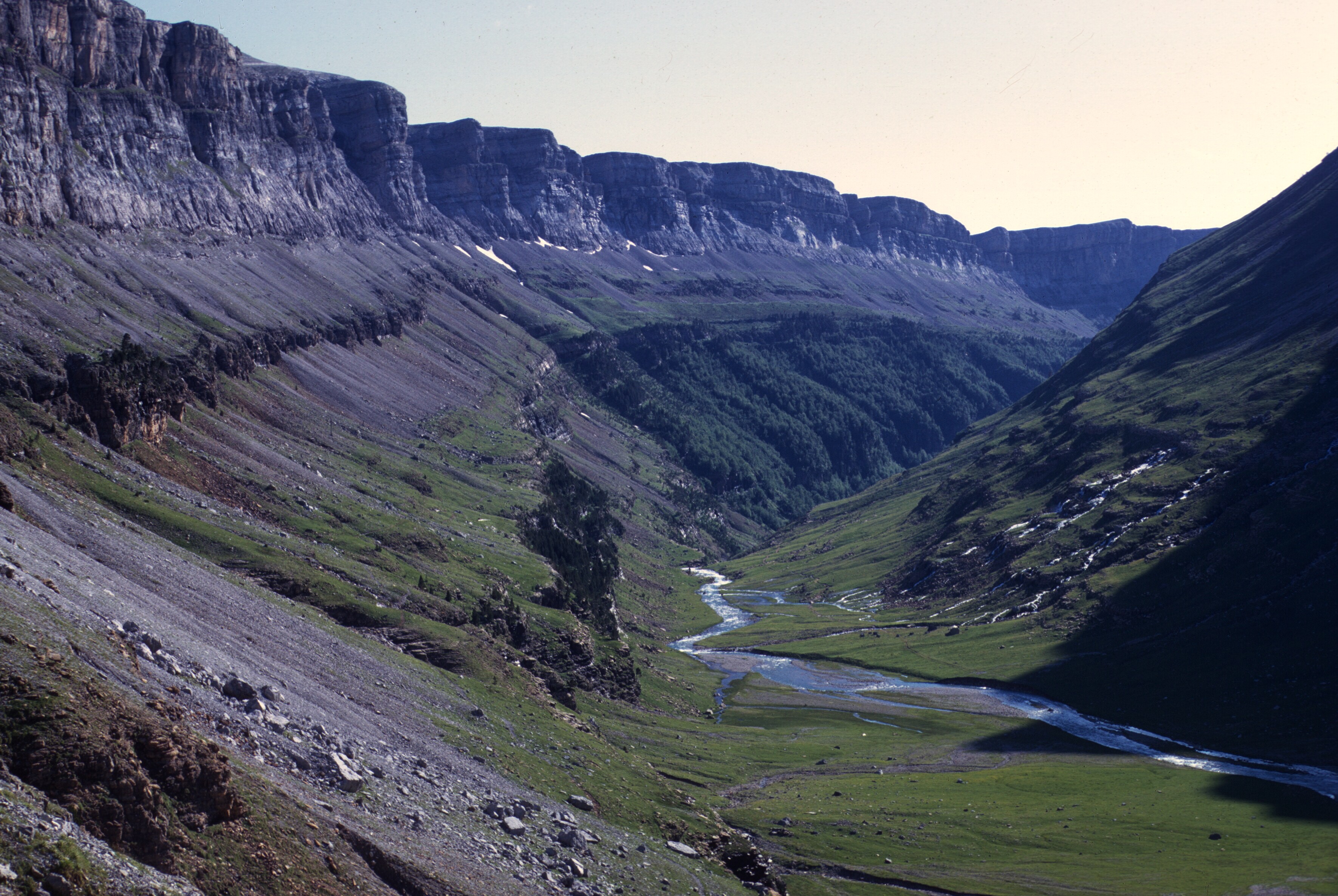
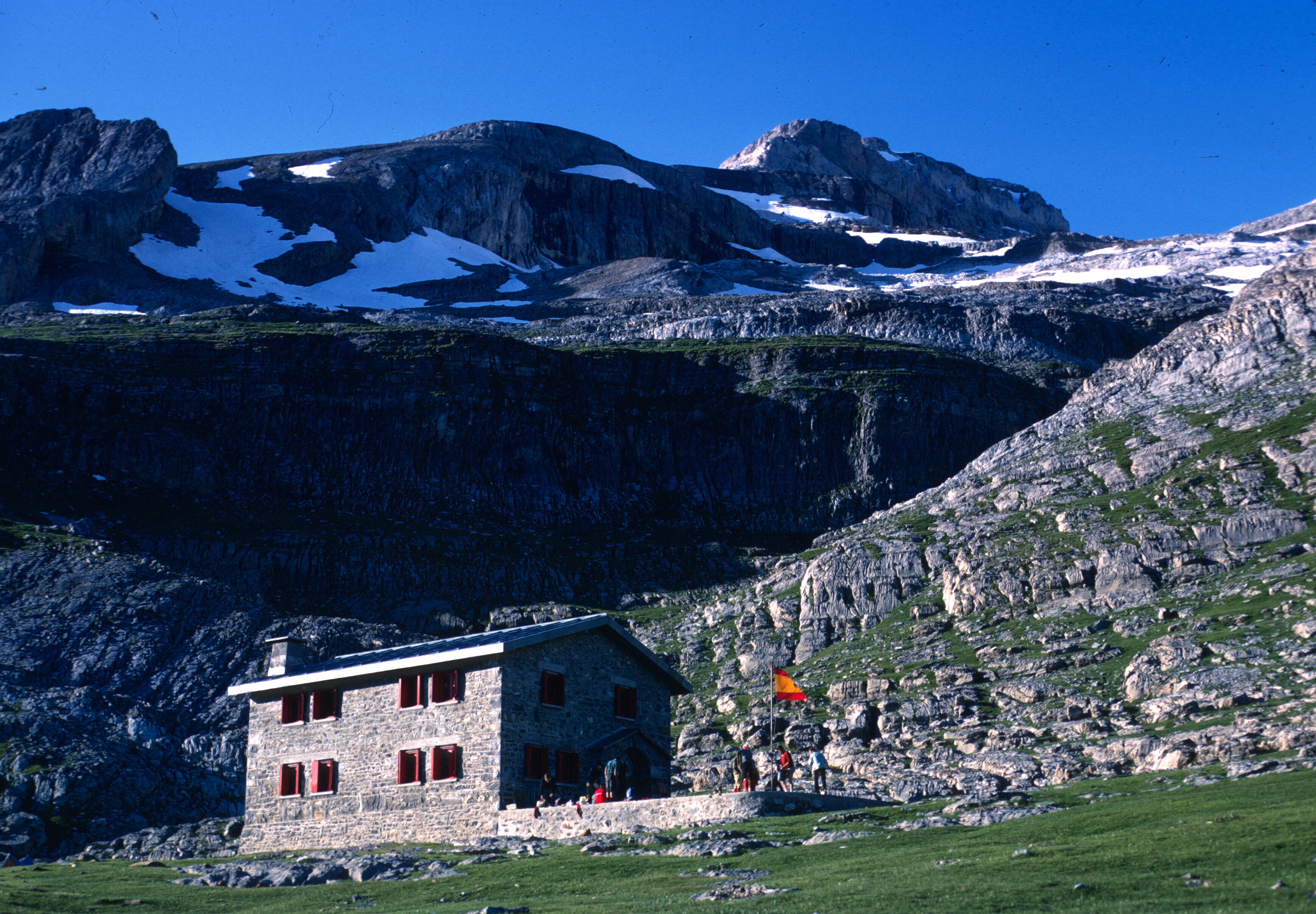
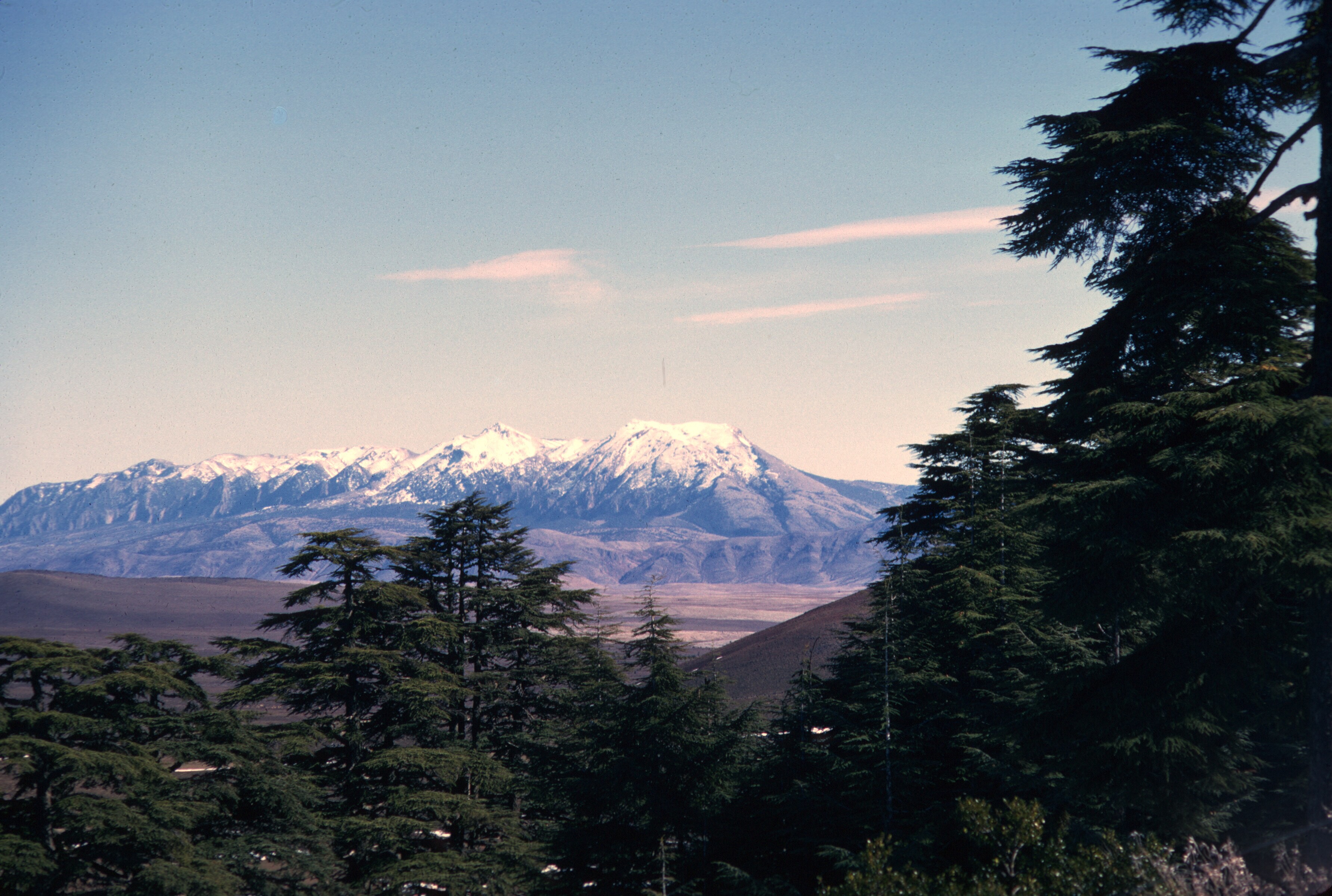
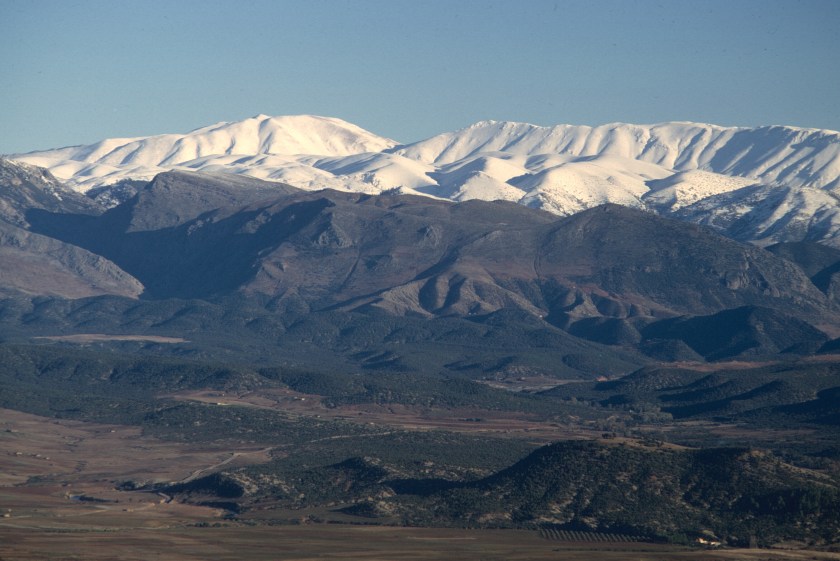
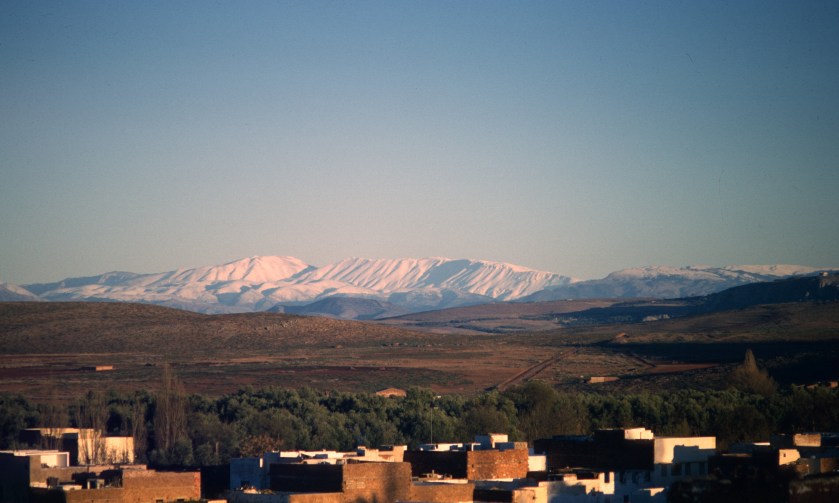
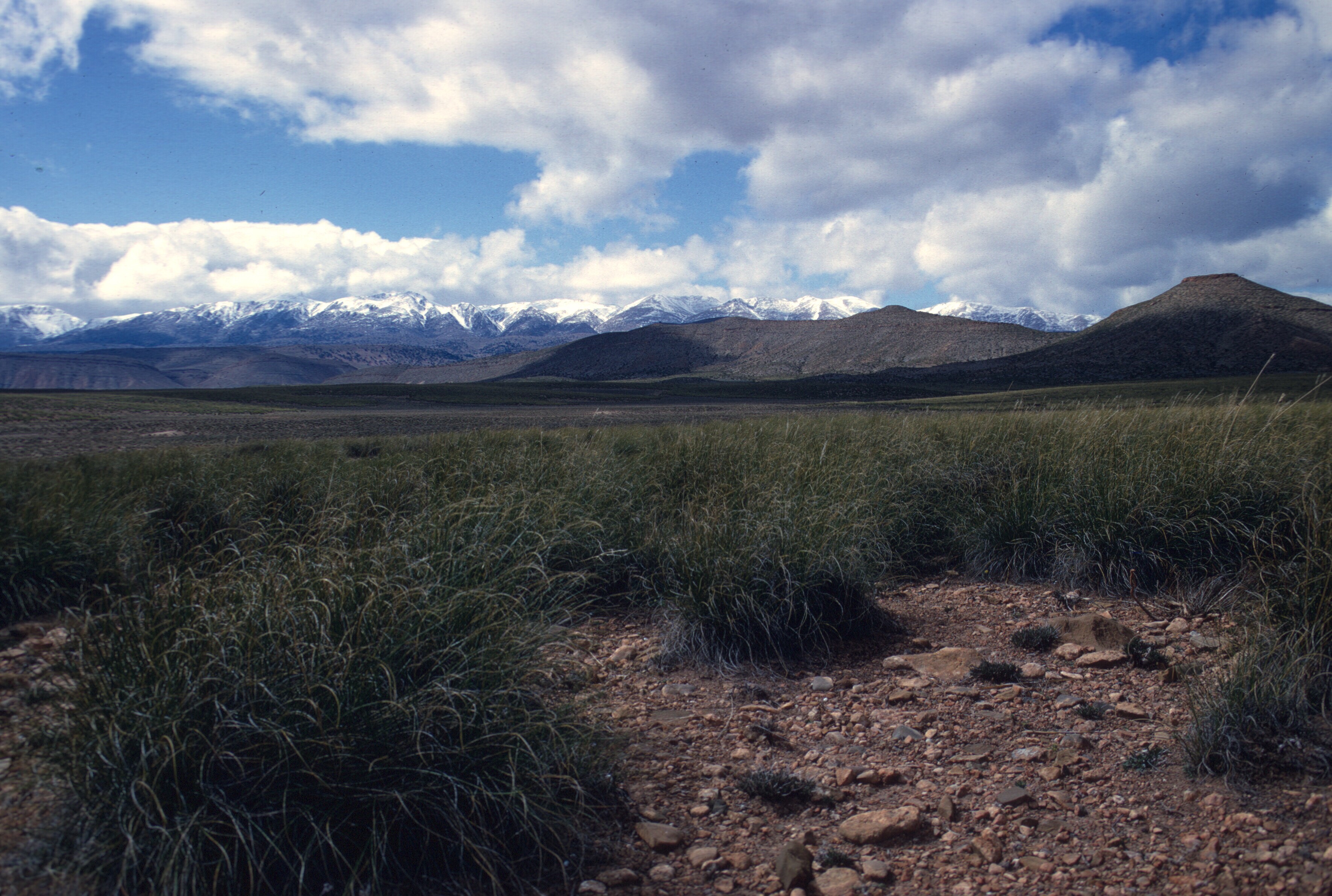
Jbel Ayachi is the highest mountain of the eastern High Atlas. It appears from much of the eastern Middle Atlas as a long, snow-covered ridge that looms, all winter long, above the halfa covered plains of the Upper Moulouya River.
scan-110122-0076
The High Atlas, seen from the Upper Moulouya River valley

Until precise geodetic measurements were made, some considered it the highest point of the Atlas, but Jbel Toubkal is over 400 meters higher, and many other High Atlas peaks exceed its height. Ayachi’s prominence arises from its proximity to the plain that borders it.

When I worked for the Ministry of Agriculture, Fes Province extended south to Missour, but most of my work was in the Saïs and the pre-Rif. I most often saw Ayachi as part of the faraway, snow-covered High Atlas crest when I traveled across the Middle Atlas plateaus.

scan-110109-0027
Jbel Ayachi, on far right, seen from the Middle Atlas plateau near Ifrane

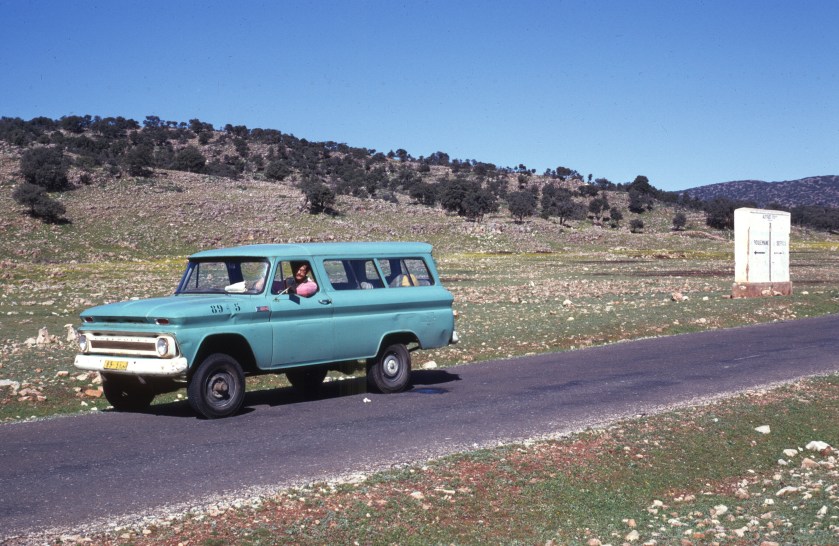
In the spring of 1969, however, I convinced my buddy, Gaylord Barr, who shared the Sefrou house with me, to drive down to a place known as the Cirque de Jaffar, which is a good starting point for climbing the mountain. We had no intention of doing that. We were just playing tourists for a day. We were able to do this because I had an old Willys Jeep for my job in Fes, and though I was not supposed to use it to sightsee, I did so once in a while.

scan-110202-0003 copy
The Cirque de Jaffar and Jbel Ayachi, May, 1969

The French use the word cirque loosely. When connected to mountain terrain, it is technically a term for a bowl carved out of a mountain valley by a glacier. The Atlas show little signs of glaciation. Even among the highest peaks in the Toubkal area, little snow survives the hot, dry summers, and glacial features are lacking. The Cirque de Jaffar is not glacier made, just a deep indentation in the edge of the mountains made by a stream. In this sense, it is a bit akin to the Cirque de Navacelle, a river-formed depression on the edge of the Massif Central, north of Montpellier.

scan-110202-0019 copy
May 1968. Jaffar piste

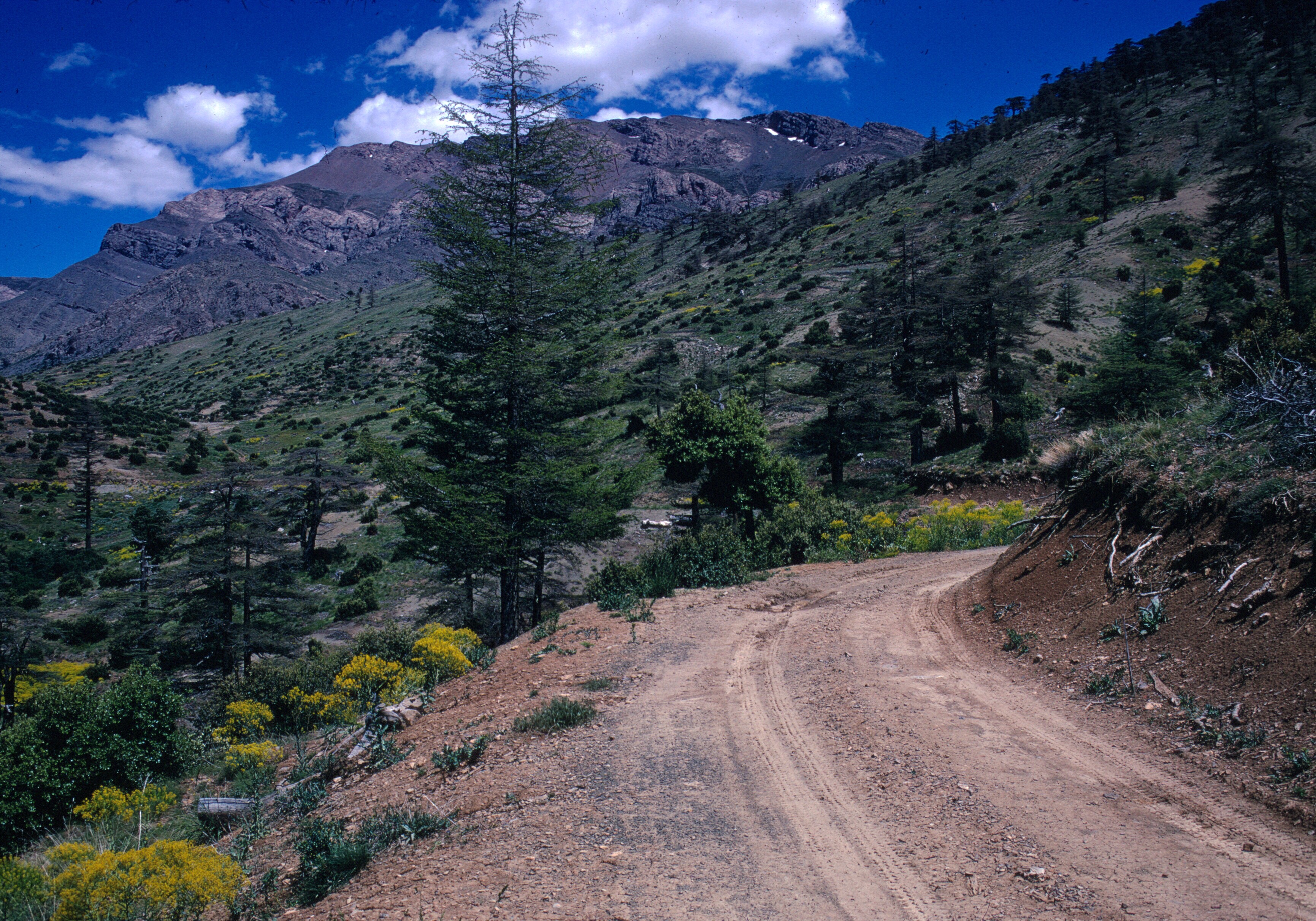
However the Cirque de Jaffar was formed, the natural scenery around it is spectacular. Some tourists pass through it en route to the Todra Gorges, but the piste is rough and this route probably should only be considered by those with solid four-wheel-drive vehicles equipped to operate off the road. The piste from Midelt to the Cirque, though unpaved, wasn’t bad at all when I was on it for the first time in the spring of 1969.
scan-110202-0001 copy
May 1969. Piste to Jaffar

May is a wonderful month in Morocco. The weather is warm and sunny, and the wheat fields are green or turning to gold. Wildflowers are everywhere, and the rivers and streams are brimming with water from the melting snows of the Atlas. The frigid cold is gone, but the land has not yet been baked dry by the unrelenting summer sun.

The drive from Sefrou to Midelt follows the old treq es-Sultan. The King’s Road connects Fes to Rissani and the Tafilalt, the birthplace of the Alouite dynasty that governs Morocco today. The road climbs over successive Middle Atlas plateaus, passes through Boulemane, under the shadow of Jbel Tichoukt, and then descends to the Upper Moulouya plains. It is an easy drive, though winter snows can make it difficult for truckers. After a storm it is not unusual to see trucks that have slid off the slick highway.

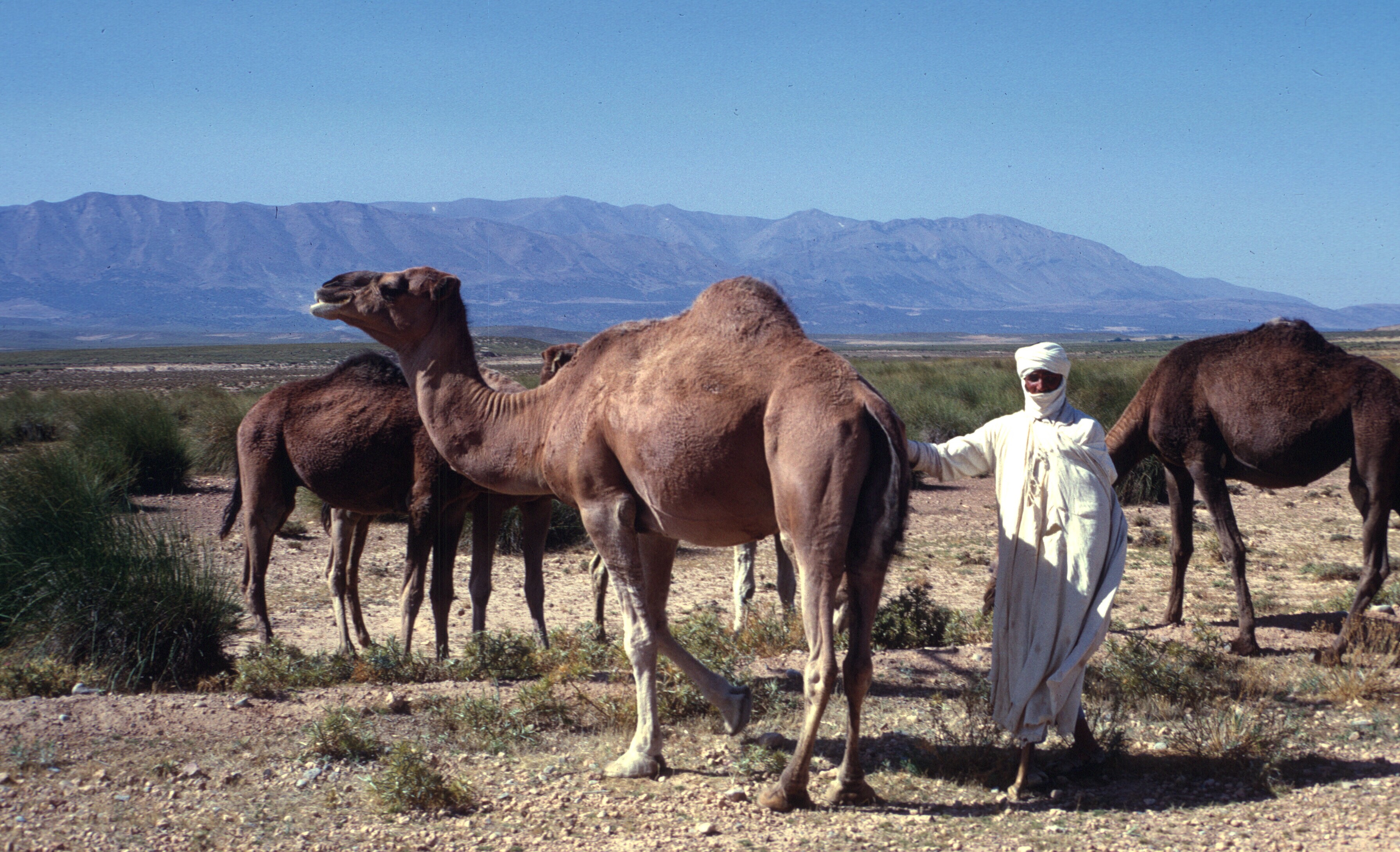
The Upper Moulouya is covered with halfa, Stipa tenacissima, a grass that is woven into ropes and mats, and also used in the mattresses of those not wealthy enough to stuff with wool, a manner of banking wealth as well as creating a soft mattress. All my banquette mattresses were stuffed with halfa, as was the mattress of my bed, and though not as comfortable as wool, the scent of the grass was sweet and pleasant.

morocco moulouya halfa rope
Making rope from halfa, probably near Missour

Halfa is also known as Esparto grass, and grows over wide areas of the Maghreb and Spain, and everywhere it is used for artisanal purposes. In the rain shadow of the Middle Atlas, agriculture in the Upper Moulouya requires irrigation, and herding is common.

morocco high atlas jaffartents.jpg
Berber herdsmen’s tents near Jaffar. The Middle Atlas is on the horizon

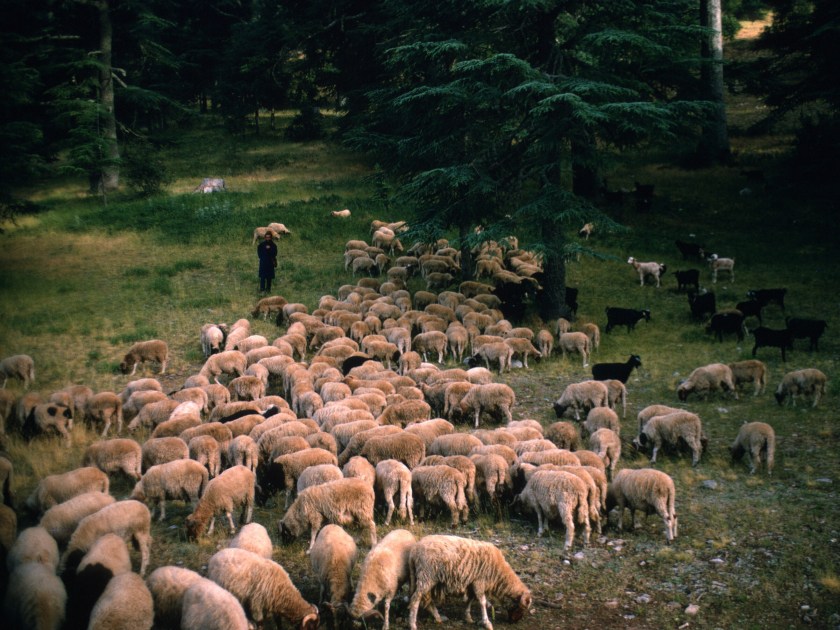
In the past, when Morocco was divided between the Bled es-Siba and the Bled el-Makhzen, the powerful Berber tribes of the Middle Atlas moved their flocks between the Moulouya and the plains surrounding Meknes and Fes, practicing a transhumance involving summer pasturage in the Middle Atlas mountains and winter in the lowlands.

enlight43
Middle Atlas herd, near Ifrane

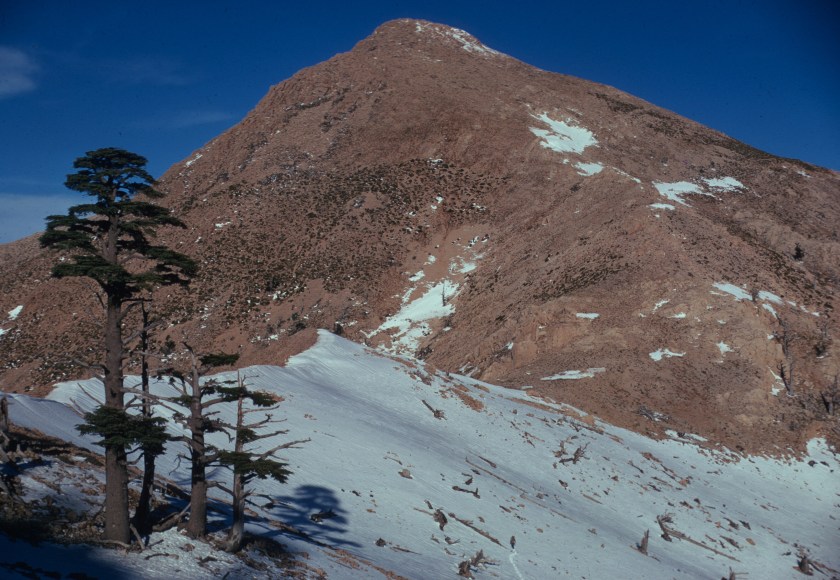
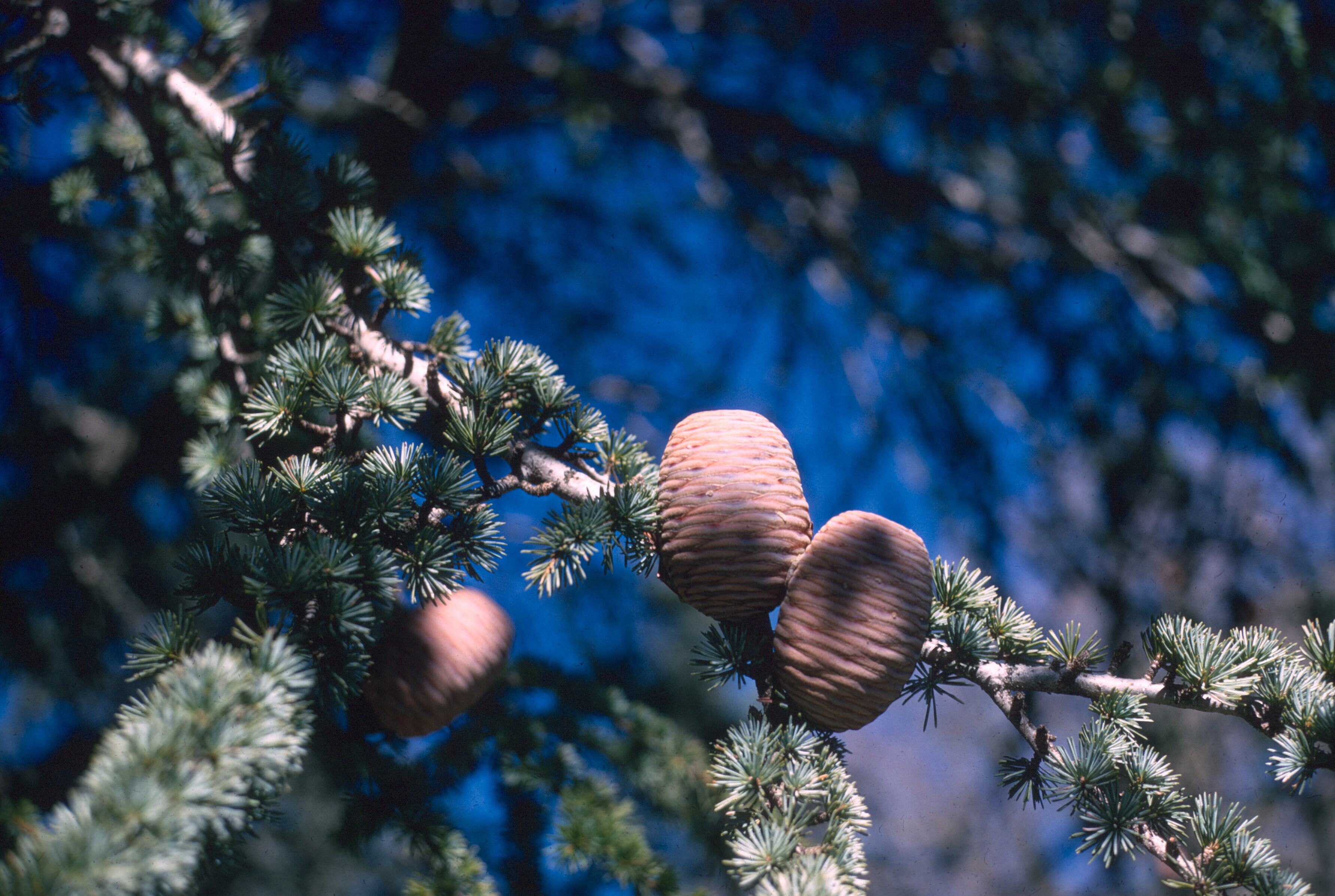
At Midelt, the itinerary leaves the paved highway, and becomes a dirt and gravel track, which Moroccans often denote by the French word, piste. Climbing along the edge of the mountains, the piste reaches an altitude at the Cirque, where it is high enough for cedars to grow. From that point, there are great views of Ayachi. All along the way, the fields were full of wild flowers which we stopped to photograph. In the cirque itself, the cedar forest was open with isolated and gnarled trees.
scan-110329-0015 copy
Upper Moulouya, August 1969 with Jbel Ayachi in distance

Alas, on one of many photography stops, I did not use the parking break. It was only by chance that I notice the jeep rolling back down the mountain road. I shouted to Gaylord, and he caught up with it and jumped in, but sadly he was too late. The jeep slipped off the road. Luckily, he wasn’t hurt.

morocco h atlas ayachi gaylord flowers 2 copy
May 1969. Photographing flowers

Our jeep ended in the drainage ditch on the mountain side of the road, and was not traveling fast enough to be damaged badly. The windshield had cracked, but did not shatter. On the other hand, the ditch was deep, and the undercarriage was caught up in such a way that even the jeep’s four-wheel drive couldn’t get any traction. As we wondered what we could do to get out, a forestry officer rode up on his mule, but the jeep was too heavy and too stuck for the three of us to lift it up and out. Then an elderly French couple, touring in their Peugeot 404, happened by. They kindly lent us their little emergency shovel, and we dug out enough of the jeep to get back on the road. We thanked them, they continued on their way, and we, thoroughly chastened, returned to Sefrou without further incident.

A Moroccan rule of thumb is whenever you are stuck along a road, someone happens by to help you! Another time, later in my life, I was driving from Chauen to Tangier in a winter rain storm. The battery of my little Simca 1000 wasn’t charging. I think the problem was corrosion on the battery terminals, but rather than clean them, I decided to chance not stopping on the trip and fix things in Tangier. I could easily roll the car fast enough to start it. To compound my stupidity, I chose to take the coastal road, not the main Tetuan to Tangier highway. About halfway between Tetuan and Tangier I came over a rise and descended into a valley where there was mud on the road and water running over it. The car became mired and stopped dead. The water was high enough to lap at the door sills. Rain was pouring. It was pitch black. I opened the car door to see how high the water was, and my glasses fell into the running water. At that point I began to wonder how much worse things could get.

I did not have another pair of glasses with me, and I am very nearsighted. I began to take off my shoes and socks in preparation for a search, but luck was with me and blind groping in the mud without leaving the Simca proved sufficient. I found them! Better yet, a group of men from a local douar appeared out of the darkness, and they were able to push the car out of the mud. I suspect that I was not the first motorist to get stuck there, but there were no other cars on the road. Maybe the local residents knew better than to drive that stretch on rainy winter nights.

Out of the mud and water, they gave me enough of a push to start the car. I thanked them and rewarded them, and, though I secretly wondered if they just hung around waiting for cars to get stuck in that spot, I was very, very grateful. In a later post, I will write of yet another personal stupidity involving cars and batteries that left me stuck halfway between Taza and Fes.

The encounter with Ayachi in May 1969 whetted my appetite for a real exploration of the mountain. I knew it was an easy ascent. I got my friend and climbing buddy, Louden, the Peace Corps doctor, to drive down to Ayachi in August. The director of the CT in Sefrou, Si Kammir, knew the supercaïd in Midelt, and arranged to get a local man to guide us.
scan-110202-0031 copy
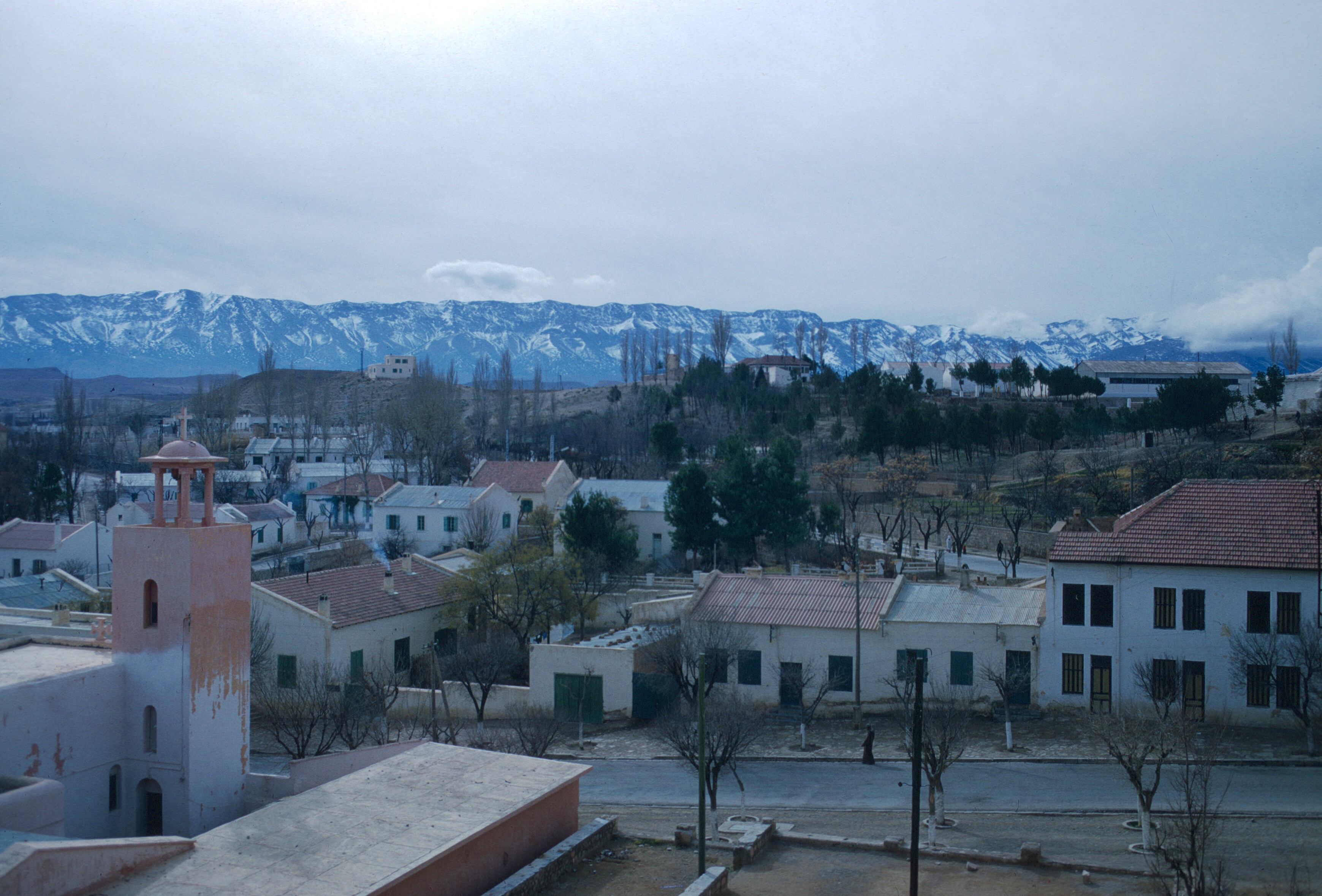
January 1968. Midelt. Ayachi is out of the picture, an extension long ridge visible to the right of the photo. This photo was taken on a bus trip returning from the Tafilalet.

We drove directly to the cirque, where we camped that night. After the dry and hot on plains, the air in the cirque was refreshing. The guide showed up on his mule the next morning.

scan-110202-0021 copy
August 1969. Early morning in the cirque
scan-110202-0009 copy
August 1969. Moonrise above the cirque

He had been waiting at a location closer to Midelt, where another trail led to the summit. He must have been dead tired, riding much of the night after he figured out where we probably were.

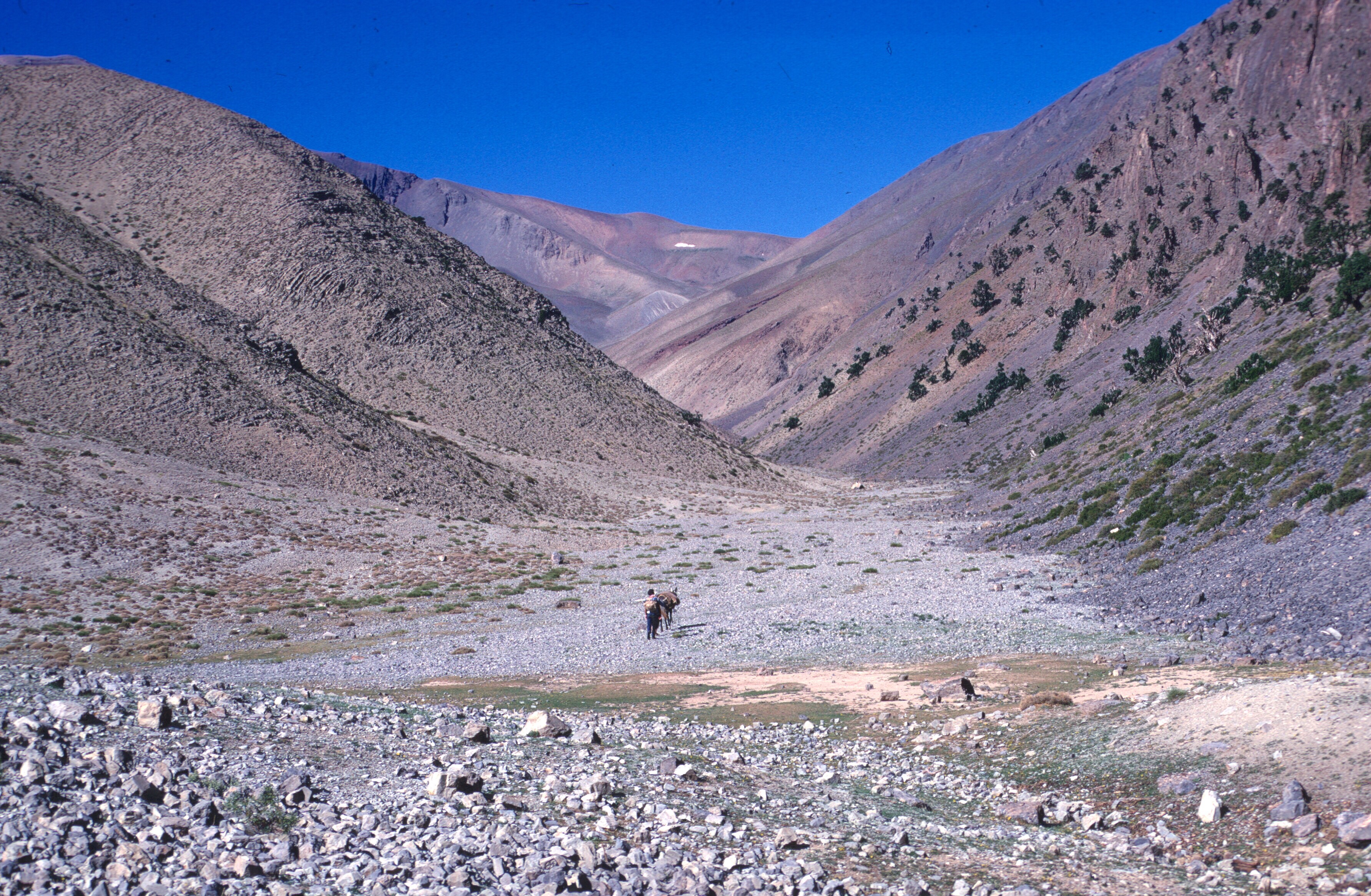
The cirque trail follows a stream that goes through a narrow defile to pass through the lower hills, then just climbs up through relatively wide valleys. There really is no trail once one starts up.
scan-110202-0008 copy
August 1969. Past the gorge. Just a long walk

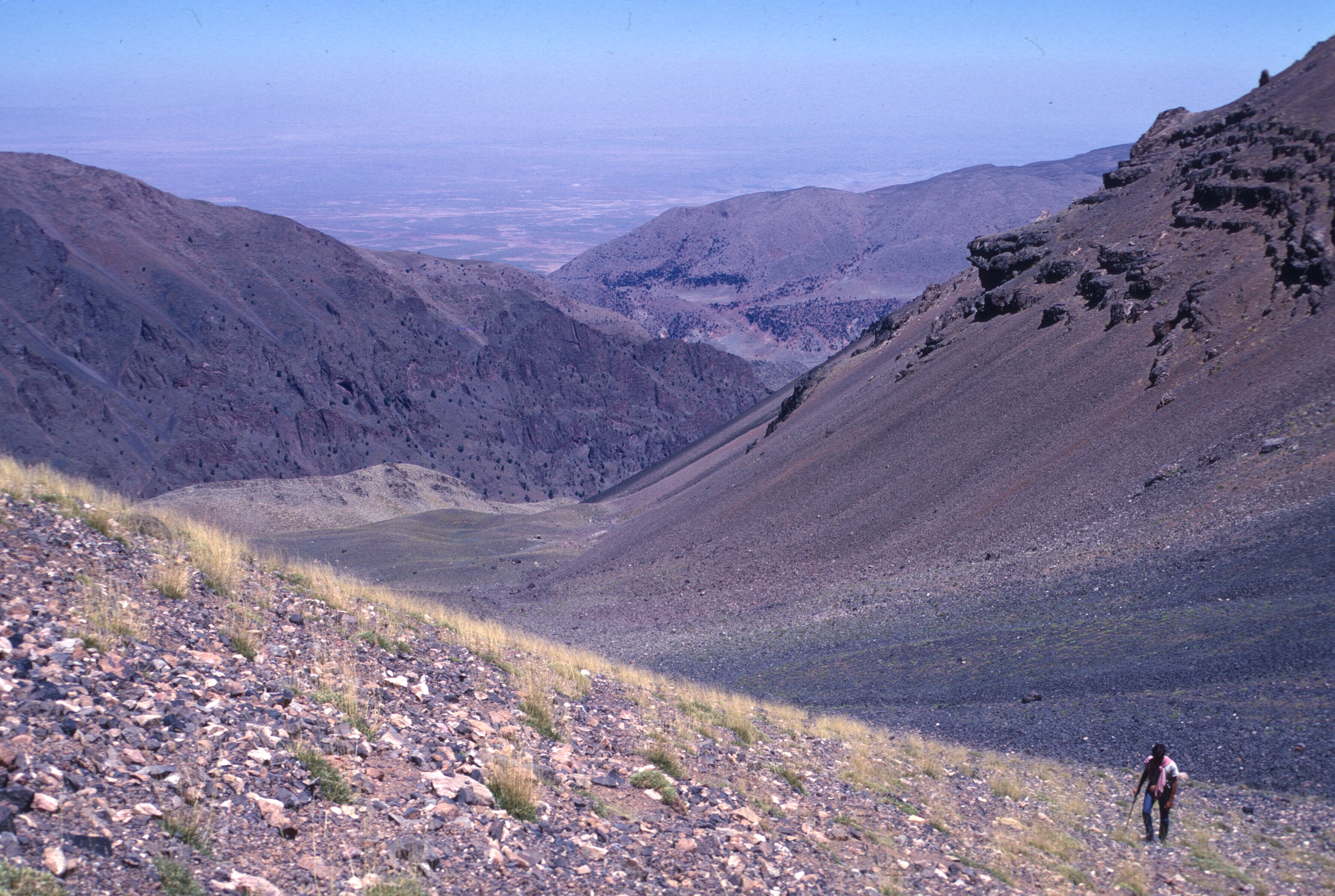
The mule went most of the way up the mountain, only stopping just under the summit.
scan-110202-0029 copy
August 1969. Louden about halfway up the mountain

The presence of numerous goat trails showed that shepherds took their flocks almost to the summit. We had no map, and decided that the more prominent western summit was the high point.

scan-110202-0024 copy
Below summit of Ayachi, goat trails

When we got there it was clear that it wasn’t. By then it was late in the day, so we descended, tired and disappointed, not only that we hadn’t reached the main summit, but also that the scenery, dry and parched, was so uninteresting. There was no water, a regular problem on the high peaks of the Atlas, but we found some snow and melted it.

scan-110202-0004 copy
August 1969, below west summit of Ayachi

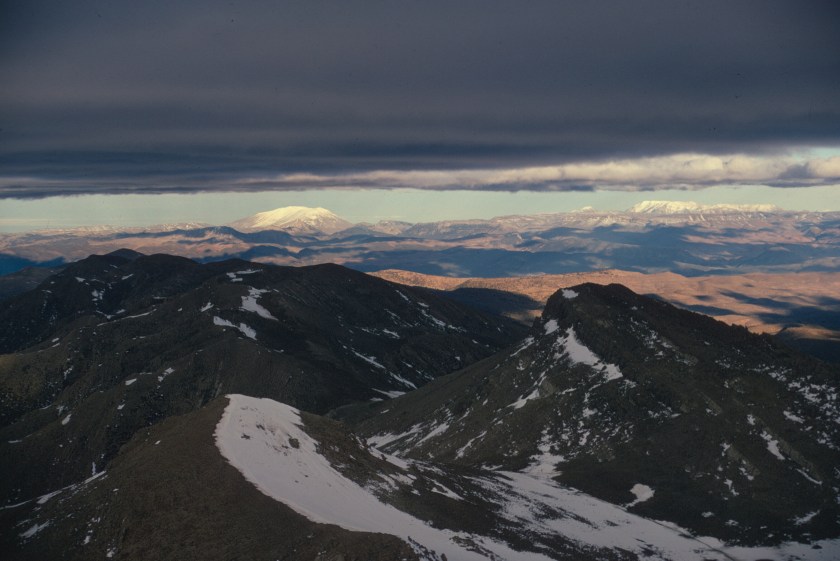
The best views were to a huge anticline to the west and downward into a valley.

scan-110202-0016 copy
August 1969. Huge anticline to west of Ayachi
scan-110202-0006 copy
August 1969. View from west summit looking north west

The southern view was mountain after mountain with no vegetation. Beyond the far ridges lay the pre-Sahara.

scan-110202-0014 copy
August 1969. View south toward desert

The eastern view was blocked by the main ridge of Ayachi. We decided that we would return and do a spring climb. And so we did.

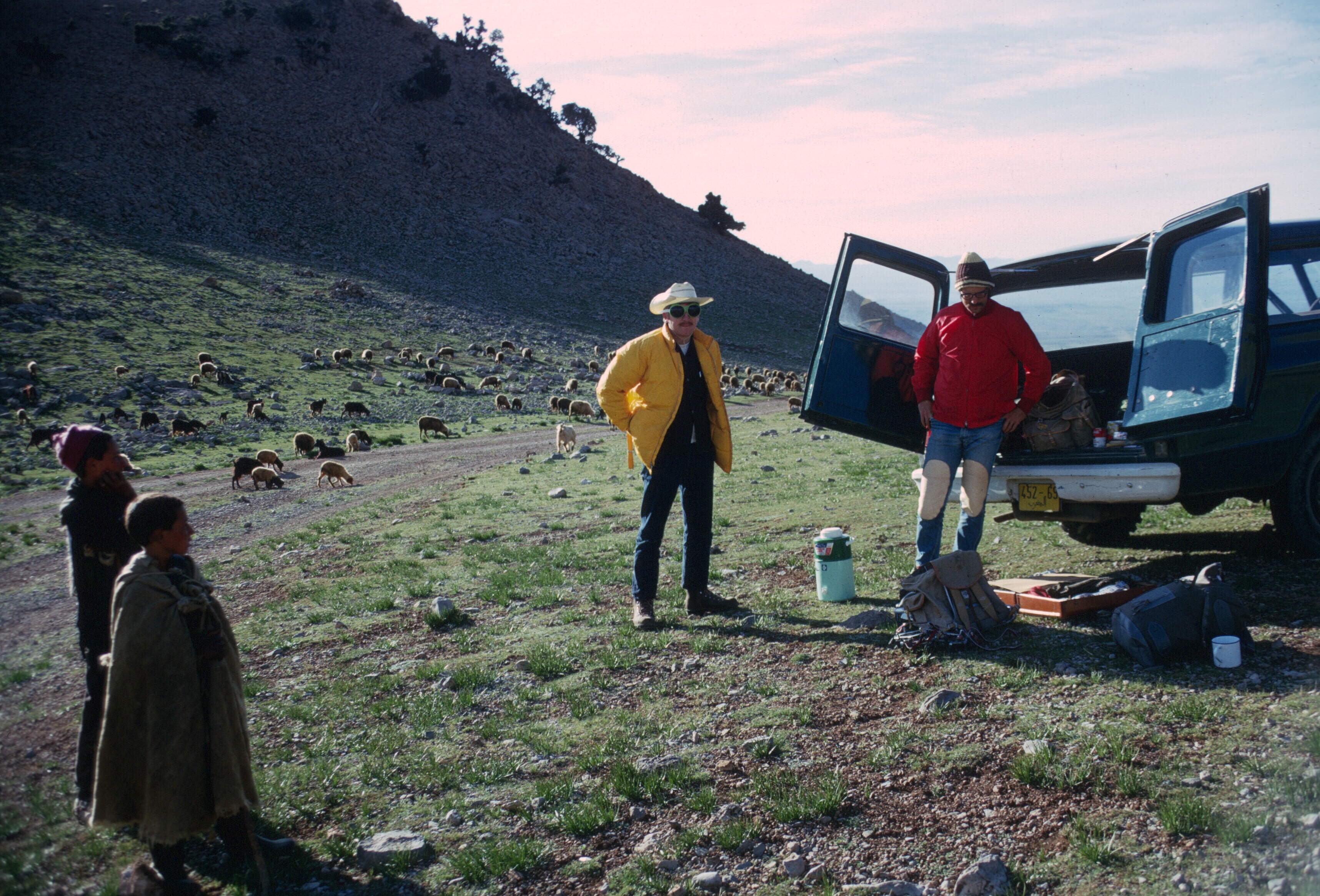
In March of 1970, Louden, Don Brown, and myself, equipped with down parkas, ice axes, and crampons camped at the Cirque, along with some Berber shepherds, who had their flocks there. We got there late in the afternoon, and set up camp.
morocco h atlas ayachi camp don louden
March 1970. Camping at Jaffar. Don and Louden and Berber kids
morocco shepherd boy 2
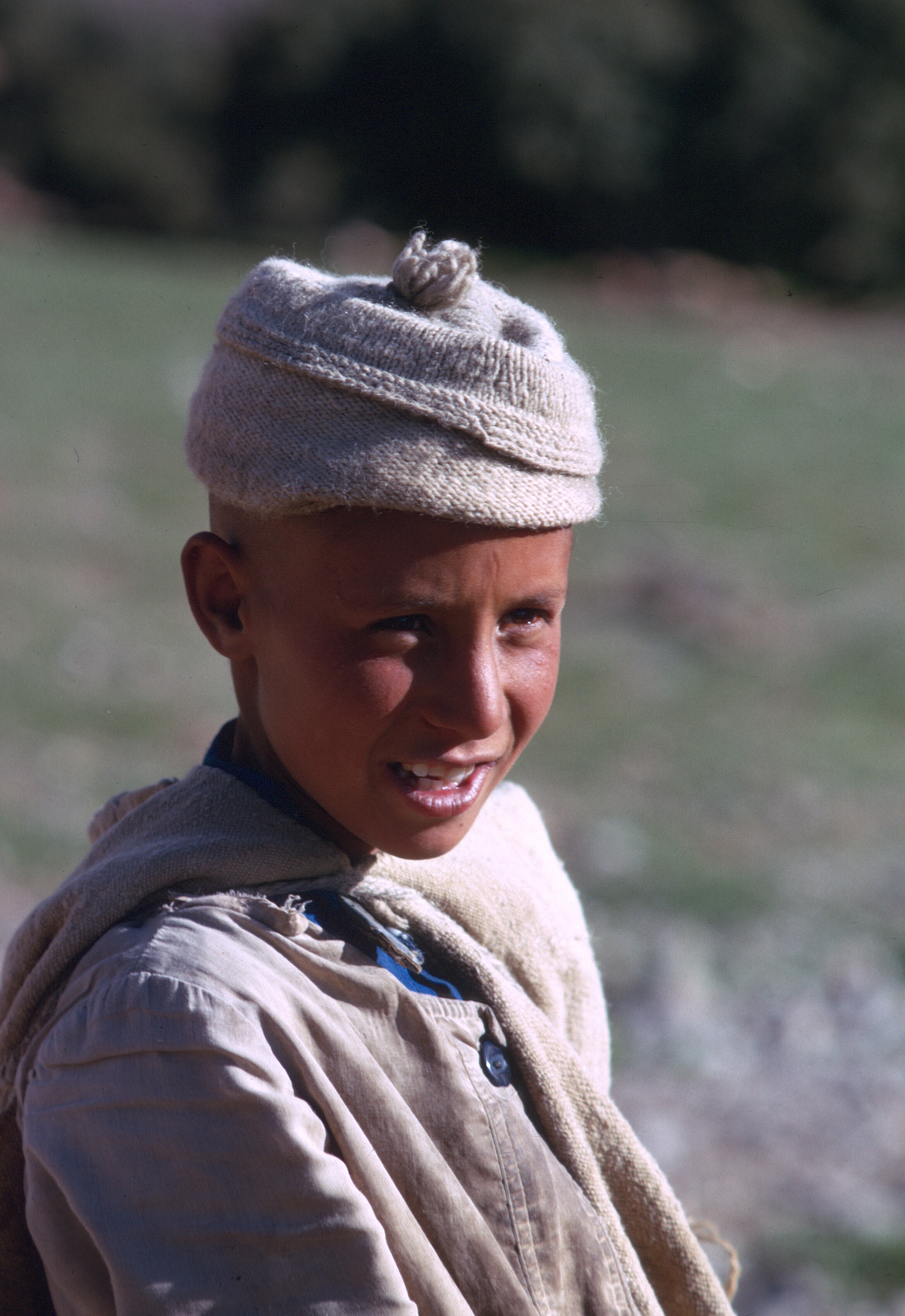
March 1970. Berber kid at our camp

I arose in the night, probably to relieve myself, and looked up. The air was brisk, and the sky dark, clear, and full of stars. There were no lights visible anywhere, except for a spotlight shining from the top of a mountain on the left side of the cirque. This puzzled me until I figured out that I was looking at a comet, the first that I had ever seen! It was in a position that made the tail appear to extend off the top of the mountain, and the lack of light in the sky enhanced its brightness. I have seen several comets since, but none have been as striking as the first.

scan-110202-0011 copy
March 1970. Louden and Don

We got off to an early start and followed the same route that Louden and I had used the previous summer. Don petered out at a lower altitude than the mule had climbed to on the previous trip, but Louden and I continued up to the highest point on the mountain.

scan-110202-0012 copy
March 1970. Don Brown

This time the vistas had snow and greenery. It was cold and we only stayed long enough for some pictures. The descent was uneventful.

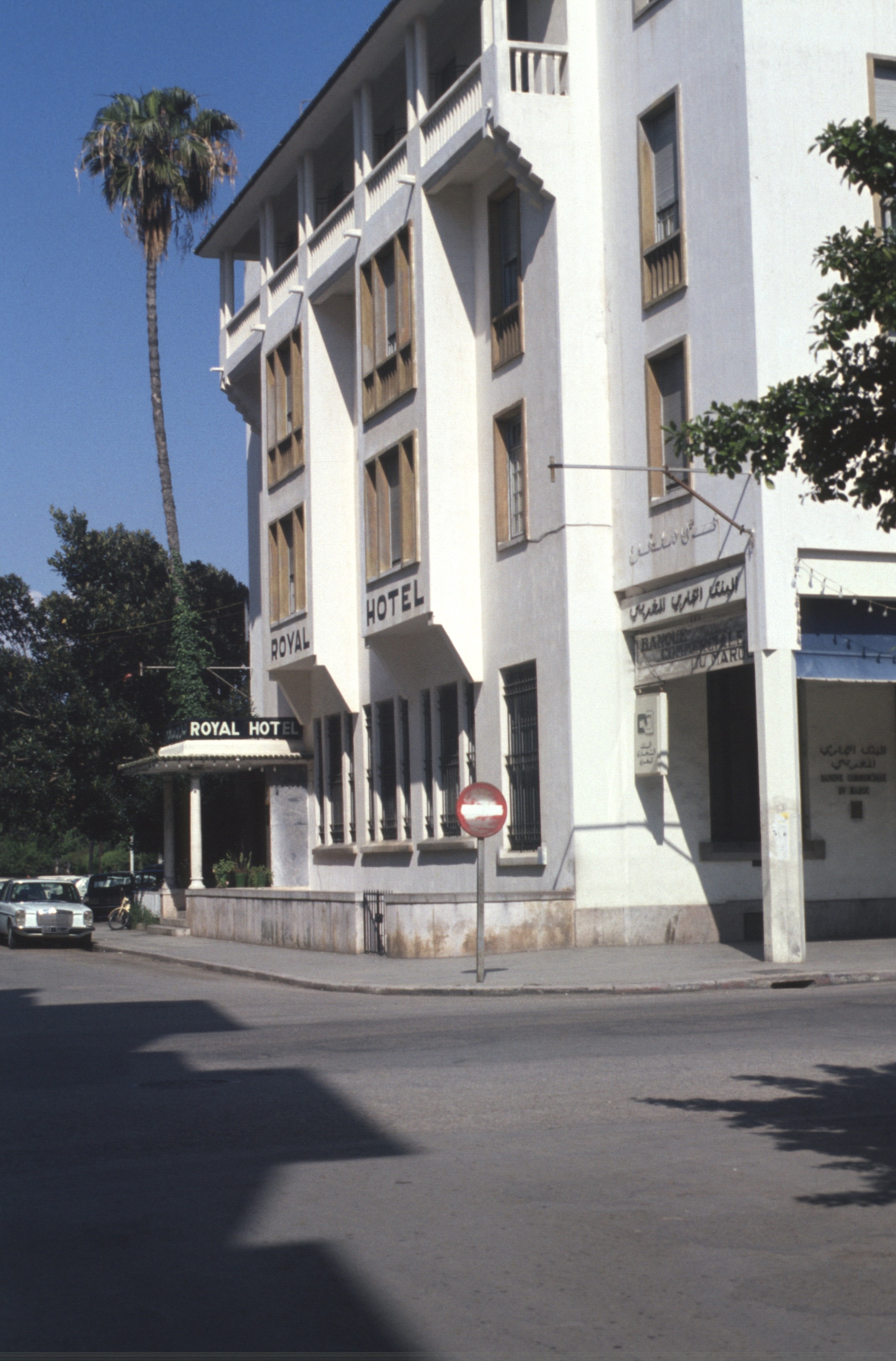
The trip was eventful for other reasons. Gaylord had gone to Aïn Kerma, south of Oujda, to visit the father of one of his lycée students at Sidi Lahcen Lyoussi. Marc Miller, a Morocco X volunteer who was by then in Casablanca working in fisheries, went along with them, but only stayed a week before returning to Casablanca. Shortly thereafter our paths crossed at the Hotel Royal, a Peace Corps haunt, clean and affordable, in a rooftop single that cost even less because it was unheated.
morocco rabat hotel royal copy
Hotel Royal, Rabat. 1968.

I was on my way to what was then the U.S. Air Force base at Torrejón outside Madrid on a flight from the U.S. Navy base at Kenitra. Marc was on his way home to the U.S., though he did not tell me. When I returned to Morocco, and found out he had left the Peace Corps, I was shocked and bewildered. When I saw him again in the U.S. he explained everything. Marc had contracted meningitis the previous year, and was hospitalized at the base hospital at Kenitra, where Gaylord and I went to see him not long after he regained consciousness. Marc looks well in the photo below, but he was still working to regain his memory.

scan-110327-0023 copy
Gaylord and Marc outside the hospital room.

Marc was one of the volunteers with whom I had developed a friendship in Morocco. In the Morocco X program, he was stationed at a CT in Azrou. I was at a Centre des Travaux Agricoles about 13 kilometers south of Meknes, off the main road to El Hajeb and Azrou. Marc was open and friendly, and always willing to lend a hand. When I had trouble with the hens laying eggs under the nesting boxes, Marc came up to Sefrou and helped fix up chicken-wire barriers to keep them out. Marc was handy and I was pretty hopeless.

In the months of service, I spent a lot of time traveling on weekends. I went up to Azrou early on. Marc was living with a group of guys that worked at the CT. His living conditions were no Posh Corps. The apartment was small, cold, and dark. Azrou is high enough to get seriously cold. I, at the CT, had my own room in a small house, and a heated shower. I was impressed by his adaptability to what I thought were harsh accommodations.

I will never forget the bus ride home from that trip. It was early morning. As the bus followed what the French called the belvedere, there was a view to the west over the Pays d’Ito. The valley was in clouds. Dozens of little volcanic peaks poked through them, appearing as an archipelago of islands. Sadly, my camera was not handy and I have only my memories.

Nothing is easy when you make it difficult. On that trip down to Rabat, when I was on my way to Spain and Marc was making preparations to leave Morocco, I planned to take a CTM bus from Fes. I bought a ticket to reserve my seat and checked my bag. Carelessly I had placed my passport in my old beat-up and unlocked suitcase. I had a couple of hours to kill, and went to see one of my friends who lived in the Ville Nouvelle. I ended up killing just a little too much time, and I missed the bus. Desperate, I decided that if I were lucky I might hitch a ride to somewhere along the route and catch up with the bus. I soon got a ride. The car was a new Peugeot 504, I think, and the young driver spoke French until I realized that he was an American, who had graduated from the same college as myself. Stationed in the military at the “secret base” at Sidi Yahia in the Gharb, he agreed to drive me to Rabat. Even stopping at the base, we beat the bus and I retrieved my bag and passport. My savior’s parents had served in the U.S diplomatic corps, and he acquired his French, which was excellent, growing up. When you are stuck in Morocco, someone always comes along to help you out.

morocco tangier rif air
Flight from Kenitra to Torrejón, with Rif Mountains and port of Tangier

I flew out of Kenitra on a routine Navy flight. Seated next to me was a civilian contractor, probably an ex-military. He worked for Lockheed, I think, training Moroccans to fly F-5 fighters. He was interested in the Peace Corps, quite impressed with my Arabic and French and knowledge of the country. As we flew into the Navy base at Rota, he remarked that he could use a few Peace Corps volunteers in his program. I just let the comment stand. In 1971, F-5 pilots were part of a coup attempt that involved shooting down the Royal Air Maroc passenger jet carrying the King. Embassy scuttlebut has it that Hassan II never really trusted Americans completely after that attempt on his life, believing that the Americans must have had advance knowledge of the plot and could have warned him.

The medical exam at Torrejón completed, I was asked if I wanted to go back to Morocco on the next flight. Of course I said no, so I was put on a later flight to Kenitra, and got to spend some time in and around Madrid. Madrid has been the capital of Spain for a long time, and many interesting places surround it that are easily reached by train or bus. I had studied Spanish as my first foreign language, and I could use what I remembered to get around comfortably. It is alway so much better to know a little of the local language. My travels in Iran were immensely enhanced by the fact that I could speak a smattering of Farsi, but that, too, is another story for the blog.

At Torrejón I learned that my GS-4 status only got me a crappy, shared accommodation on base, so I stayed in a modern hotel near a subway stop in Madrid for about five bucks a night. The airforce wanted as much for the GS-4 accommodations. In Toledo, I stayed in a pension for a dollar or two.

spain toledo stret narrow
March 1970. Toledo street

I had been to Toledo before (and would return again), but this time I had some leisure to see the sights, and it was not tourist season. Close to Madrid, home to great art and architecture, historic from Arab times to the Spanish Civil War, Toledo is overrun by tourists in the summer.

spain toledo knitting
Woman sewing in late afternoon sun, outside cathedral doors
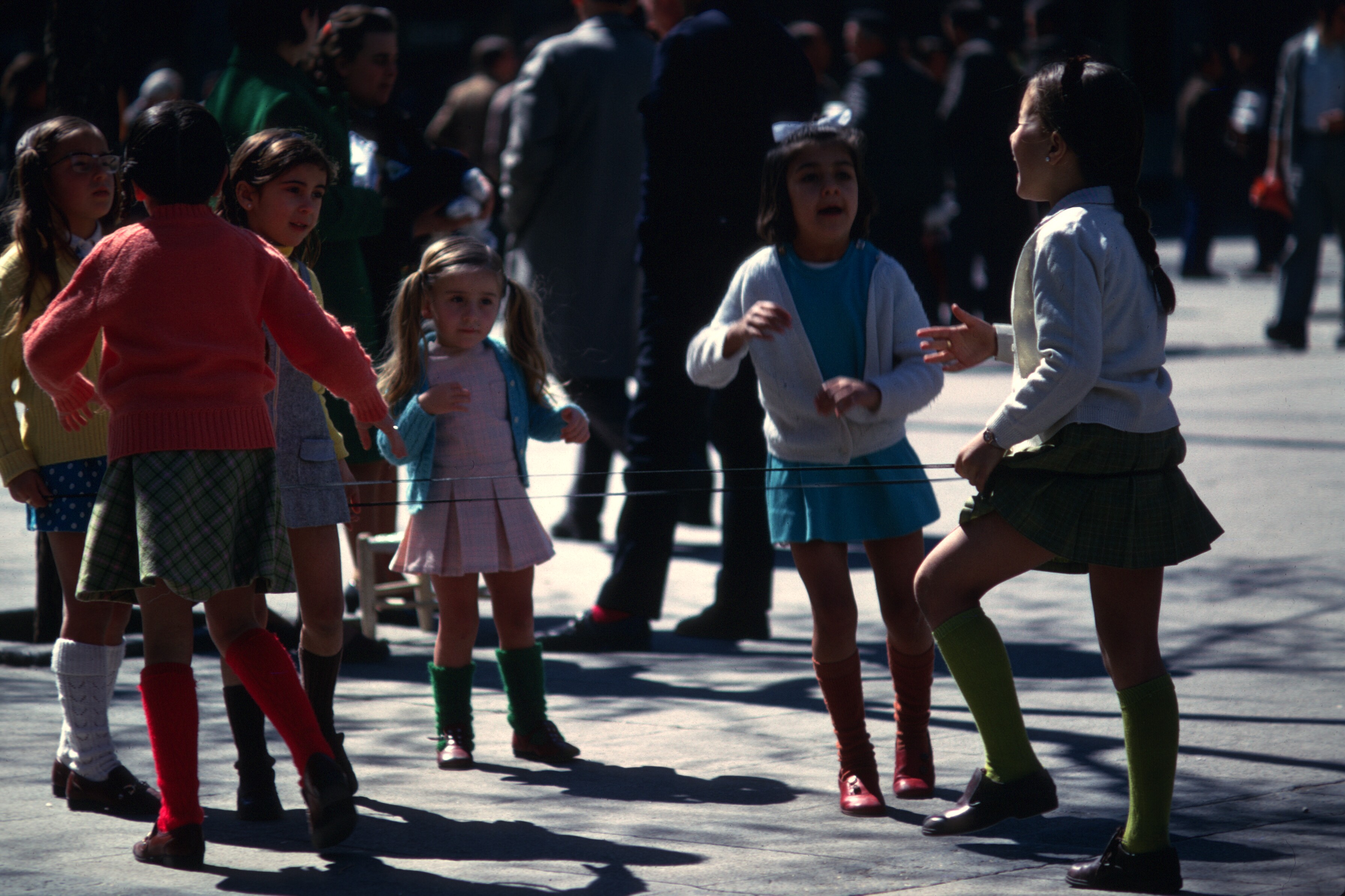
spain toledo kids
Kids playing in a square
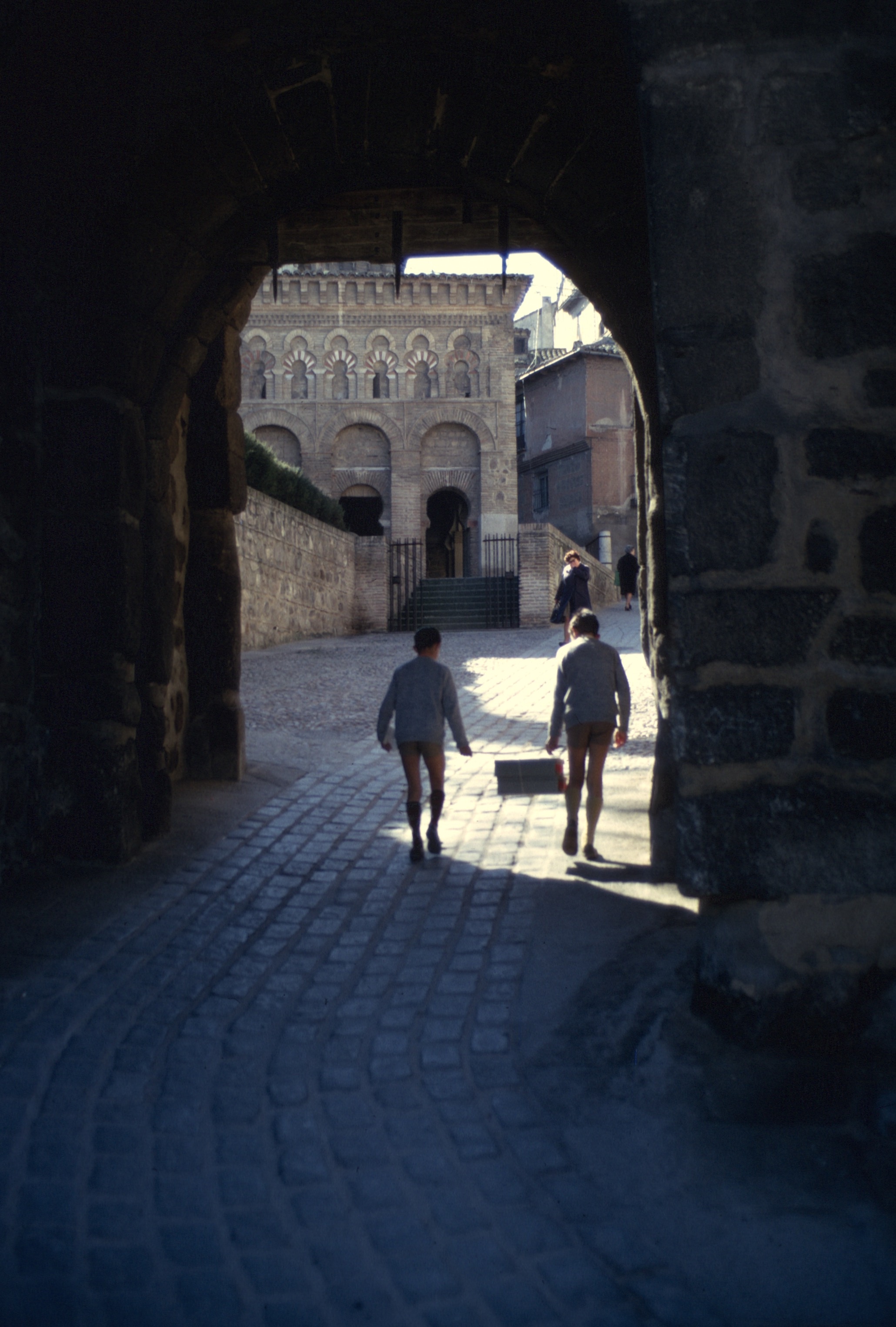
spain toledo gate mosque
Former mosque
spain burial 1
Detail from the Burial of the Count of Orgaz

I also visited Ávila and the birthplace of Cervantes in Alcalá de Henares.

spain avila walls
The walls of Ávila

March is still very cold in Madrid and I do not remember being dressed very warmly. The proverb about Mardrid’s weather, “Nine months of winter, and three of Hell,” has a basis in fact.

Interestingly, a year and a half later, as I was leaving Morocco, Gaylord Barr was being airlifted on the same Kenitra to Torrejón flight, with a severe case of typhoid, and he spent a much longer time there than I did! Another story, which I may try to tell in his stead, since he tragically passed away five years ago.
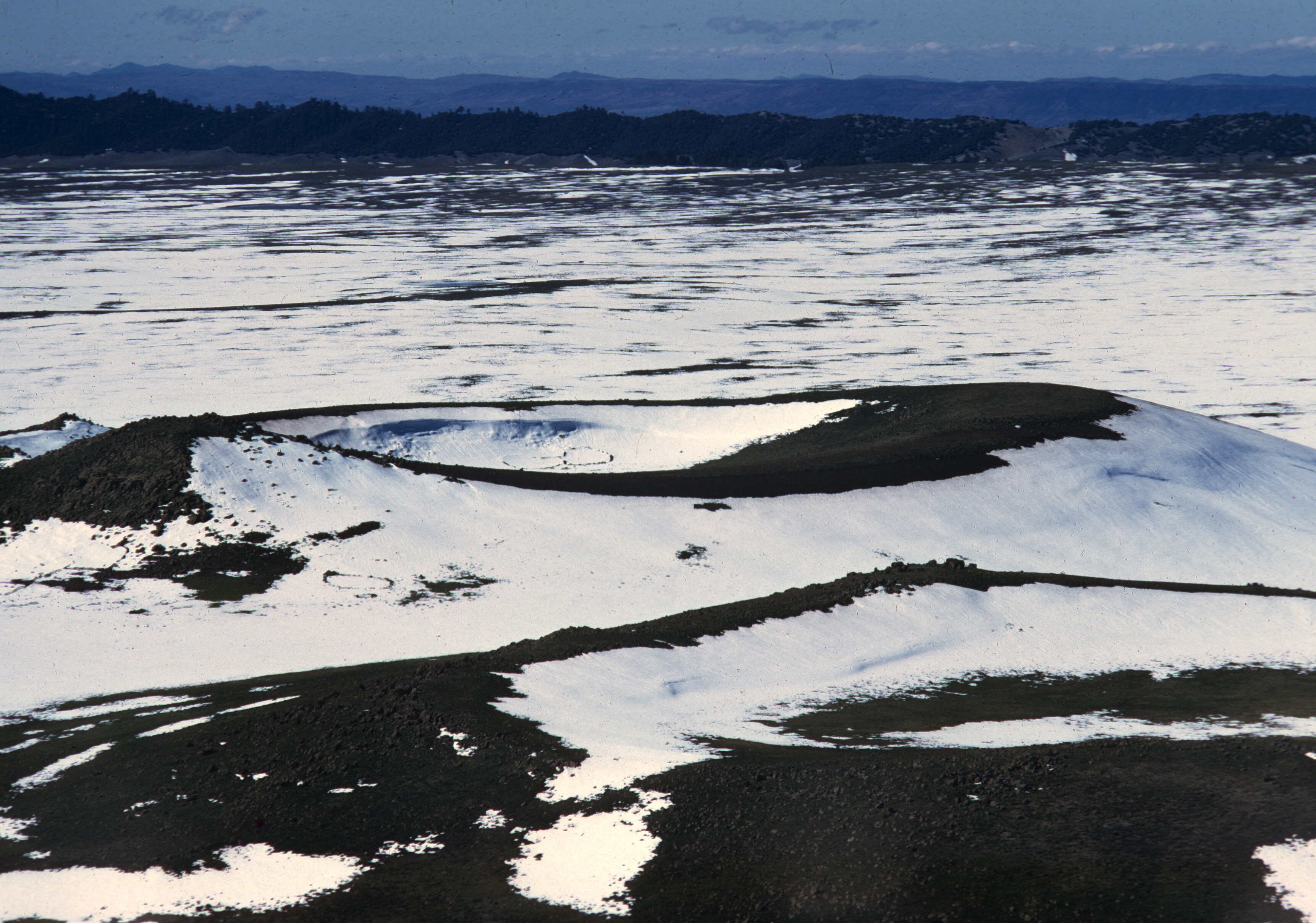
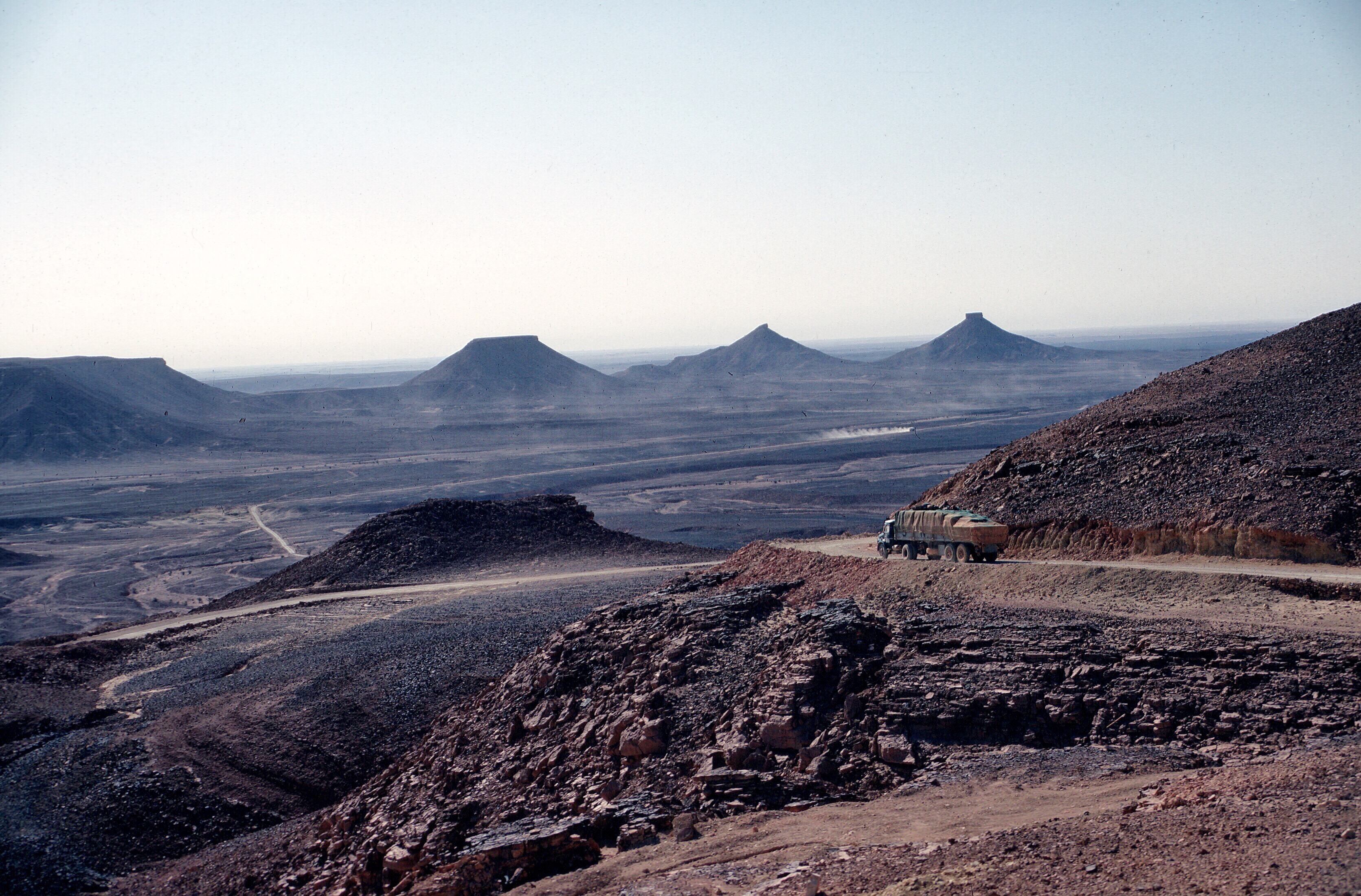
Morocco Middle Atlas Volcanoes
Volcanic cones, on the plateaus near Ifrane

A walk above the woods

Peace Corps volunteers who taught English as a foreign language were tied to their schools during the academic year, but had long summer vacations. A few undertook special projects, but many took the opportunity to travel. Outside of what was then called TEFL, volunteers had to take time when they could, though many had jobs that gave them a lot of freedom. The Moroccans often described our jobs using the French word stage, essentially meaning training, and didn’t always expect much from us.

As Peace Corps volunteers in Morocco, travel to Europe, except for Spain, violated the Peace Corps country rules that were in place in the sixties. Many volunteers simply ignored them as they did other rules that they thought were unreasonable such as owning motorcycles. Volunteers seldom got caught and there was no real punishment. Staff probably found the rules restrictive, too, and often looked the other way. Without examining your passport, how would Peace Corps know what you did last summer?

There was a problem for volunteers, however, and that was Morocco’s location. Where could one go? It is not without reason that Morocco is known as the land of the farthest sunset. With an ocean to the west and a desert to the south, Morocco was a cul-de-sac.

Algeria was off limits as a hostile country in the sixties, sadly as my experience in Algeria suggested that Algerians were friendly and eager to meet Americans. Anywhere else required expensive airfare or a daunting trip across the Sahara. If you follow this blog, you can read about my Saharan adventure later. A few of us actually did the trip, crossing the Algerian desert by truck, but it was not a casual affair.

enlight28
On the road to Tamanrasset. Algeria, April 1971

I think that these rules may have loosened up over the years. Some volunteers had families with the means to provide funds for European trips. In the sixties, the Peace Corps was definitely elitist, just as the foreign service has always been, with many members coming from the Ivys. In any case, given the historical connections with Morocco, the Peace Corps judged Spain to be acceptable, but put the rest of Europe off limits.

By July, the heat had settled into Sefrou. The grain fields around the city had been harvested, and the country had taken on the thatch and earth colors that it would keep until the winter rains.

morocco sefrou fields
The Saïs plain with the hills west of Sefrou in the distance

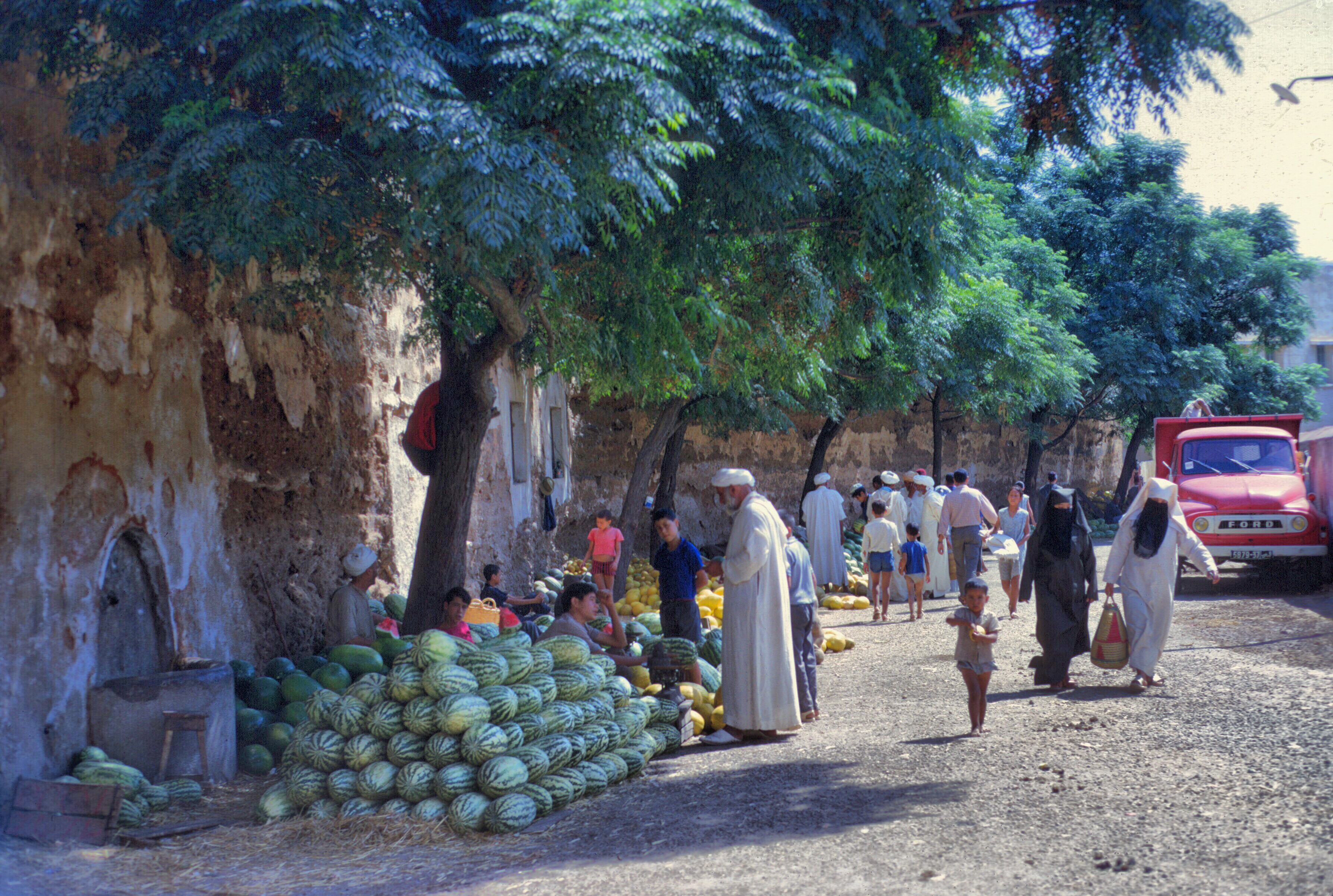
Bouiblane disappeared into the haze at the horizon, and the streets became dusty. Melons were on sale in the market, and life slowed down a bit.

enlight33
July at Bab Merbaa, Sefrou

Gaylord Barr, the volunteer with whom I shared the house in Seti Messaouda, and myself had persuaded one of the Peace Corps administrators, Don Brown, to come to Sefrou. Don had served in Oujda. He had never learned much Arabic, and wanted to improve his command of the language. We had a woman, Khadija, who cooked and cleaned for us. I fixed Don up with a tutor, my friend Hammad Hsein, and Don moved to Sefrou for a couple of weeks, where he had a chance to immerse himself in dialectical Arabic. Khadija would take care of Don and the pets. Off we went. I don’t know how much Arabic Don learned, but I know he enjoyed his time there that summer. Old Sefrou was lovely with its gardens and country walks.

scan-100508-0063 copy
Out for air, walking along the old Jewish cemetery, Sefrou.

It always gave me a lot of pleasure to see women taking strolls past the old Jewish Cemetery or students walking together, studying for their exams.

Hammad was an elementary school teacher. He lived in Seti Messaouda, as did his extended family, just outside the city wall and down the street from me. I had gone to his and his brother, Hassan’s wedding, and I often ate at his house on feast days. I was told that he emigrated to France, as many other people I knew have done.

morocco sefrou hammad
Hammad Hsein, Sefrou, 1973
enlight32-1
Gaylord and Don Brown at Taffert in Morocco

In early July, the mesetas of central Spain bake in the sun, just like much of Morocco. Oleanders flower in the dry water courses, but the only green is where farmers can irrigate. The early Arab invaders surely felt at home there. For them, Spain might have been Syria. And when the Abbasids wiped out the Umayyads in the East, the Umayyad kingdom in Spain survived and continued as the caliphate of Córdoba until overrun by successive waves of Berbers from the Atlas.

The previous summer Gaylord and I went off individually and traveled in Spain, making short forays into southern France and visiting Carcassonne, Albi, and Pau. By coincidence or by the nature of things we traveled much the same routes though we were not traveling together. In retrospect, I think I might have suggested the French sites as I was interested in visiting them myself.

enlight31
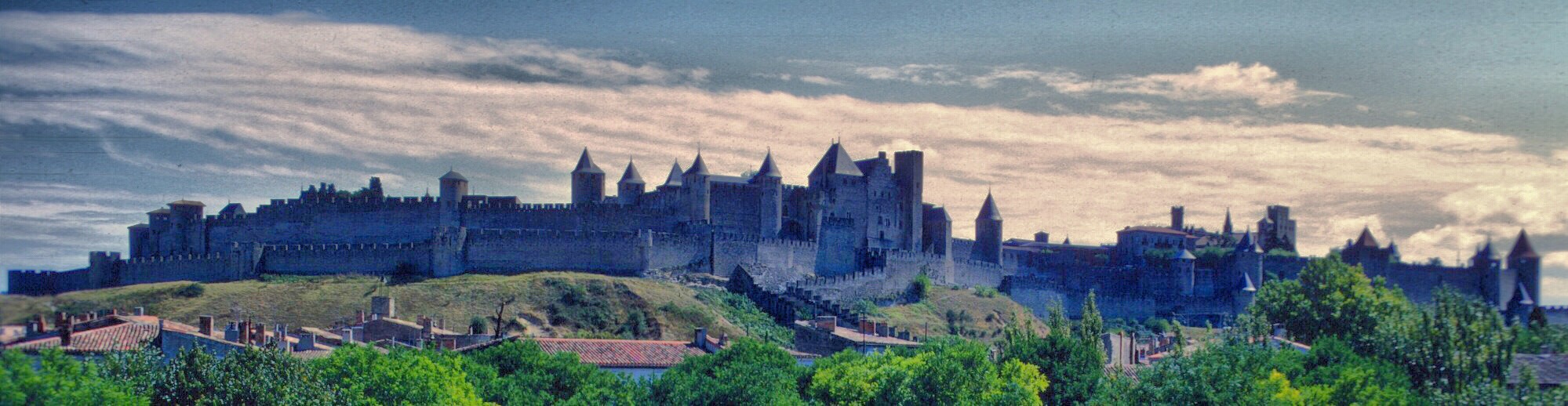
La Cité de Carcassonne from the new town below

Carcassonne needs the least introduction. The fabled walled city, heavily restored by Viollet-le-Duc, justly deserves its reputation as an icon of medieval military architecture, though if you would like to see a more authentic walled town, you might visit Aiguës Mortes instead.

Enlight41
Carcassonne, looking toward the chateau and barbican.

I had wanted to visit Carcassonne, when I lived in France in 1965, but never made the time. In December 1965, I was living in Castelnau-le-Lez, and a neighbor and host to another foreign exchange student took us along with his daughter and dog, Blackie, to see the sun set on the walls of the city. I have returned a couple of times since. The last time my wife, Liz, and I walked the entire circuit of the wall, then dined on mussels at a little restaurant just outside the main gate.

Aiguës Mortes was built as a port for the Crusades, in a very short period of time, but it was never used as the French soon acquired more territory on the Mediterranean gaining better ports. It soon silted in, and lost all importance, for which we have to thank for its extraordinary authenticity and preservation.

france aigues mortes 2
Aïgues Mortes, at sunset, friends and neighbors

Albi is probably known to most Americans as the birthplace of Toulouse-Lautrec, and the place that gave its name to the Albigensian heresy, though it was never controlled by Cathars.

enlight36
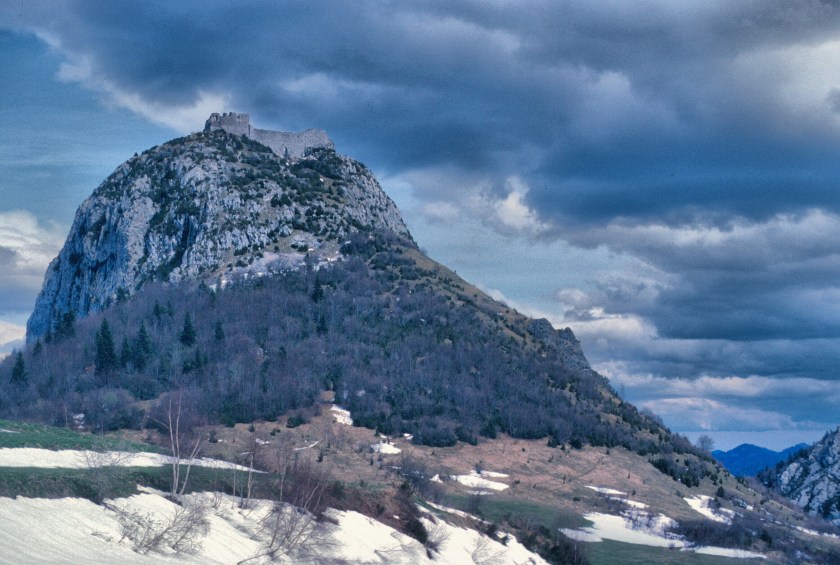
On March 16, 1224, after being surrounded by an army of 10,000 for a year, the Cathars at Monségur marched down from their castle, singing, and threw themselves into a giant fire that had been prepared for them. They had the choice of abjuring their faith or burning. This was the end to the crusade against them, and the start of the Inquisition.

The center of Albi is occupied by a fortified, red brick gothic cathedral, and the adjacent bishop’s palace is a museum for Toulouse-Lautrec art. The buildings in Albi are distinctively red brick, and strech along the banks of the Tarn.

enlight30
Ste. Cécile, Albi

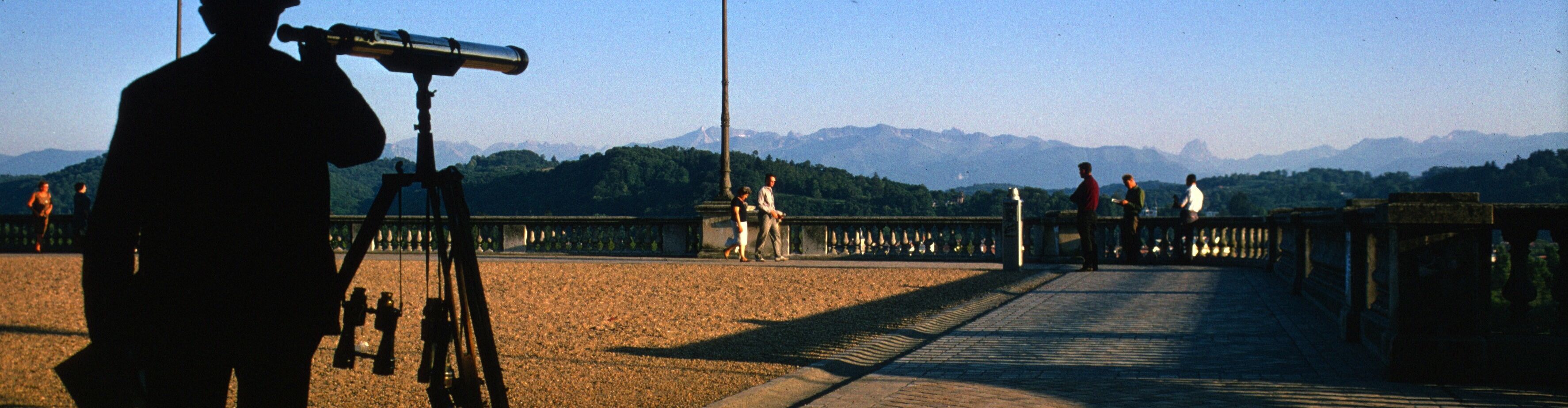
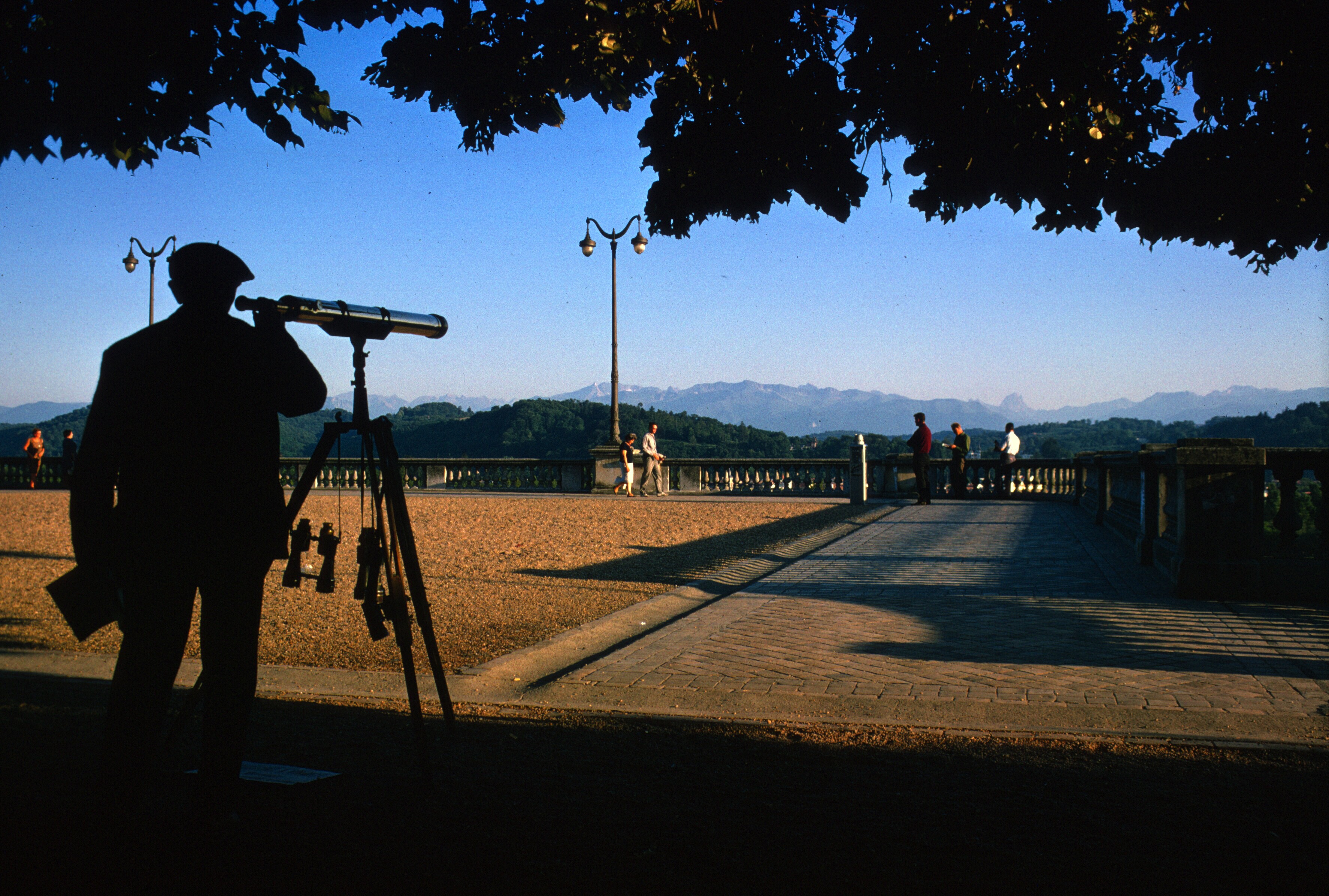
Pau would be the least known for most Americans. It sits on a hill that gives it an expansive view south to the Pyrenees.

france pyrenees vista copy 2
Panorama from the Boulevard des Pyrénées, Pau. Pic du Midi d’Ossau on the horizon is on the border with Spain

Henri IV was born in the Renaissance château in Pau, and cradled in a giant turtle shell. A statue of him stands outside the château, with the inscription, «Lou nostre Henrico », and the locals remain rightly proud of their native son. To ascend to the throne of France, he converted to Catholicism, and is known for the apocryphal quote, « Paris is well worth a Mass. » This cynical comment belies his success in putting an end to the religious wars that were tearing France apart, as well as for a public works program that helped modernize his kingdom.

Unfortunately, Henry was assassinated by a Catholic fanatic, and the regency of Louis XIII began, which, you may remember, was the setting for Dumas’ The Three Musketeers. Its protagonist was the hotheaded D’Artagnan, a Gascon. Pau is in Béarn, a part of Gascony, a traditional term that applies to the lands south and east of Bordeaux. In Pau people appreciate armagnac as opposed to cognac, and local cuisine is shared with the Basque provinces next door.

Pau was a nineteenth-century watering spot for the British and a few Americans. The climate is mild and the atmosphere is calm. So much so that France trains paratroopers there. Today it is a regional administrative center with a university. I studied there in the summer of 1965, and my reason for returning was to see my former landlady, Madame Pinaud, who fed me a nice dinner, set me up with a date, and put me up over night. She was a widow, and the boarders she took in were an important source of her income.

france pau chez pinaud 2
My room in Pau, chez Mme Pineau

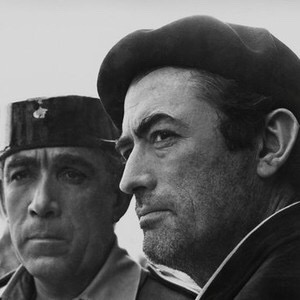
Pau was the setting for a movie with Gregory Peck, Anthony Quinn, and a young Omar Sharif. Behold a Pale Horse is worth a watch. Banned in Spain during the Franco years, it dealt with a bitter Catalan anarchist, veteran of the Spanish Civil War (Peck), and a corrupt officer of the Guardia Civil who is out to catch him (Quinn).

img_1812
Anthony Quinn and Gregory Peck, during the shooting of Behold a Pale Horse

It never gained any popularity as Peck’s character is dour and bitter, the movie was in black and white, there was no love interest other than Quinn’s mistress, and the setting is obscure. Peck usually played a hero and nice guy, and his fans expected roles with those attributes. In his final trip to Spain, Peck enters Spain through the Brèche de Roland, of which more later.

The château of Pau also served briefly as a prison for Abdelkader, the Algerian patriot, known for military acumen as well as his chivalry. At the height of his power, Abdelkader controled much of western Algeria and even some of eastern Morocco.

From Pau, the easiest route back to Spain was by rail through Canfranc. The second largest railroad station in Europe, Canfranc is perched high in the mountains. Trains had to switch from one gauge of track to another, as the gauges differed between France and Spain. Trains do not pass there any longer. The station was shuttered in the early nineteen seventies, and today is just a curiosity, rusting away in the wilds.

I think that the idea of crossing the Pyrenees through the Brèche had been in my mind for a while. I knew that the site was spectacular as I had visited Gavarnie, and I had watched Behold a Pale Horse, probably one of the late night movies CBC Toronto used to show after the 11:00 p.m. news. It is said that the Spanish government blocked its showing on American TV networks. Over the winter of 1968-1969, I began a correspondence with a member of the French Alpine Club in Tarbes. I had wanted to get some serious climbing experience, and he counseled me to enroll in the Union Nationale des Centres de Plein Air, a summer sports program for French kids. I asked him about crossing the the Pyrenees from Torla to Gavarnie, and he recommended the hike, saying that it was not difficult. If you research it on the Internet, you may find it described as one of the finest treks in the world.

I cajoled Gaylord into going with me. He did not share my passion for wandering about high mountains, but he loved nature and appreciated Spain.

img_1795
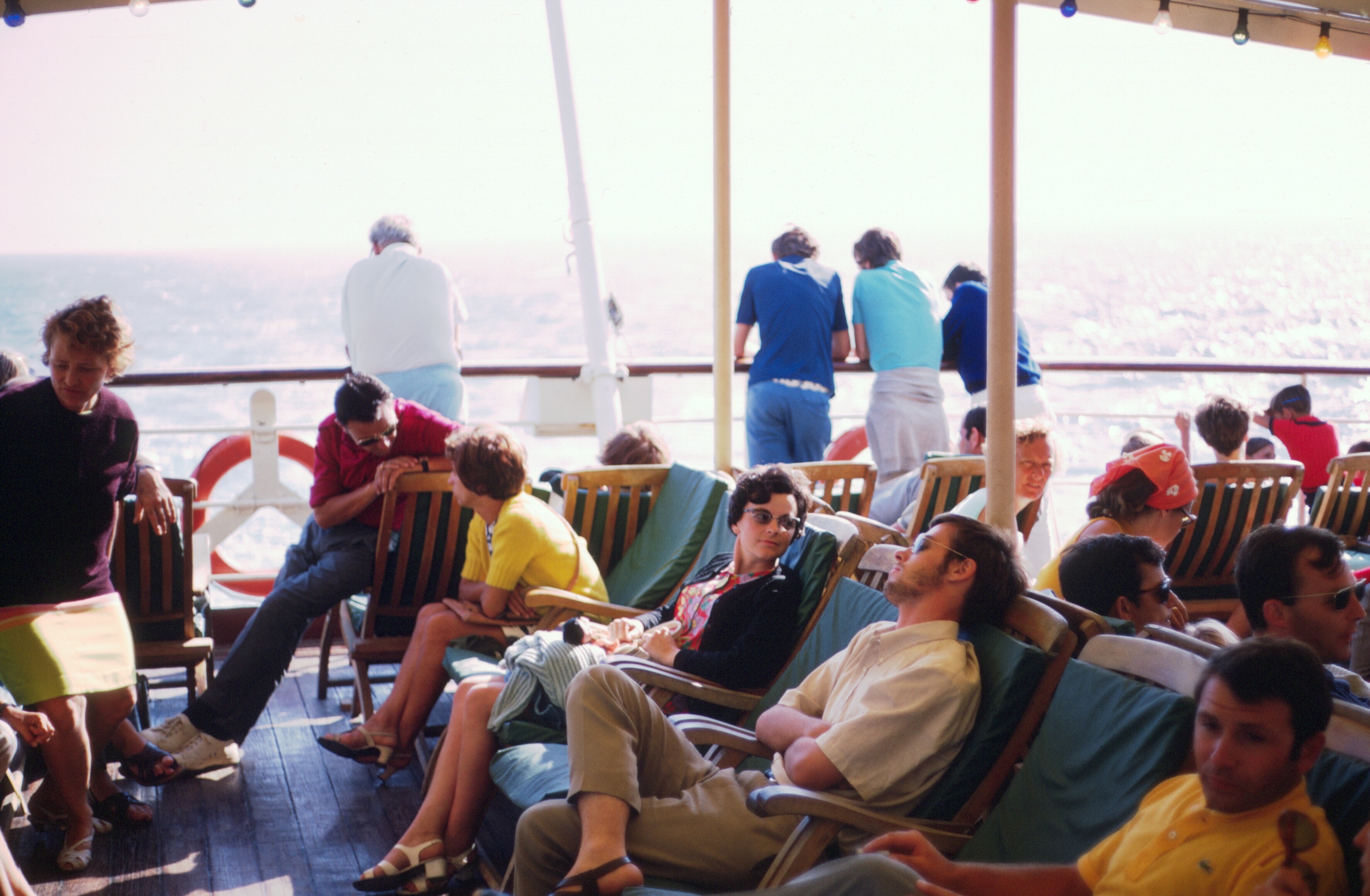
The Tangier-Algeciras Ferry with Gaylord snoozing in the deck chair

We set off in early July 1969, taking the train from Fes to Tangier. Crossing from Tangier to Algeciras, we took a night train to Córdoba, where we spent the next day looking at the medieval center and the Mezquita. I had been there before, and have gone back since. The Mosque is a gem. The previous summer I got off a night train from Algeciras and wandered at 4:00 a.m. through the twisting and turning streets of the old quarter. Here and there were lights of a bar or hotel, but most was shadow and dark and quiet. It felt very much as if I were at home in Sefrou.

spain cordoba mezquita 1a barr (2) copy
La Mezquita, the great Mosque at Córdoba

Spain did not have many fast trains in those days, and second class ticket holders were crammed six or eight to a compartment. The weather was sweltering, but we were used to it and it didn’t bother us. I remember Águila beer was eight pesetas a bottle. With roughly seventy-five pesetas to a dollar, it was easy to quench our thirst. Águila was a pale lager, and, on the train, at least, it came in small bottles, cheap to buy and easy to drink. It has sadly disappeared, swallowed up by big European breweries.

img_1813-1
Nothing better for a long, hot train ride

The long rides afforded some time to read and I think I read Hugh Thomas’ The Spanish Civil War, still one of the best books on the subject sixty years later. The previous year I reread The Lord of the Rings. I remember riding a bus through the Catalonian Pyrenees on the way to Andorra. It had piped music, and the driver was playing the Concerto de Aranjuez. It was a grey day, a bit misty, and the forests appeared in various shades of green. As the bus climbed toward Andorra, the peaks moved in and out of the clouds. It was a magical way to take in the spectacular scenery.

scan-110127-0020 copy-1
The old Atocha Station, Madrid

Arriving at the Atocha Station, we got a room at the Hotel Atocha. I had stayed there before. The rooms were threadbare and ratty, but it was conveniently located near the center of Madrid, across from the station, and the staff were friendly and used to dealing with budget travelers. I had come down with something, and had a fever. I remember going to see Walt Disney’s Fantasia, which I had never seen, in a big theater with chilling air conditioning. I ended up spending a day in bed while Gaylord saw sights in the city. I made a quick recovery, though, and we soon left for northern Spain by rail.

spain torla village-1
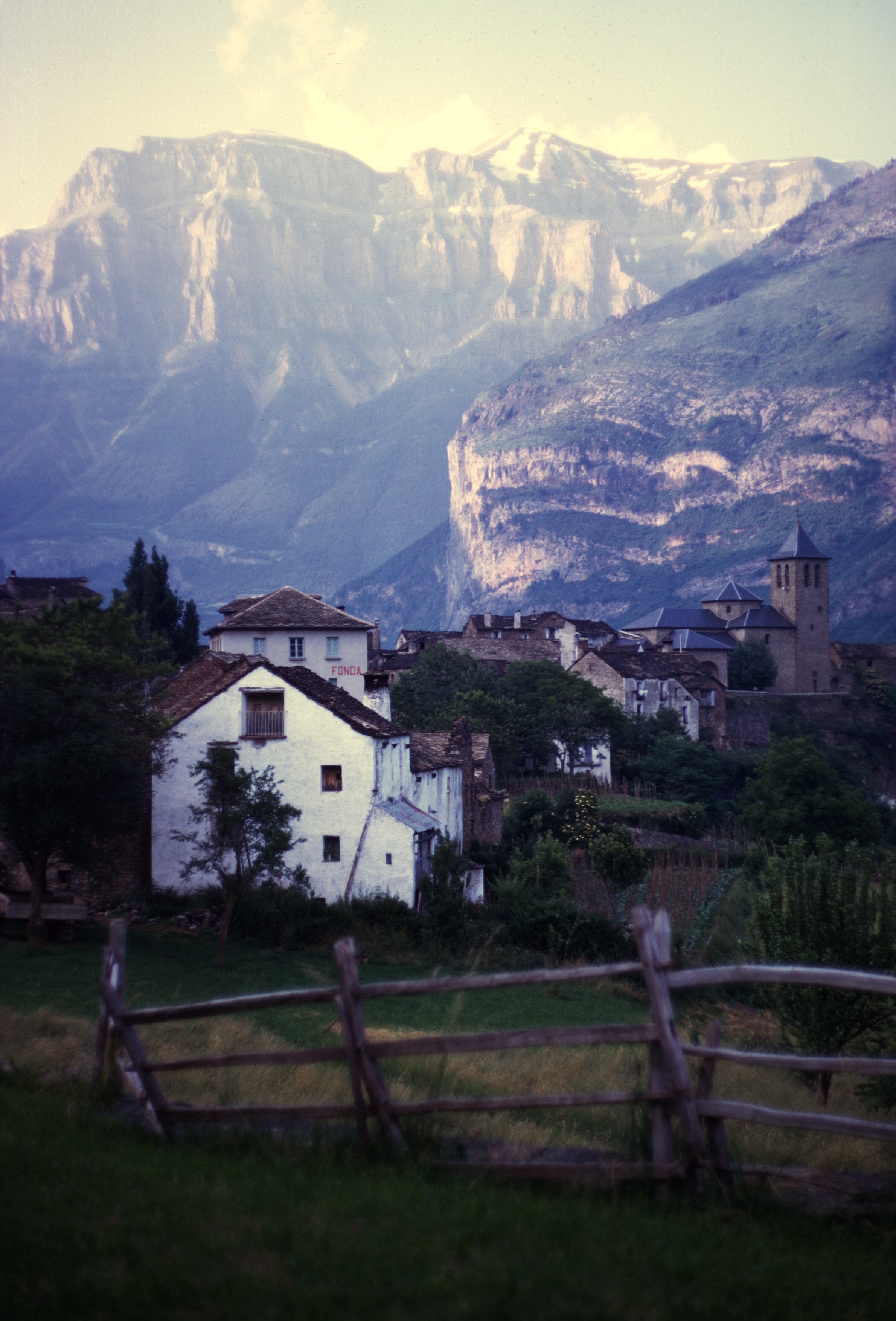
Torla, at the end of the day

Torla was a little mountain village and not on any rail line. I think we got off in Jaca, and had to hitch hike through Sabiñánigo to get there. It sits in a small valley, between the National Park of Ordesa and the town of Broto in the valley below.

enlight34
Broto, in the valley below Torla

At the time, Torla wasn’t as developed as it is today. Near the entrance of the National Park of Ordesa, if you were wealthy, you could stay in the Parador in the valley of the park. That was something like staying at the Ahwahnee in Yosemite, and just as expensive. We stayed in a pension in Torla, paying five dollars per day for room and board. At the time, you were able to drive to the park, and we hitchhiked. Today there is a shuttle bus, and the park is closed to automobile traffic.

spain pyrenees pension view
A view from the pension room over the roof tops of Torla

The food in Torla was local, fresh, and tasty, and was served with plenty of local wine. Gaylord remembered it, a few years before he passed away, as some of the best food in his life! There was a bar which had a TV, and one could sit and watch the Tour de France while drinking cheap Spanish brandy and expresso. There wasn’t much night life in Torla. With the windows open, you could hear the Río Ara.

spain pyrenees torla bridge
The bridge over the Río Ara at Torla

We hiked around the valley for a few days before continuing.

spain pyrenees ordesa valley barr copy
One of the numerous waterfalls
spain pyrennees ordesa tower
Tower from valley bottom

We climbed the canyon walls to the clavijas of Cotatuero one day, but we had no harnesses or ropes so we couldn’t proceed.

spain pyrenees ordesa tower 2 copy
Tower near the Cotatuero trail

Unfortunately, I had left my boots in Madrid. I desperately looked for replacements, but the choice was limited to either ski boots or canvas shoes with rope soled interiors, a cheap and popular choice in Spain.

enlight8
On the way to the clavijas of Cotatuero

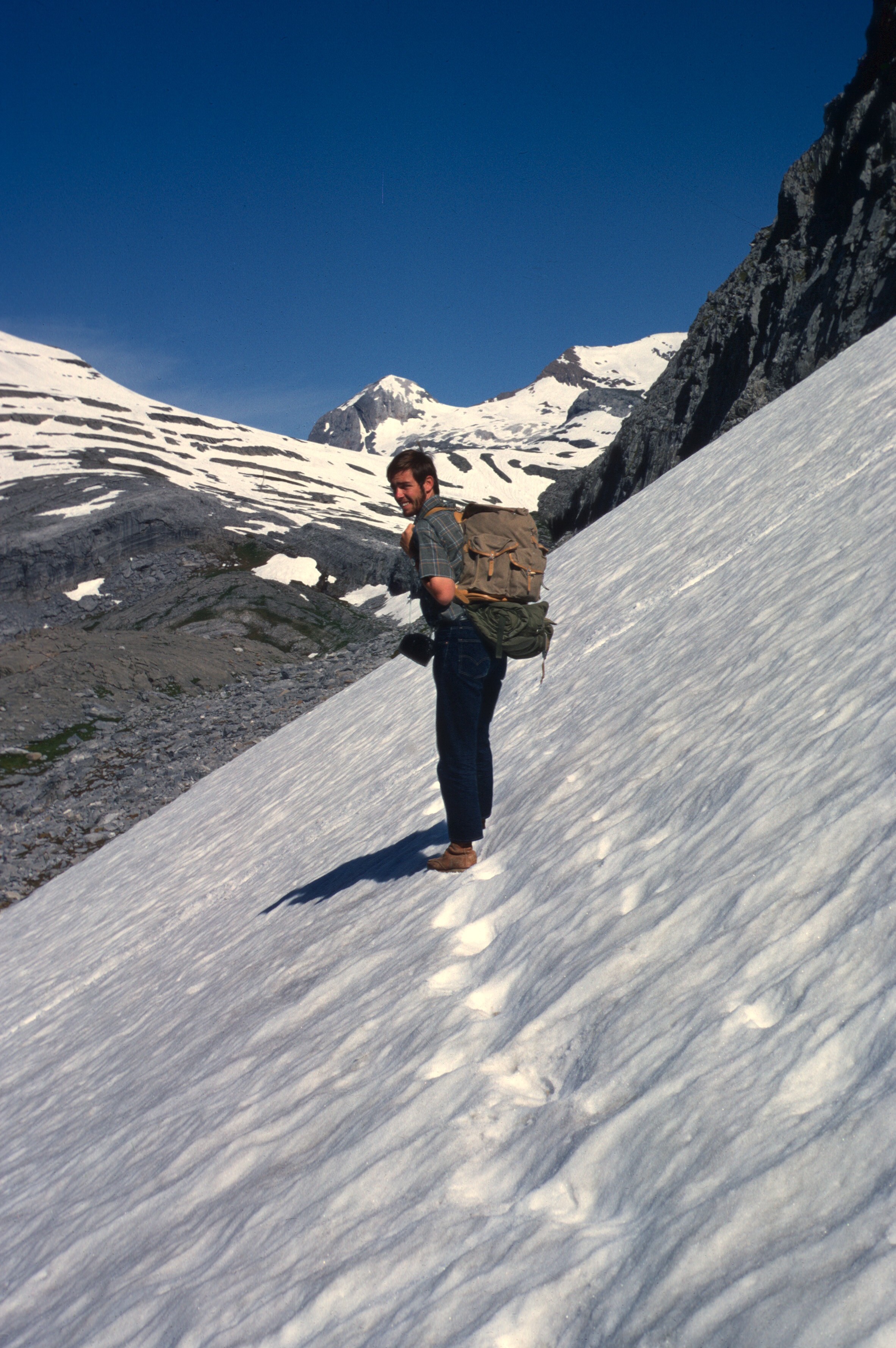
My French correspondent had not factored in difficient footwear nor large amounts of snow, and, though the canvas shoes were comfortable, neither they, nor the heavier work boots that Gaylord wore, were really suitable to the task. Most of the way from Góriz to Gavarnie I walked in the equivalent of wet tennis shoes! We should have suspected a lot of snow as we found the Río Ara with an ice bridge over it in the lower part of the canyon. Ice axes would have been handy. The previous winter had been a snowy one.

spain pyrenees ordesa ice bridge
Ice bridge over the Río Ara

The National Park of Ordesa and Monte Perdido has been designated as a World Heritage site by UNESCO, and certainly merits the distinction. A steep glaciated canyon, with hanging waterfalls, lush beech and pine forests, and snowy uplands, the Park may not be huge, but it is breathtaking. It reminds me of Yosemite, with its waterfalls and vertical cliffs, but the rock is limestone and just above the canyon walls are snow-covered peaks.

Our plan, and a very reasonable one we thought, was to climb to the Góriz Hut, above the end of the valley, stay overnight, then to cross through the Brèche de Roland and descend to the town of Gavarnie, which I knew from a visit in 1965. We had no reservations at Góriz, but if you were to plan this trek today, you would probably need them. All we had to guide us was a rough trail map handed out by the park people. Today there are excellent maps. Góriz to Gavarnie is a long day’s hike.

The hike up the valley was easy, and we soon left the forest of beeches and pines behind.

spain pyrenees ordesa me valley end
Nearing the end of the canyon, with companion bota
spain pyrenees ordesa valley end copy
Upper reaches of the canyon. The Góriz Hut is just above the end.
spain pyrenees ordesa canyon view
A view back down the canyon

At the Góriz Hut, there was a group of young Aragonese kids, dressed in local colors, who played flutes, sang, and danced after dinner.

I think they climbed Monte Perdido the next day, and I remember looking wistfully in that direction the next morning, before setting off for the Brèche. We would have been totally unprepared for that ascent.

We had left most of our clothes in Torla, to be retrieved on the way home, so that we could travel light. The proprietor of our pension packed a copious lunch and dinner of roasted chicken and sandwiches and, of course, wine. That was our food for the hike, and we didn’t buy food again until we reached Gavarnie.

spain pyrenees pano me-1
On the way to the Grotte de Casteret

We had sleeping bags, but I don’t remember real outdoor wear of any sort. We just had jeans and shirts with sweaters and light jackets in our packs. I had an old wool Pendleton shirt that my uncle Bill had handed down.

spain pyrenees ordesa trail barr
Leaving Góriz

Luckily, the weather cooperated. The sun was brillant until we crossed through the Brèche. The French slope had damp clouds rising out of the valley, but no real precipitation.

spain pyrenees sierras
Looking back toward Góriz.

We didn’t think finding that route would be difficult.

Had the weather turned, it might have been a problem, but the Spanish slopes are sunnier than those of France, and we had luck with us.

spain pyrenees route to brecha stop
On the trail to the Grotte. The bota seems to have gotten a lot of use!

From Góriz we headed to the Grotte de Casteret, named after Norbert Casteret, the famous French caver.

spain pyrenees casteret cavern view copy 2
A Spanish group and me, outside the Grotte de Casteret

There was a group of hikers there, and, at that time, you could easily enter the cave. At about 9,000 feet, the cave has a frozen lake and waterfall. That itinerary took us out of the way.

spain pyrenees brecha
The Brèche from the environs of the Grotte

We decided that we would descend to the basin under the Brèche and climb back up. This turned out to be trickier than we had reckoned. It was around noon, and the snow on the Spanish slope had melted and become slippery. We plodded up to the Brèche, slowly and carefully.

spain pyrenees brecha g
Gaylord Barr ascending the Spanish side of the Brèche

The Brèche is a imposing natural feature, a gap in a knife-thin rock face, about 120 feet wide and 330 feet high. It sits at 9,100 feet, above and to the left side of the Cirque de Gavarnie. It cannot be seen from Gavarnie, but it is clearly visible from many high points of land. From the summit of Pic du Midi de Bigorre, it appears as a tiny notch on the horizon.

img_1834-1
The mountains on the far horizon are on the Spanish border. The Brèche is a tiny notch on the right hand side of the photo. In the foreground is the Neouvielle Massif. Taken from the summit of Pic du Midi.

The Spanish call it La Brecha de Rolando, and the locals attributed it to the times of Charlemagne. Roland was Charlemagne’s best knight, who accompanied the king to Spain to fight the Moors. Roland was mortally wounded, and fearing that his magic sword, Durandal, would fall into enemy hands, he tried to break it against the rock. The rock was split, but the sword did not break.

With some trepidation, we arrived at the Breche. Looking back was Spain.

spain pyrenees brecha pano
View back into Spain from the Brèche

Looking down into France, we saw a steep snow slope.

france gavarnie sarradets (1)
Hikers on their way to the Brèche

A couple of hikers were on their way up to the Brèche. They had ice axes, and we wished that we had had them, too.

The view to the east, into the cirque was spectacular.

france gavarnie me
Descending from the Brèche, I am crisscrossing the slope. The cirque is in the background

To the right, clouds floated in the cirque. With no ice axes, we zigzagged back and forth, carefully traversing the slope, until we reached the hut.

france pyrenees refuge sarradets-1
Sarradets Hut, from below the Brèche

I did not expect all the snow, and was relieved when we finally reached the hut, and got off the slope. A fall would have meant a long slide, and possibly an injury.

My canvas shoes had been soaked all morning, and my feet were wet and cold. We needed a break and ate some of our provisions while the clouds rolled up from the cirque. I was able to switch to a dry pair of socks.

There was a French couple with children at the Sarradets. I think that they were surprised to find foreigners, who did not seem very well prepared for what they were doing, and they eyed us suspiciously. Maybe they thought we’d walk off with their ice axes?

france pyrenees sarradets barr copy
Resting at Sarradets

Having rested, we began the trip down to Gavarnie. The snow, which had caused so much consternation, soon disappeared, replaced by a broad stone trail. We met a young Frenchman coming up the trail to Sarradets, and said hello. He asked where we hailed from and was visibly surprised to find that we were Americans. The day turned darker as we continued down, and when we finally trudged into Gavarnie, it was almost night. We found a place to stay, showered, and went to bed. I think we were too tired to eat, and very sore to boot. I wanted out of those soggy canvas shoes much more than food.

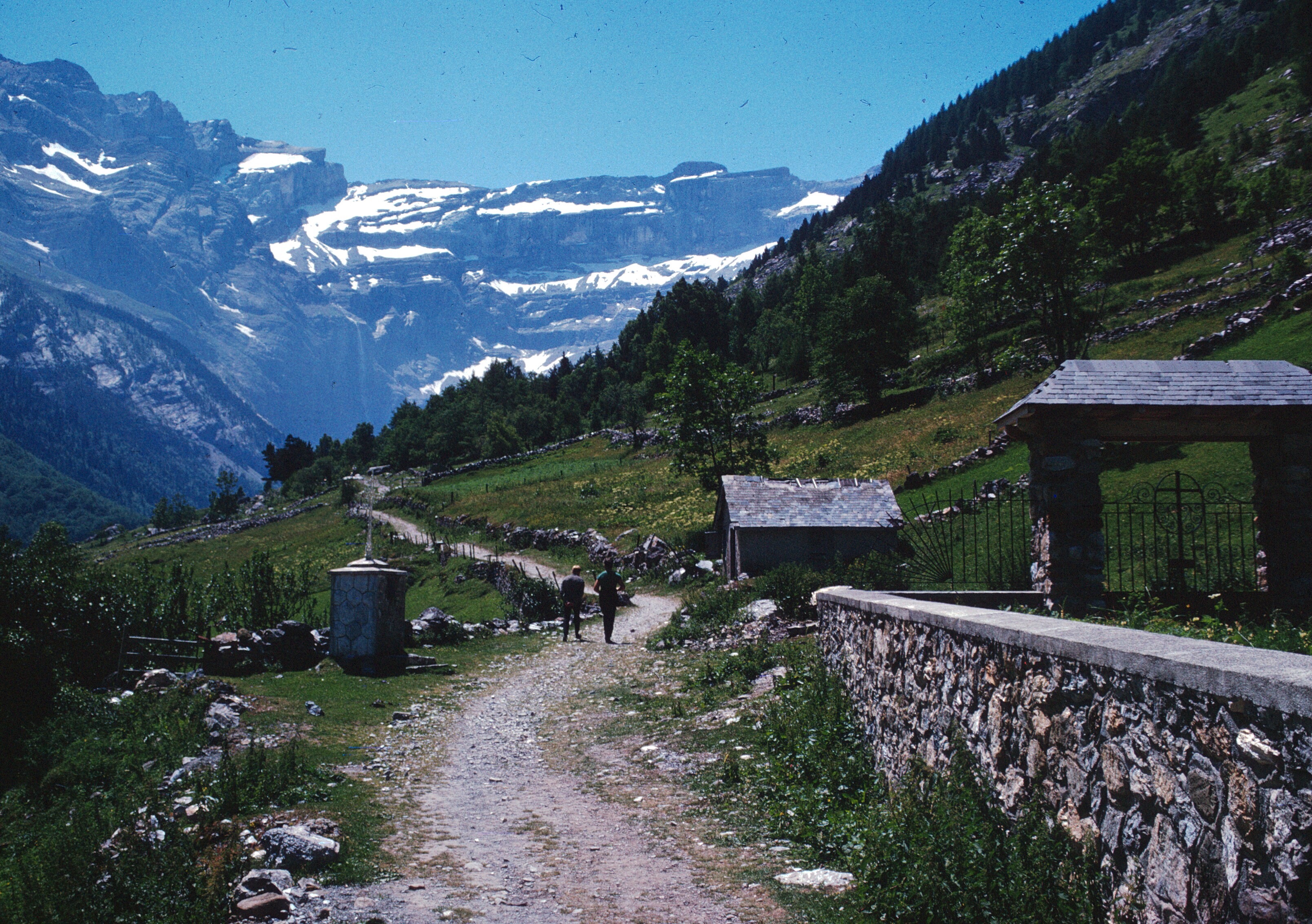
The next morning we arose late to find the clouds parting. Sitting on a cafe terrace, we enjoyed café au lait, croissants, and a magnificent view of the cirque.

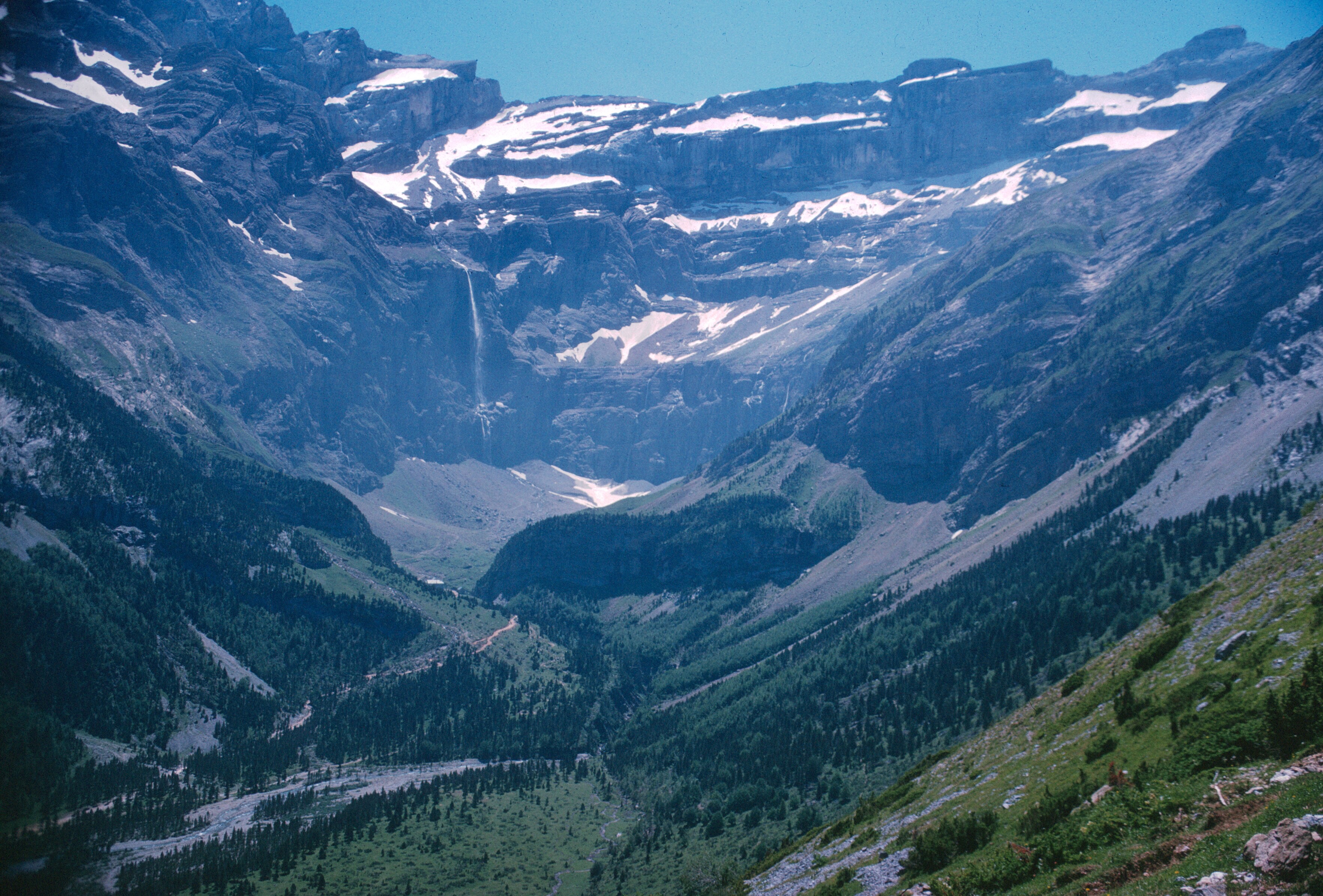
A rock wall rising thousands of feet, with a myriad of small waterfalls, the cirque has the highest waterfall in Europe. Victor Hugo described it as a coliseum, and, enclosed on three sides, it resembles an amphitheater. During the last ice ages, huge mountain glaciers occupied the cirque and hollowed it out. Layered strata form ledges and collect snow, and the snow provides horizontal banding that contrasts with the vertical walls adding contrast to the overall effect.

Since it was cloudy and dark, I took no pictures on the way down, but I have a couple from 1965 that give an idea of the trail and show the cirque from a different angle.

france pyrenees gavarnie town copy
Gavarnie, August 1965
france gavarnie trail to spain start copy
The beginning of the trail to Sarradets, in Gavarnie

If I were to do this trip today, I think I would return to Torla on foot via Bujaruelo, or a more scenic route. I’d also be dressed for the trip. But that summer we were just happy to have arrived, and still tired. After eating we hitched down the valley. We wanted to get to Pau, but hitchhiking wasn’t easy and we only got as far as Lourdes. With nothing else to do and stuck for the night, we poked around the souvenir shops and went to a Truffaut

movie, Mississippi Mermaid. The next day we bussed to Pau to catch the train to Spain. Picking up our belongings, we traveled back to Morocco, stopping in Madrid to get my boots at the Atocha Hotel. My big adventures were over till the next Peace Corps summer, the subject of yet another blog post.

ثيشوكت

Tichoukt (ثيشوكت)
In the east, the Middle Atlas range ends in folded mountains that contrast with the elevated plateaus around Azrou and Ifrane. In the winter, from any elevated spot around Fes, Bouiblane and Moussa ou Salah dominate the southeastern horizon. Behind them, looming over the upper Moulouya, Bou Naceur is even higher. Access to these mountains used to require a long and rough ride, though they are easy ascents if one approaches them right (more on this in another post.)
Directly south of Fes, just outside of Boulemane, is a third, lower peak named Tichoukt, which I think means little mountain in Berber. At 2787 meters (a little over 9,100 feet), Tichoukt is close to the town, and an easy climb, requiring nothing more than good shoes, lungs, and feet. There are remnants of a cedar forest, and the area to the east of the mountain has now received a special status as a natural area.

We went up to the summit of Tichoukt three times. The first climb was memorable, because the soles on my boots fell apart. I had given them to Jim Humphrey, living in Rabat at the time, to have them resoled. The shoemaker put the soles on perfectly, but the rubber was so soft that the limestone tore it to shreds. I had hardly any soles left when we returned!

Louden Kiracofe was with me. We were disappointed by the views, which were limited by haze and clouds. We just went up the west side of the mountain, which is separated from the true summit by a little saddle.

Gaylord Barr and Karin Carter and I climbed Tichoukt in the late fall, but the best ascent was with Louden in the winter. We approached from the south side of the mountain, climbed to the saddle, and just followed the ridge to the top where there was a geodesic marker.

The mountain had snow, and the view at sunset was memorable. The snow-covered summits of Bouiblane and Bou Naceur were sandwiched between the setting sun and the clouds, in a terrific vista.

Hockey Night in Morocco 

Kadri, number 43, scores! 2017.

In the autumn of 1967, I reported for Peace Corps training to a migrant labor camp in Hemet, California. The year had been eventful. I had graduated from college. I had visited Expo 67, the World’s Fair in Montreal. I had worked for two Peace Corps training programs in la Pocatière. I had hiked in the Canadian Rockies. I had witnessed Charles DeGaulle address to a Quebec crowd shouting “Vive le Québec libre.”  And I had listened to Foster Hewitt on Hockey Night in Canada as the Toronto Maple Leafs won their fourth Stanley Cup of the decade.
Living along the US-Canadian border for much of my life, I also had an academic interest in Canada. I didn’t play hockey, and, in fact, could barely skate, but I followed the game closely through the Toronto Globe and Mail, for which I had a subscription.
In 1967, there were only six teams in the National Hockey League, though the league was on the verge of expansion. Almost all the players were Canadians.
Tonight Liz and I tuned into the Maple Leaf game. From our home, we can receive it clearly over the air. I had been thinking about writing about the Muslim players in the NHL, and took a screen shot just as Nazem Kadri scored against Philadelphia. Kadri is one of two Muslim players in the NHL. He is a a native of London, Ontario, not too far from here. His father was born in Lebanon and emigrated to Canada where Nazem was born.
If you had suggested to me while I lived in Sefrou that I would be watching Muslim hockey players playing professional hockey, I think I would have been sceptical. When the Leafs won their last Cup, I believe that the entire team was made up of Canadian players. Today, of the twenty-three players on the roster, six are European and five are American , including their franchise player, Auston Matthews, from, of all places, Arizona.
Kadri is an elite player. He scored twice in tonight’s game, and he is one of the reasons the Leafs may finally get another chance at the Stanley Cup in the coming years. He practices his faith, and keeps the Ramadan fast as best he can, not an easy thing for a sports professional.
I don’t expect a Moroccan hockey star soon, but fifty years ago I didn’t expect Muslims in the NHL either.

Trout Fishing in America

Depending on your age and life experience, Trout Fishing in America may bring different things to mind. If you are a fisherman and fly enthusiast, it may remind you of the opening of trout season on one of America’s classic streams, such as the Delaware or the Madison.
If you are young, perhaps you will think of the homonymous band that sang children’s songs. My favorite, as a former school library media specialist, was Alien in My Nose, wherein the fate of the world is settled in a school library, saved by a kid killing time.
Then, again, if you happen to be a baby boomer, one of college age in the late nineteen sixties you may recall Richard Brautigan’s short novel.
The sixties were a time of ferment and turbulence. A counter culture arose that is familiar, and shared, at least to some small extent, by almost everyone who was young then.
By 1968 Brautigan’s book had gotten into the hands of Peace Corps volunteers. I read it, because everyone was reading it, or, perhaps, because there may have been nothing else to read at the time, but it did not captivate me. It was not long enough to fill up multiple grand taxi trips from Sefrou to work in Fes and back home. I preferred longer and more ambitious novels such as Bulgakov’s The Master and the Margarita or classics such as La chartreuse de Parme. Brautigan was mildly amusing, but shallow. Perhaps you had to be high to enjoy him.

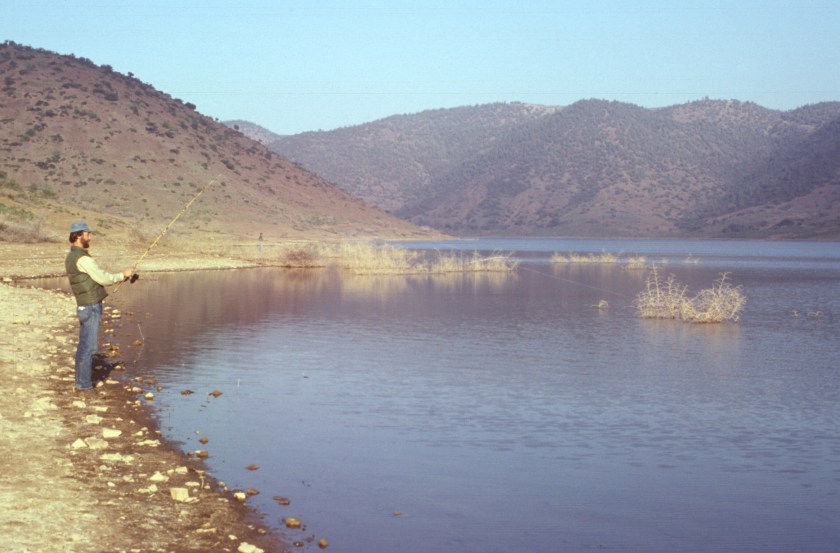
Trout fishing in Morocco was a different matter. At the time, I was interested in hiking and climbing, and fishing was secondary. I had some tackle, and fished a bit in the Middle Atlas lakes where European pike ruled, but the real trout fishing was in the central High Atlas. Al Jessup, the local Christian missionary, was by profession a fisher of souls, but Morocco was a difficult stream to poach. He was befriended by a French sports shop owner in Fes, and the two of them went on fishing trips together. He bragged of the ease of catching rainbow trout, of size and quantity in the cold mountain lakes and streams. I am not aware that he ever caught any souls.

The rainbows were stocked, of course, as were largemouth bass, and other sport fishes. Morocco has its own native species of trout, one of which lives in Ifni Lake, in the shadow of Jbel Toubkal, a place frequently visited by hikers. All of Morocco’s trout are probably endangered today. If you are interested in Morocco’s native wildlife, you may enjoy this article on trout.
Before the Romans, Morocco probably had many of the large fauna of Africa: elephants, bears, lions. The North African elephant, was used in warfare by many armies besides those of the Carthaginians. Intensive use of North Africa for farming, and the insatiable demand for animal fights in the arenas of the Roman Empire eventually led to the extinction of most of the large fauna. Wild boar and macaque monkeys are the most serious threats you might encounter in a Moroccan forest today. I once asked a shepherd near Ifrane if he had seen any monkeys. After two years in Morocco, I had not seen one. His reply: “Are you kidding? The little sons of bitches are everywhere!” I finally did see the Barbary macaques, both in the Middle Atlas and in the Rif in the mountains overlooking Chauen. I never encountered a boar, except one my friend Jean-Michel shot and served roasted at the dinner table. Needless to say, Moroccans do not eat boar, but they do hunt them as the animals can be a nuisance. Around the turn of the twentieth century, pig sticking–hunting boar from horseback with pikes–was the dangerous pleasure of the more avid European hunters who lived in Tangier.
Thomas Pellow, an 11-year old English boy captured by Barbary pirates in 1715 and sold as a slave to Moulay Ismael, explains in his memoir, The Adventures of Thomas Pellow Mariner, what to do if one happens to cross a lion on the road:

The lion, on the other hand, shows himself boldly sitting on his breech with a very sour look in the road, about twenty or thirty paces before travellers. In this case, instead of walking on and keeping their eyes off him, they must stand still and stare him full in the face, hollowing at him and abusing him all they can ; and for fear he may not understand English, in the language — if they can — of the country. Upon this hollowing and staring at him, he gets him on his legs, and, severely lashing his loins with his tail, walks from them, roaring after a terrible manner, and sits himself down again in the road, about the distance of a mile or two, when both traveller and lion behave again in the same manner ; and after proving them thus a third time, the lion generally leaves them without interruption.

There is no danger of that today. Traditionally, it is said that the last wild Barbary lion was killed in 1920. Some put the date in the nineteen forties. Sadly, today the Barbary lions are gone except for a few in zoos and manageries such as kept by the kings.

Those caged lions had their uses. El Rogui Bou Hmara led an unsuccessful revolt against the sultan Moulay Abd el-Hafids from 1902 to 1909. When his tribal support disintegrated, El Rogui took refuge in a mosque thinking he had sanctuary. It was bombarded by the sultan’s French supplied artillery, however, and he was captured. Displayed in a cage in Fes, he was tortured and eventually thrown to lions, though it isn’t clear whether they were interested enough to actually eat him!

Extinction is a thought much on my mind these days. I’ve been following Elizabeth Kolbert’s articles in The New Yorker for years, and finally read her book, The Sixth Extinction, this spring.
This post was prompted by an article I read the other day in La Dépêche. I’ve been thinking of a hiking or climbing holiday in the Pyrenees, so I follow what goes on in the region by reading this newspaper published in Toulouse. If you have been following the news, then you know that the Catalans and Spain have many issues that are coming to a head. The Catalans have my sympathy: they suffered years of cultural suppression by Franco’s dictatorship. Yet I find rabid nationalism dangerous, too. The future of mankind, if it is to be happy, will surely entail greater economic and political integration, as well as cooperation and common sacrifice. May the coolest heads prevail and everyone receive what is most important to him.
I noticed an article on the discovery of mercury in some of the high lakes of the Pyrenees. Investigators have come to the conclusion that the mercury arrived in the form of trout fingerlings, that are raised in hatcheries and stocked in the lakes. The trout are fed meal derived from ocean fish that have bioaccumulated mercury. Here is a case where humans unknowingly are transferring toxins between species and environments.
If you’ve read The Sun Also Rises, you know that Hemingway’s idea of heaven was trout fishing in the Pyrenees. He thought Spain had the best fishing in Europe.
O brave new world!

Trees and God

The great benefit of not having trees

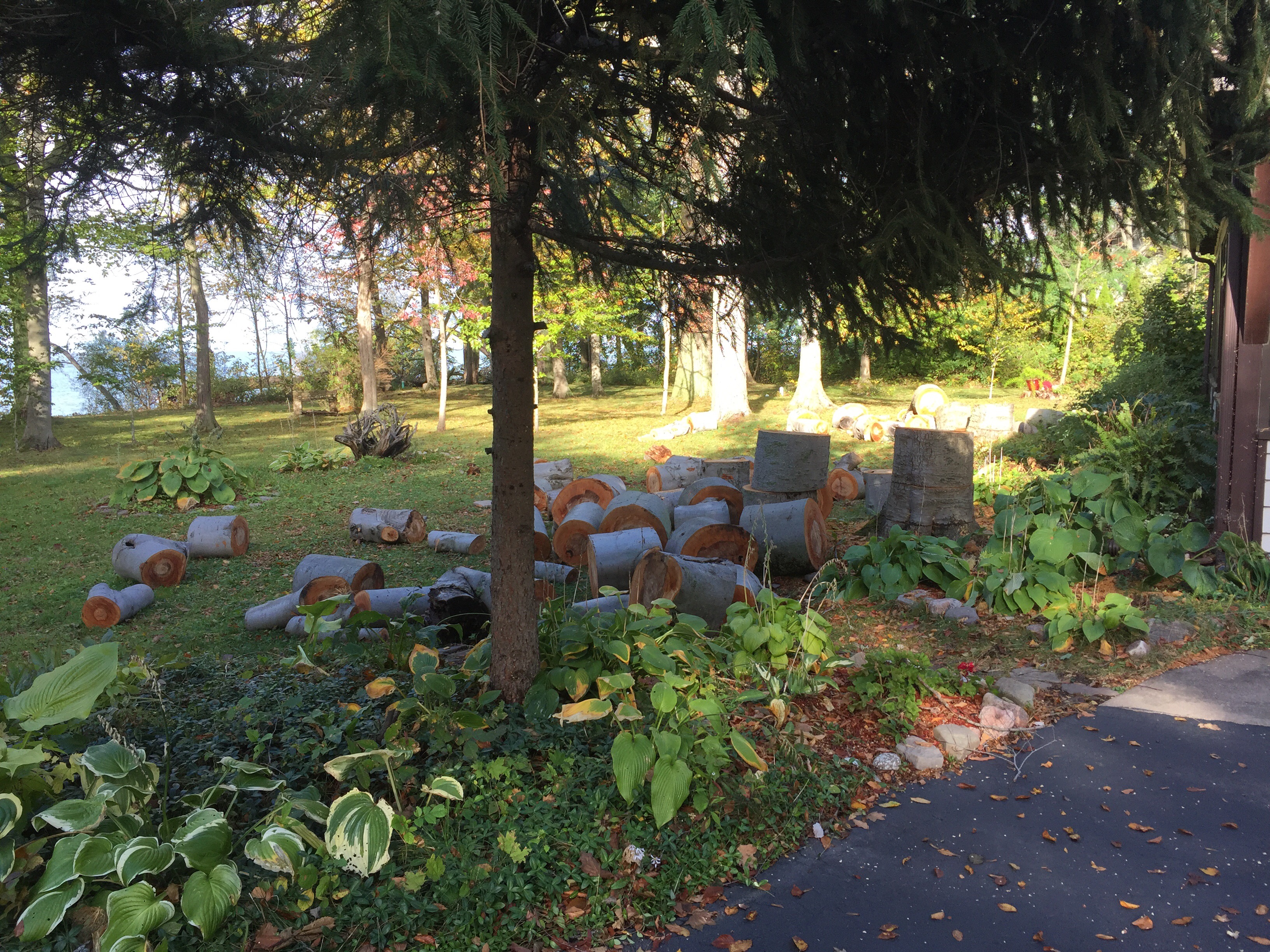
My wife and I just had five tall, old trees cut down. One was dead, one was a nuisance, and three were just a little too close for comfort. We loved those trees, and cutting them down, even if they do provide wood for next winter’s fires, was a heartache.

Now one has a slightly better view of the lake, the gutters will not fill up from beechnuts from the mast, and my wife will have more sunshine in her gardens. But we will miss those trees and the cicadas that sang in them during the long summer twilights.

A newly emerged cicada.


Where there are no trees

If you travel around the United States, and have the inclination, you can equip yourself with a series of books on roadside geology. I haven’t checked so I don’t know if there is one for every state, but there are many states represented for sure. In the west, where the climate is more arid and the rock strata are not covered, you can often witness the forces that shaped our planet from the comfort of your car.

Morocco, because it has only Mediterranean and desert climates, could benefit from a similar guide. The geology, in all its splendor, spreads out before you, plain to see.

Morocco also tends to lack biological diversity. Add up all the native species of trees and perhaps you may get a couple of dozen, far less than you would find in Western Europe or the Eastern United States.
That said, Morocco still has some great forests, notably the cork oak forests of Mamora and the Cedars of the Middle Atlas, though both are under pressure and threatened by climate change, overgrazing, and charcoal manufacture.

Flock in cedar forest near Ifrane. The forest was populated by boars and monkeys.

When I was visited by three volunteers from Libya, just before the revolution that launched Gaddafi’s career, I took them in the Willys jeep up to the cedar forests southwest of Sefrou. They were impressed by the karst lakes and the dense, tall Atlas cedars. It had been some time since they had even seen a tree.

I can’t help thinking of them when I watch some English period drama that frames the earl, walking with his old dog, past the huge Atlas cedars adorning his estate. I actually tried planting one a few years in my backyard, as I live on the edge of a climate zone that supposedly permits their growth. Unfortunately, after a few good years, it succumbed to a particularly bitter winter. Perhaps I’ll try again, but I will never have ones like the Earl of Grantham or those surrounding the châteaux of France. An old friend was fortunate enough to purchase some hilltop property above Albi, and the French government subsidized its reforestation with thousands of Atlas Cedars!
The rocks in Morocco contain more than a record of the physical forces that have shaped our planet.
From the skeletons of giant dinosaurs to earliest evidence of modern man, Morocco has been a great place for paleontologists and archeologists in recent years, and it is virtually certain that there will be new discoveries that expand our knowledge of the history of the world.

If you drive from Sefrou, through Ahermoumou, to the western slopes of Jbel Bouiblane, look in the stream beds that the road crosses, and, in the Cretaceous rocks, you may find large and beautifully preserved ammonite fossils. The ammonites perished in the last great extinction, when a Manhattan-sized rock struck what is now the Yucatán and left the Chicxulub crater. These long gone creatures, in their beautifully coiled shells, also may remind us that a great extinction is taking place today, caused not by an asteroid, but by ourselves.

Darwin’s Dilemma Solved

Proponents of creationism have recently pushed their point of view by claiming that “Darwin’s dilemma” demonstrates that God had His hand in the “Cambrian explosion.” The argument conflates two somewhat different facts. Darwin found it difficult to reconcile the period of rapid diversification that took place in the early Cambrian, between 541 and roughly 518 million years ago, with the short time in which it took place. Darwin was still operating in a uniformitarian mindset of course. And he knew nothing about modern genetics which helped explain the process of evolution. This has prompted the latest challenge by intelligent design promoters, namely, that diversification could not possibly happen fast enough for all modern animal phyla to develop. God must had intervened.

Now, this explanation has been permanently discredited. A.J. Bateman and a team of scientists at the University of Texas, Austin, have conclusively proven that God was on vacation during the geological time period in question, and simply left everything up to nature. “We got the idea from the Old Testament. Though God is everywhere and all powerful, He may not always be working,” said Bateman in an exclusive interview last Friday. “We knew from Genesis that God rested after creating the world, so we simply searched for vacation rentals over the last 690 million years,” said Bateman’s graduate assistant, Samuel Clemens, who also noted that a day in God’s eyes might be millions of year in ours.

It didn’t happen every day, or, possibly, it never happened

There were many stories about the first Morocco Peace Corps programs that we heard as we trained and served. I met a couple of volunteers from an early program in Hanover, NH. I worked at the reserve desk of the library with the wife. One day they needed a babysitter, so I was pressed into service. It was in their house that I saw my first picture of one of the monumental city gates of Meknes. I really knew nothing about Morocco yet, although the following year I was to develop a good friendship with a Moroccan student who lived in the room immediately across the hall from mine.
Strangely the only thing I remember was an offhand comment by the husband that there were no beautiful Moroccan women, which I doubted at the time, and found to be utterly untrue after living in Morocco. The wife, however, did share with me the discrimination that she suffered as a child growing up in Colorado. That was my first insight into the discrimination that Hispanics faced in my own country. It was 1966, I think, and it was a wake-up for me.
Other than that, the older volunteers I knew were either training or country staff, or those still living in Morocco when I arrived (VII or VIII.) They all had stories, and, of course, every volunteer has them. It is unfortunate that there is not something like NPR’s Story Corps to capture them for posterity.
Some of the first programs were apparently disastrous. Morocco had only been an independent country since 1956, and Moroccans tended to be suspicious of foreigners. Also suspicious were the numerous French still working in the government or living in Morocco. France has its own volunteer service, called la Coopération, an alternative to military service for some, and was not terribly interested in having the Peace Corps on what it thought of as its turf. The French government was led by Charles de Gaulle, who distrusted the anglophone world, in general. Peace Corps TEFL teachers could be seen as yet another attack on la francophonie.
Moroccan bureaucrats were perplexed about what to do with these young Americans and probably about the programs that came with them. Foreign aid is a tough business, and my experience with USAID was that many of its projects were questionable and many AID people collected high salaries for doing very little. This may be a jaundiced view, but it still feels right today.
There were stories about the early programs that were difficult to believe. Volunteers from a failed program, hanging out in Rabat, racing their blue Willys jeeps up and down Avenue Mohammed V in Rabat, waving winners with a checkered flag. Volunteers grabbing policemen’s hats and running into the USIS building, where they stood behind the Marine guard, and taunted the policemen.
Two stories were more interesting. The first is true, and the second sounds true, but I did not witness it first hand.
In the early days, a doctor was assigned to the Peace Corps office in Rabat, to take care of the volunteers. Given that one had to be young and healthy to get into the Peace Corps, the Peace Corps doctors had plenty of time on their hands. By Morocco XII, the role of the doctor was replaced by a nurse. I knew the last doctor, who became a good friend, and developed an affection for the first nurse, an older woman, retired from the military, whose gruffness often obscured her kindness and generosity.
One early doctor was a would-be poet and avid surfer, reputed to be difficult to get in touch with on short notice. A volunteer serving in Nador became seriously ill and could not reach Rabat. She had met a Jewish doctor in Oujda at some point, and called him in desperation. He told her not to worry, just go to the airport and wait. Within an hour or so he arrived in his private plane, and whisked her back to Oujda, where she recuperated in his clinic until she regained her health. I don’t think he ever charged for his services.
The second story took place in Fes. It reminds me a bit of stories from the Thousand and One Nights, where the fifth Abbasid caliph, Haroun er-Rachid often wandered the streets of Baghdad in disguise, hoping to discover what his subjects really thought. This was during the Golden Age Of Islam, when Baghdad was a great center of thought and learning.

One day the local police circulated throughout Fes rounding up volunteers. They knocked on apartments, went to volunteers’ work places, and even found volunteers in cafes. Needless to say, this was at first a cause of consternation, but the police made it clear that there was no law problem, but rather that they were delivering invitations to an official dinner, thrown by the local government for David Rockefeller, the banker. Rockefeller had a lifelong interest in Morocco, and was a friend of the King. Tired of official receptions and eager to know more about the work of the Peace Corps, which he admired, he had asked that some volunteers be invited so that he could meet and talk with them.

So the police found as many as they could and that night they dined with some high ranking officials and Rockefeller. At the dinner, Rockefeller told a story about meeting Hassan II a few days earlier. As is customary, Rockefeller brought a gift, a very fine telescopic sight for a hunting rifle. The King accepted it with thanks, and told Rockefeller that he had a little something for him. He led Rockefeller through a palace doorway into a room piled high with fine Moroccan rugs. They continued through another door into a room filled with fine pottery, and then into a third room stuffed with brass trays and kettles. Rockefeller commented at the dinner that he went away embarrassed by the King’s largesse.
It reminds me of a refrain from Georges Brassens’s song, Marinette: “Avec ma p’tit’ chanson, j’avais l’air d’un con…”.
David Rockefeller had a long history with Morocco, and played a key role in some important diplomacy when the Shah of Iran was forced into exile. One of Rockefeller’s Moroccan pleasures was visiting Fes and shopping there.
Perhaps someone out there will confirm or correct the details of this story.

Defamation

Here’s a bit on Fes that I picked off the Internet. It is an anti-Mason, anti-Shriner piece, but it also defames Muslims and Islam. If one knows anything about the history of Fes and Morocco, one knows that it is a fabrication.

Fes was founded in the 8th century and populated with Andalusian emigrants and local Berbers in the 9th. Given the sizes of cities at the time, it is unlikely that the population was very large. Not much is known about the early history of Fes, but there is no mention of any significant Christian population, let alone 50,000! Perhaps there is no historical mention of Christians at all!

Moreover, throughout Moroccan history there have never been any huge slaughters of Christians. Jews have suffered over the centuries, but usually in localized events, when the sultan did not have the power to protect them.

It is extremely unlikely that a Muslim ruler would slaughter mass numbers of “People of the Book” since one’s subjects are the wealth and strength behind a ruler.

Talaa seghira, just inside Bab Boujloud

In any case, the following episode, found on the Internet, is a manufactured, falsehood.

Now, if one wishes documentation about the Christian slaughter of innocent people, history is rift with them. No invention or imagination is required, nor need one go all the way to distant and ancient parts of the world.

Christians should remember that one of the commandments is “Thou shalt not bear false witness against thy neighbor.”

The Disgusting Blood Red Shriner (Mason) Fez And Oath To The Pagan Allah:

The Masonic Shriners wear a red hat known as a Fez named after a town in Morocco, where in 980 AD, 50,000 Christians, including women and children, were brutally murdered by the Muslims. As the streets ran red with the Christians’ blood from the massacre, the Muslims dipped their hats in that blood as a testimony to Allah. The red Fez symbolizes the slaughter of Christians in that town. The Masons still wear the red Fez adorned with the Islamic crescent symbol. Among the oaths of the Masonic Shriner organization is one that says, “…and may Allah the God of Arab, Muslim, and Mohammedan, the God of our fathers support me to the entire fulfillment of the same. Amen, Amen, Amen.”


The fez derives its name from the place where it first was manufactured commercially, the city of Fez, in Morocco. Some say, the red color is to memorialize the color of blood, and the Muslim victories over Christians. The City of Fez formerly had a monopoly on the manufacture of the fez headdress because it controlled the juice of the berry used to color the fezzes. The color red may represent the blood of innocent victims, like Christians and Jews who Islam plans on subjugation.


I haven’t annotated this quote, but anyone can find it easily. If one wants a good book on the real history of Fes, try Roger LeTourneau’s Fes in the Age of the Merinides. The University of Oklahoma Press used to sell an excellent translation of the French language original.

Blood does run in the streets of Moroccan cities once a year. On Aid el-Kbir, every family that can afford it will slaughter a sheep to celebrate the sacrifice of Abraham.

Aid el Kebir, Sefrou. 1970

Biblical plagues

When I think back to my Peace Corps experiences, recollections are sometimes of brief or momentary things. The abandoned and deserted city streets at the end of the days of Ramadan, for example, when people sat around the table at home anxiously waiting for the canon or siren to sound the end of the fast so that they might pick up their hrira (Ramadan soup) or cigarettes, whichever mattered more.

The road from Casa to Marrakech is long and straight, and crosses some of Morocco’s most productive agricultural land. I traveled it from Rabat many times on the way to Toubkal massif, south of Marrakesh, where I went hiking or climbing. On a hot summer day, the stubble fields exuded heat, and little dust devils would cross the road from time to time. It you hit one, the car would shudder. I always worried that my French friends’ little cars, traveling at 120 kilometers an hour, would spin out of control.

Often, it was more convenient to travel at night. It was far cooler and there was less traffic on the road. But more than once, there were explosions of the mice and frog populations. I can understand the former: after the harvest, there was plenty of grain for every hungry mouse, and since the mice gave birth every 21 days, it didn’t take long for the fields to be crawling with mice. You might not notice them from a speeding car, at night, except that so many tried to cross the road and were run over. The highway was literally wet from the blood and squashed bodies of thousands of dead mice. We never stopped to look at them so I can’t say what species they were, but I did see the reflections of their eyes as they scurried back and forth across the highway, uncertain as to which way to turn.

I witnessed the mouse massacres several times, but on one occasion, it was frogs that littered the road with their bodies and coated it with their blood. I think they were frogs, though they might have been toads. The numbers, like those of the mice, were astronomical, and the wet road in the middle of a rainless summer was all the more astounding.

Eventually one would drive out of the slaughter zones, but it always reminded me of the plagues of the Bible. I never witnessed a desert locust flock, but I suppose that, if I had, I could add them to the list. Southern Morocco has long been plagued by them.

Vietnam

Tonight Ken Burns’ documentary series, Vietnam, premiered, and I watched the first episode. Vietnam was the defining issue of my generation and the next. As I was entering college, the U.S. was quietly engaging in Vietnam. I knew virtually nothing about Southeast Asia. I was an international relations major with a deep interest in Canada, particularly French Canada. This was the sixties. With the end of the Duplessis government, what was known in Quebec as the Quiet Revolution had just begun. My only real knowledge of Southeast Asia came from the freshman geography class, imparted by my professor, Robert Huke, and he spent more time disparaging Wengener’s drifting continents, soon to become legitimate geological theory via plate tectonics, than he spent on Vietnam. My knowledge of Vietnam was through the popular press. As has become evident over the years, much was happening outside the eyes and ears of the press, and much of what was reported was ignored or denied by the government and military.

In 1964, a buddy and I decided we would hitchhike to Alaska, where we would work for the summer. We began in New Hampshire, heading north through Montreal. The goal was to follow the newly completed TransCanada Highway as far west as we could. Outside of Ottawa, while we waited along the highway with a sign with Vancouver written on it, a group of Carleton College students stopped. They weren’t going anywhere, but they gave us the telephone number of one of their friends, and advised us to look him up in Vancouver.

After a few days of good luck, we actually arrived there. With no place to stay, we called the number we had received in Ottawa. George wasn’t home yet, but his parents offered to put us up and we stayed with them for the better part of a week. During this time, they fed us, took us around town, and acted pretty much like surrogate parents. George’s’ mother even washed our clothes. They were as kind as could be. They were also the first communists either of us had ever met. The father was willing to admit Stalin had made mistakes, but the mother was not. Among the periodicals they received was a Canadian communist publication that carried news from Vietnam. They urged us not to believe everything that we read about Vietnam. We were still teenagers, and neither of us knew the history of Vietnam, nor exactly why we were engaged there. Our global view was the Cold War.

A year and a few months later, I found myself studying French in southern France, and began reading an account by French journalist, Jean Lacouture, of the Vietnamese conflict, Vietnam, entre deux paix. This work which had just appeared, convinced me that you could only understand Vietnam through the prism of intense nationalism, and suggested that American policy might not work at all. The French military experience had been a disaster.

Africa begins at the Pyrenees. Boulevard des Pyrénées, Pau, 1965.

Returning to the States in 1966, I found that opposition to the war increased as had our government’s involvement. The Selective Service was a burning issue. It ensured a steady feed of manpower from the baby boom generation, but the inductions included many who opposed the war or were confused about it. In each category were young men ready to serve, though some were more reluctant than others. Still others opposed the war strongly, some refusing to serve and seeking conscientious objector status, others considering exile in Canada. Anxiety about the draft plagued young men graduating from high school and college. Draft boards followed very different policies across America. Some were hard-nosed, others granted deferments for practically anything. Influence and favoritism were a big problem. If your family was rich and had connections, deferments came easier. In 1966, a returned PCV from Texas told me that his board told him as he returned to college and would soon graduate, that he had done his peace service, and when he graduated he would have to do his war service. No law school for him.

I applied to the Peace Corps before I graduated. I had a good Moroccan friend who occupied the room across from me in Cutter Hall, and another student who, having grown up in a missionary family in Beirut, had developed a deep interest in the Arab world. The latter, by the way, strongly opposed the war, and when drafted, ended up doing clerical work in Alaska, despite his knowledge of French, which might have served the military’s interest in Vietnam.

I did not feel ready for graduate school, and thought that the Peace Corps would permit me to learn and serve. My hope was that I would have a deferment for my Peace Corps service, and be able to put off the draft for a couple of years. I asked the Peace Corps for assignment to Morocco. Of course, I was offered Senegal instead! I turned down the assignment, and asked again for Morocco. Fortunately, Dartmouth had a Peace Corps training office, and a site at a collège catholique in Ste. Anne de la Pocatière, Québec. I was fortunate to work with two West African Peace Corps training programs in that summer of 1967, and ate the best institutional food of my life. What a beautiful spot it was, and what a contrast to the migrant labor camp in Hemet, California, where Morocco X was trained.

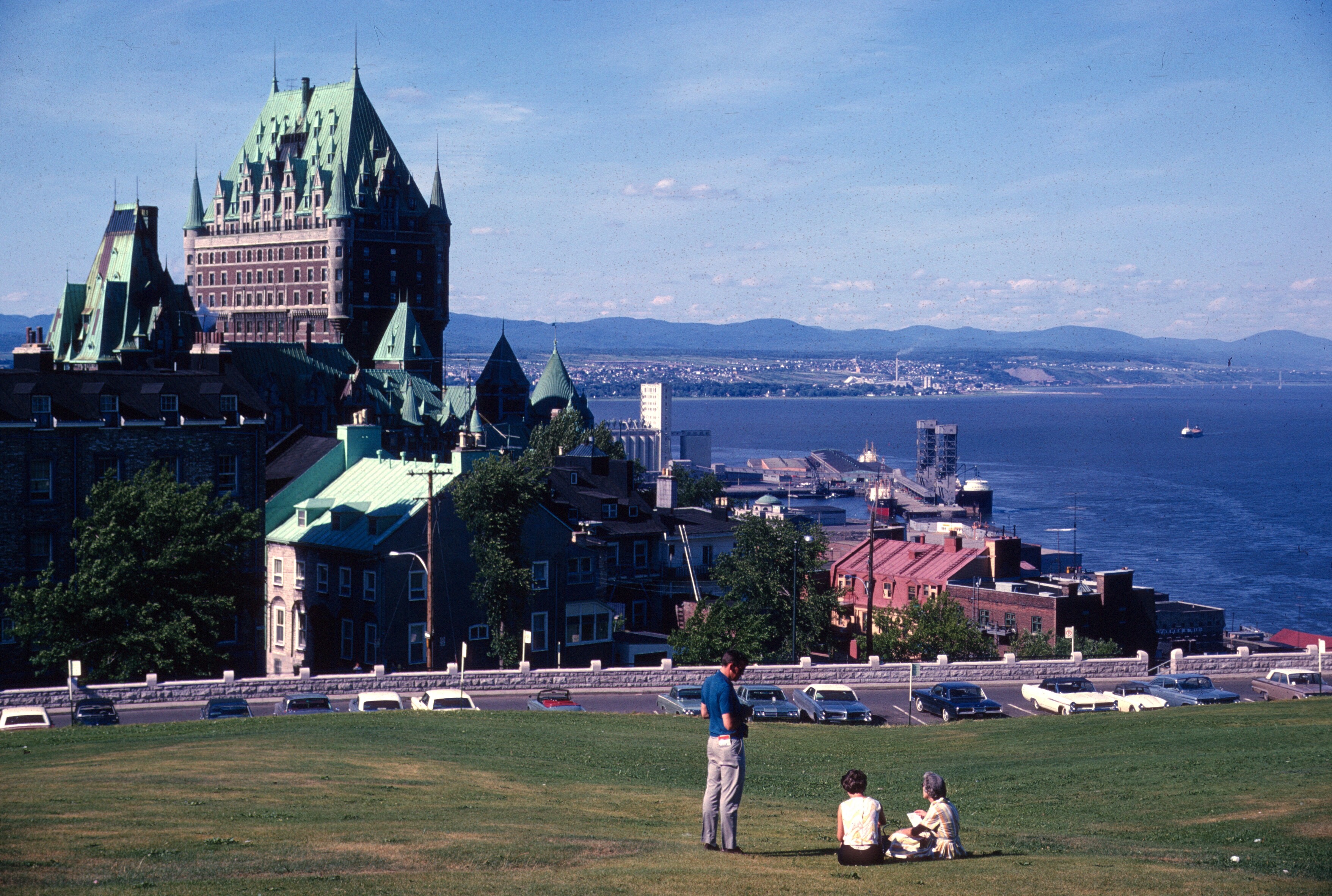
Château Frontenac and the St. Lawrence, 1966.
Kids playing in a fountain in Quebec City.

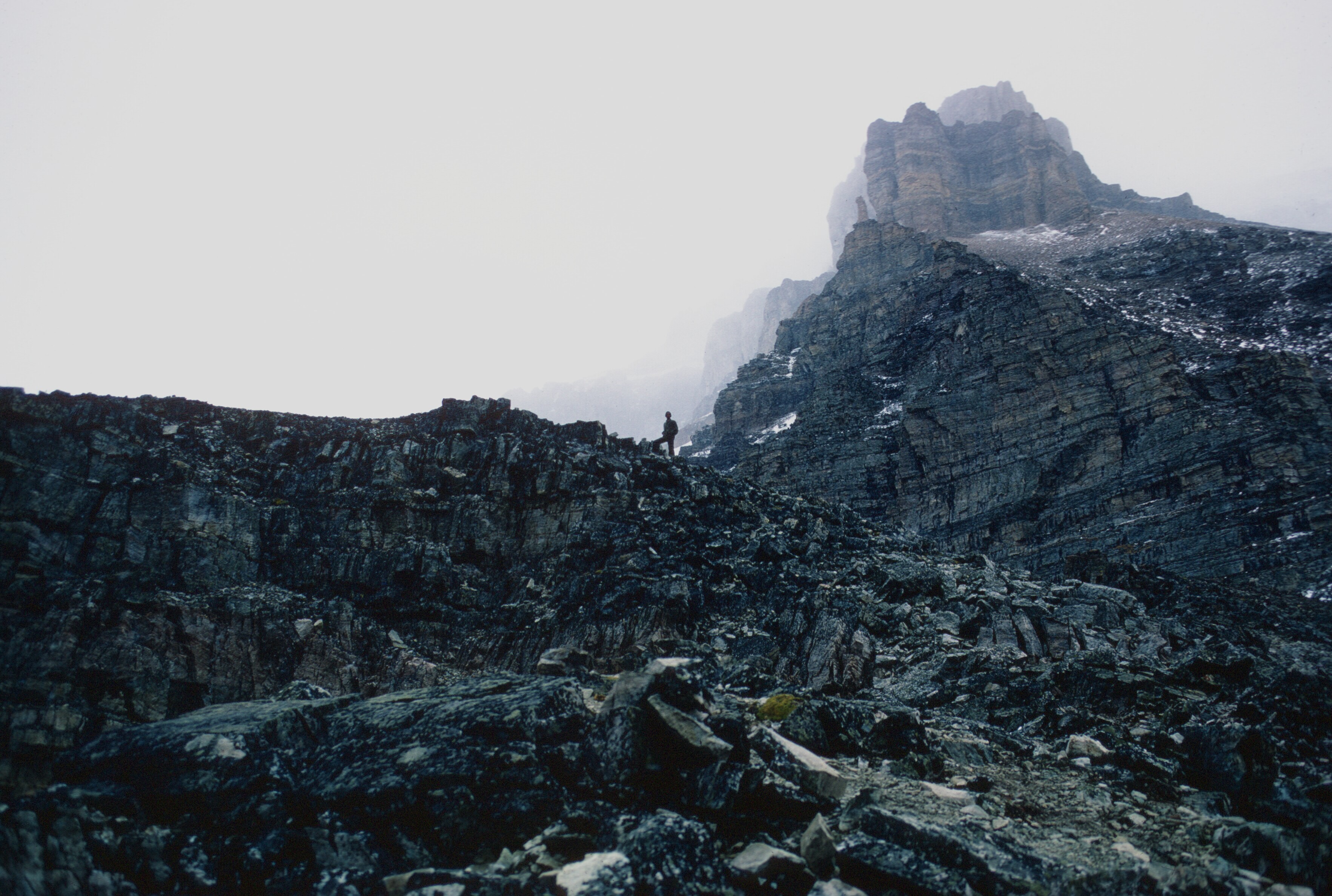
Peace Corps finally did give me an assignment in Morocco, and, to my great surprise and delight, found that one of my closest friends at Dartmouth, who lived down the hall in my dorm, also was invited to the Morocco X program! We celebrated and killed a bit of time until our training program began by hiking in the Canadian Rockies.

Hiking trail to Berg Lake, Mt. Robson Provincial Park. Mt. Whitehorn, September, 1967.
Jim, on Sentinel Pass, below Mount Temple. Banff National Park, September, 1967

In Morocco, the faraway war always hung over us. It was understood very differently by different strata of Moroccan society. Younger, more educated Moroccans mostly saw it as a post-colonial, Cold War episode in a remote part of the world. With past colonial experience, they tended to side with the Vietnamese. Others, like my maid’s husband, Ali, had actually fought in Vietnam, part of the French excursionary forces. These non-French soldiers were mercenaries, and once France withdrew from Vietnam were happy to be home in one piece.

For most, Vietnam was just a remote, faraway place. The Middle East dominated the thoughts of more educated Moroccans, and there was widespread sympathy for the Palestinian cause, and a deep antipathy to Israel, which, by 1968, was occupying the West Bank and Gaza. The media played on the issue, and the Moroccan government gave lip service to the Palestinian cause without doing much. The position of Moroccan Jews became even more precarious. There was a lot of hostility toward Jews, though Moroccan Jews often maintained long-lasting and close personal relationships with Muslims, in and out of the government.

Late in my service a draft lottery was instituted. I drew number 333, and the issue of serving in Vietnam disappeared. I would not enlist, and, leaving the Peace Corps, entered graduate school to study anthropology.

Bread

A couple of days ago, I stopped at DiCamillo’s, a local Italian-American bakery. Recently my wife and I have been in the habit of buying freshly made Italian-style bread. This is not a new habit, but periodically we go off white bread since most nutritionists consider it unhealthy. At the moment, it’s taste over health.

There are not many bread choices locally. In twenty-first century America, most people buy Wonder Bread style bread. It keeps well, it is sliced, and it makes reasonable toast and sandwiches. But traditional Italian bread, with a crispy exterior and a soft interior is so much better.

DiCamillo’s business began in Niagara Falls in the early twentieth century, and continues there to this day. My grandparents lived across the street from the original bakery on 20th Street, and, through the Fulgenzis, I am connected by webs of affinity and kinship. Not so well connected, however, that I get my bread free.

Last Wednesday I was on my way to an appointment with my dentist, and stopped at the Linwood Avenue bakery to buy bread. I was pressed for time, and the clerk was indulging another patron who went on and on about taking the bakery’s products to her sister in Pittsburgh. When my turn finally came, I asked, as I always do, for a large, unsliced loaf. The clerk selected the bread from a stack of four, carefully taking the furthest from the front. I wondered about that, and noticed as I left the bakery that the crust was surprisingly hard for freshly baked bread. Later at home, my wife and I agreed that the bread wasn’t as fresh as it usually is. On my next trip to DiCamillo’s, the same clerk was there and I told her that the bread she had sold me had not been fresh. This did not go over well with her. “Our bread is always fresh,” she replied with indignation. I asked when bread was made, and was told whenever it was needed. And there I left things as far as the clerk was concerned. However, I had purchased the bread at about 10:30 in the morning, so the bread had probably been made the previous night to have a crust so hard. Were the loaves that she didn’t give me fresher? I hope not. A good bakery (and honest business) doesn’t push old goods at a premium price.

Now why make such a fuss over bread? The answer is that it is a staple of life, and in many places regarded almost religiously. Once some of my secular French friends told me how happy they would be to finally cross the border and leave Spain, where the bread was “infecte,” and finally enjoy a French loaf!

Carrying bread home from the oven. Moulay Idriss. 1968.

In Morocco, one could find well-made French bread in the large cities, as well as loaves and baguettes that looked French, but weren’t quite there. On the other hand, many Moroccan families made their own bread in the local communal oven (el ferran). In Sefrou, Gaylord Barr and I shared a maid, Khadija Demnati, who cleaned, washed clothes, shopped, and, of course, made bread every day of the week. There was a large bag of flour in the room that served as the kitchen, and the daily routine involved Khadija making bread, taking it to the ferran, and returning with it still warm and aromatic. I think she also made bread for her family, with our flour, but we did not begrudge her that.

As a result, there was fresh bread most of the time. Normal meals were tajines, eaten out of a common plate, with the bread being used to pick up the juices and small pieces. Not surprisingly, Moroccan bread is just right for that. I did not live a rich life in those days, but it was privileged. I had a couple of hundred dollars a month as an allowance, and it went a long way. What a luxury to eat freshly made bread on a daily basis!

Bread has its special status, too, but I leave commentary on that to my Muslim readers. It was considered a shame to throw away good food. If one found a piece of bread in the street, the proper thing to do was to lift it off the ground, and put it in the crook of a tree, or on a wall, so if someone less fortunate happened by, they might find it. I can remember doing it myself once.

Here is a rather unconventional use of stale Moroccan bread soaked in condensed milk: cat and tortoise food!

Hamara, kittens, and tortoise on the Sefrou roof. 1969.

Clifford Geertz

In the spring of 1969 or perhaps it was the summer of 1968, I had gone to the Sefrou post office to buy stamps, pick up a box of developed Kodachrome slides, or possibly to get the postal money order that represented my Peace Corps living allowance for the month. It was a warm, sunny morning, and the Ville Nouvelle was quiet. Sefrou was much smaller then, and most everyday life took place away from the new town. I don’t have any pictures of any real traffic in the Ville Nouvelle from any time from 1968 to 1971 except during the Cherry Festival.

Outside the front door of the busta (post office) squatted this skinny, redheaded kid, clearly an American. He had a big goofy smile, and kept eye contact, which made me search my memory. Did I know him? Was he one of the village idiots? No, he was dressed casually as an American.

I don’t know whether he engaged me or I engaged him. It might have been me, just out of the curiosity of seeing a foreigner hanging around. Sefrou didn’t get many tourists, and most of the French were old bureaucrats getting ready to retire to France or  young coopérants doing alternate service in the former colonies. Other than that there were a couple of Peace Corps volunteers, and an American missionary, Al Jessup. And there was this American professor that one of the Jewish merchants in the Ville Nouvelle talked about, but whom I had not yet met. No one in any of those categories would be found squatting under a post office portico, trying to strike up a conversation.

The kid was Paul Rabinow. He had come to Sefrou to work on his graduate thesis. His thesis advisor was professor Clifford Geertz.

A few days ago I received a copy of Clifford Geertz in Morocco, and it prompted these recollections.

I had met Paul in Pau, France where we were both studying French, but our contact there was minimal. He hung out with a crowd I didn’t know, and lived in a dormitory at the lycée serving the program. I had a room in town, offered by an elderly and very kind widow who let rooms in the summer, and I had a girlfriend with whom I spent most of my time. The summer program that we attended at Pau was in 1965. Now in 1968 Paul had arrived to do his doctoral research in the area around Sefrou, and was hanging out while getting his bearings.

I don’t think Cliff Geertz was there at that moment. I never met him in Morocco, though I am pretty sure I saw him or Hildred driving their kids to school in Fes in a Peugeot 404 station wagon (or maybe a VW), when I worked in the Ministry of Agriculture, so I think there was some overlap. Once I was living inside the medina wall on Seti Messaouda, my life was pretty much centered on the medina and the newer areas south and east of my house. My maid used the oven near the main mosque, I used the hammam in Seti Messaouda. For some reason, I seem to recall that Rabinow briefly had an apartment in Derb el Mitr, that later got rented to a Peace Corps TEFL teacher. On a little square, that apartment was noisy and hot, with music blaring late into the evening.

I never mixed with the French coopérants, nor the few remaining French, and spent little time in the Ville Nouvelle. The French were there for shorter stays, had little interest in learning Arabic, and I had no daily contact with them. Strangely, later, living in Chauen, I did meet and socialize with a crowd of coopérants, but in Sefrou I was in the Peace Corps, and the Peace Corps experience for many of us PCVs was to try to get to know our hosts, not foreigners.

I never saw Paul very much after that, though I am sure I had him over for dinner. He had been in Paris for the riots of May 1968, and he was still excited from that experience. Paul struck me as an almost stereotypical contemporary. Morocco was “groovy.” I wondered at the time if he would enjoy being in such a small place. In any case, he had research to do, so whether he enjoyed it himself was irrelevant.

Paul seemed to be a bit paranoid about his Jewish background. I think it was certainly unwarranted, as his American citizenship gave him his real public identity, and what did it matter for him, anyway? As a Peace Corps volunteer, I was thought of by some Moroccans as a spy, since the whole idea of the Peace Corps was foreign, even if la Coopération was understood vaguely though through post-colonial eyes. My name, David, labeled me as a Jew, since there were few Daouds in Morocco who weren’t Jewish, though in fact I wasn’t Jewish. In retrospect, it has surprised me how Jewish the Geertz crowd was, though they appeared pretty secular, but Sefrou was beginning to get more attention from Jewish researchers because of the old mellah, pretty much deserted by the time I arrived there in 1968.

My contact with Moroccan Jews in Sefrou was limited to my Arab friends talking about mahya, and my limited commerce with the merchants in the Ville Nouvelle. After moving to the medina, Miloud Soussi became my primary grocer in addition to the butcher, Moulay Ahmed, and the grocers and vegetable sellers around me. The only interesting experience that ever involved a Jew in Sefrou, took place one day when I was hitching home from work in Fes. I usually took a bus or a grand taxi to and from Fes, though I had a jeep most of the time I was there. If one missed the last bus, at the corner where the route to Sefrou entered Fes, you either hitched or stayed in Fes. The taxis and buses stopped after dark.

A car stopped, driven by a young guy, and the first thing he did was to show me a picture of his brother or cousin in the Israeli army. I’m not sure why he did that, nor what he expected as a response. I did not know him. I suppose he was just proud, and it was something he could share with an American without embarrassment. In general, most of the people I knew in Morocco wanted a better life, and the easiest road to it was emigration. And in the course of the years, many of the people I knew actually left for France for better opportunities. If you were a Jew, you were leaving a place where religious slights and prejudices were a fact of life, and if you were a Muslim, you were entering a new place filled with slights and prejudices that had disappeared at home, but were amplified in Europe.

In 1969 or 1970, I was passing through Paris, and I made a point of speaking dialectical Arabic to every waiter on the Left Bank. All were amazed and flattered that a foreigner would speak to them in their mother tongue! But economic opportunity was at the base of emigration as far as I could see, and Moroccan Jews weren’t going to Israel, so much as to France and Canada. Morocco was a tough place to scratch out a living, and even Israel, with strong prejudices against sefardim and with a contant threat of war, was a better bet than Morocco.

In the course, of my stay in Sefrou, I saw the Geertz researchers come and go, and wondered what they would come away with. I also watched the people who lived around me all go to France.

I was surprised at what happened to Tom Dichter. I didn’t not know Tom or his wife well. In February 1971 I was preparing to leave on a trip through Algeria, and across the Sahara. I had no idea of the drama playing out in the Ville Nouvelle. Sorry, Tom.

To be continued.

Election Night 1968

On this national election eve, I have been thinking about another presidential election 48 years ago. It was my first chance to vote for a U.S. president.
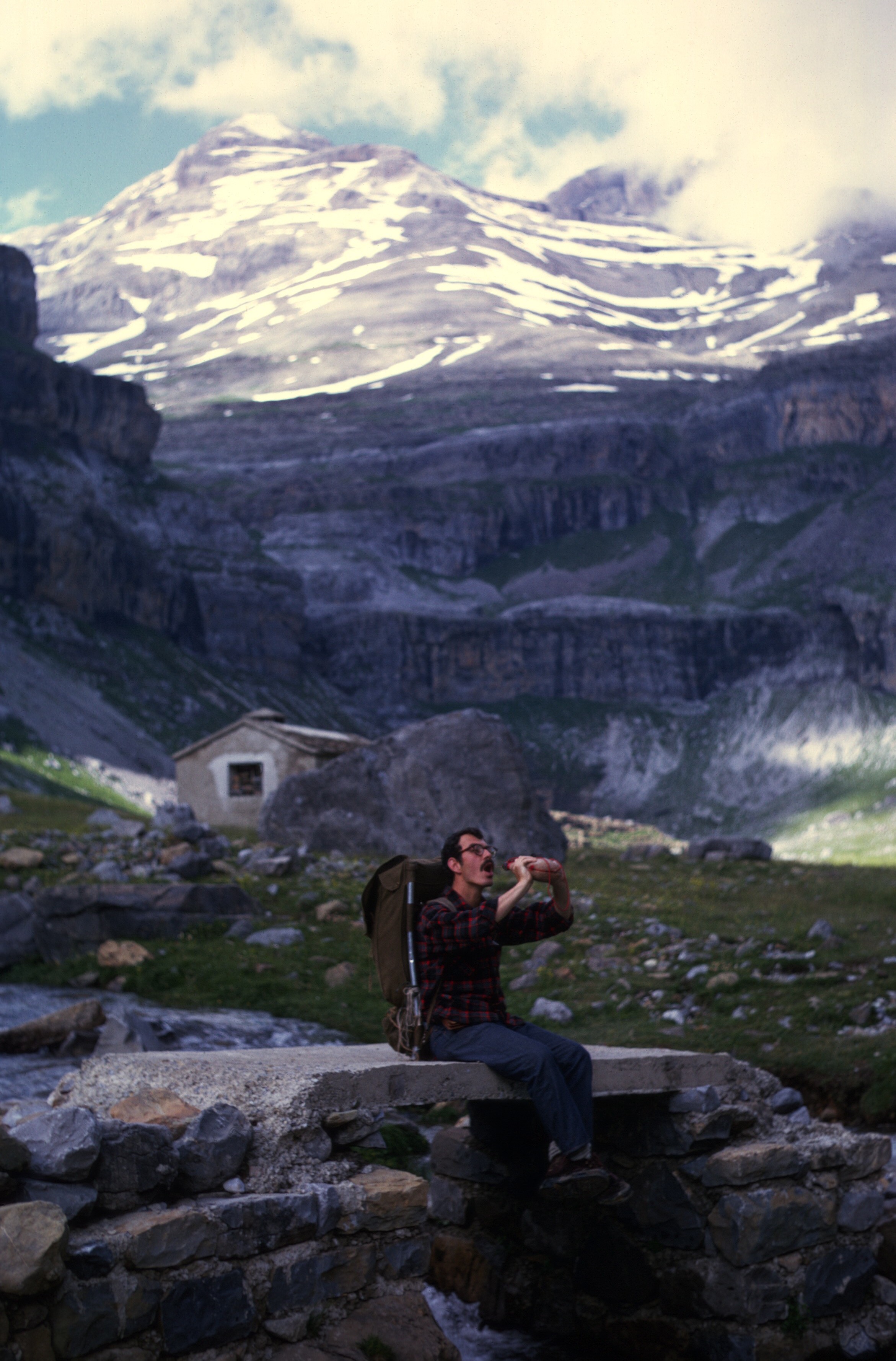
In Morocco with the Peace Corps, in the fall of 1968, Gaylord Barr and I had moved into a medina house, owned by a cloth merchant Moulay Abderrahman. He had a shop in Sefrou’s small kissariya. sefrou-medina

Sefrou medina. 1968 

Gaylord had been living in one of Mr. Andersen’s properties, high up the hill at the upper limit of the Ville Nouvelle, past the church, which still held services for a few French families. Andersen was an elderly Danish ex-patriot, with a twin brother in Fes. The little house was charming, but it had tadpoles in the drinking water and was a hell of a walk to the CT (centre de travaux) where Gaylord worked, and a worse one on the way back home. There were no stores or anything else nearby.

I had been living in a very basic house, built for the chicken co-op in the Habouna quarter, in the garden of an elementary school. house-in-garden

The garden, the house, and the coup. Habouna, Sefrou.


There was not much privacy there, and the house was cramped. When I returned from my summer vacation to Spain and France, I found Gay in my house watching the cat, and he suggested sharing a medina place. It sounded great to me, and somehow he found one quickly, just inside one of the city gates.

medina-house-door
Door to my house. Sefrou

Living in the medina had a charm for us. It was authentic, and traditional. Of course, the medina was slowly turning into a slum, but we didn’t really notice that. We liked the shopkeepers and neighbors. It was far more interesting than living in the Ville Nouvelle.

bab-house-1200
City gate. The house was just inside on the right?

The house had several rooms, a convenient location, and great views of Bouiblane to the southwest and the flocks of the kestrels which nested in the city wall next to the house.

medina-house
House from courtyard with Khadija and Gaylord and Merrycat. I took over the back room, Gaylord the front one.

There were shops all around, and it was an easy walk to the Bab Mkam where the grands taxis loaded passengers for the trip to Fes.mohammedie

Si Mohammedie, vegetable merchant. 1968

The election of 1968 looked bad for the Democratic Party. Johnson had decided not to run in the face of the growing unpopularity of the Vietnam War. Robert Kennedy had been assassinated, and the nation was on edge. Hubert Humphrey, good man that he was, wore the war, his president’s war, like an albatross around his neck. Nixon was offering a secret plan to end the war, and crack down on drugs and civil unrest. Of course, despite Nixon’s victory and his secret plan, the war continued on for six more years. We got Richard Holbrooke as country director soon after, a refugee from the Democratic Party wreckage. His major interest was Vietnam and editing Foreign Policy Magazine.
Our generation wasn’t fond of Nixon, and feared the worst. Living abroad, we had to vote by absentee ballot. I don’t remember mine, but Gay’s Washington State ballot featured some guy wearing a Hawaiian shirt and running on a platform consisting of a recipe for clam chowder!
It must have been cold. November was never a warm month in Sefrou. We had bought an old wood-burning cook stove in Fes and installed it in the room adjacent to the city wall, which served as a kitchen, though it had no running water. The stove’s flue didn’t draw well. Maybe the chimney should have extended up and over the height of the wall. In any case, the wood fire smoked upon the room, and the street below as well. I think the neighbors were happy we hardly used it. Eventually it went to Jan and Ruth, PCVs who moved into the Hajja’s next door in 1970.
Karin Carter, a former PCV was staying with us, though I might be confusing things. I remember her playing the guitar, and singing folk songs, but it could have been a different night. We had some lycée students over who had been friends of PCV Carolis Deal, who worked the co-op before I arrived. I only remember Aboudi, I think, because of his red hair and friendly personality, asking if one song was in Hebrew. It was, and I’m sure the students wondered if we were Jews, but to make a long story short, Karin, a fourth-generation Californian, admired Steinbeck so much that she modeled her college career on his and studied the Bible. There is a tape of her singing and if it is playable and, if I can ever find a reel-to-reel player, I will digitize it and add it to this recollection. Shortwave reception was poor in the kitchen. Maybe it was the weather. Maybe it was the thick city wall. In any case, there wasn’t any doubt about the results. The election was a disappointment, but life went on. The biggest change was that Peace Corps began supplying us with Time Magazine rather than the NYT News of the Week in Review, which we had been receiving. And eventually there was a lottery for the draft. I won a very high number. But for many others, the war continued on.

The roof of the Sefrou house was a great place in good weather. There were always animals: Aid sheep, turkeys, doves, and you could have tea or just get some air. There was a room there that we set up for guests, but it was cold despite the addition of a wood-burning stove for occasional use. We eventually abandoned it and used it as a place for the doves, which were in constant danger from one of the the cats. Later I set up a wood structure roofed with bamboo, which gave relief from the sun, but not necessarily from the flies.

The roof had a terrific view to the southeast, where the eastern end of the Middle Atlas Mountains was represented by Jbel Bouiblane, snow covered for half the year.

Joel Bouiblane, winter.
Jbel Bouiblane, winter

Kestrel hawks lived in the holes in the city wall on the other side of the house, where there was an abandoned garden. In the twilight they would turn acrobatic circles in the fading sun, before diving into their nest holes.

One summer evening, with guests at the house, we watched a major lightning storm over Taza, to the east. With every flash, the mountains south of Taza suddenly appeared out of the darkness, and then were gone. The storm was so far off we couldn’t hear the thunder. Over Sefrou there was no storm.

Collared dove.
Collared dove

Lillibullero

In the sixties, only well-off Moroccan families had TV sets, and broadcast hours and programming were limited. No Peace Corps volunteer whom I knew had a TV. Most listened to the radio. The choice of stations was limited, and depended on where you lived. In the northeast one could get Spain, Algeria, and, where or when reception was good, France. Moroccan radio, in literary Arabic, was too difficult to follow. Before the Internet, shortwave was the only choice.
While going to college, just before Peace Corps, I began to listen to the BBC World Service. I think it was because I had bought an old, wooden console style radio and record player at a garage sale where I was helping out someone with whom I worked at the reserve desk at Baker Library. I was living in a basement dorm room, and, to improve reception, strung a long wire antenna out my window. At the time, I was interested in Canada, and I also listened to the CBC and, once my French was good enough, Radio-Canada.
When I was selected for Peace Corps training, I bought the best shortwave radio I could afford. Shortwave radios were expensive in those days, and the one I purchased, a GE multi-band, wasn’t great at all, but it worked. In Morocco, I hardly used any bands but the shortwave ones. The best English language programming was on the BBC World Service. It broadcast 24 hours a day, and it kept Greenwich Mean Time, which was the time Morocco used. I could generally tune in on one band or another and get decent reception.

My bedroom, the multi-band radio, and the cats.

In those days, the signature tune for the World Service, played before the news, was Lillibullero, and it was played in more than one arrangement over the time period I listened to BBC. I really had no idea of the origin of the tune. Recently, I searched for more information, and found that the tune dates from 17th-century revolutionary England, and was also played by the Orangemen as a regimental tune, a history that must have given a pause to the Irish who listened to the World Service. For me, Lillibullero meant that the BBC World Service was about to broadcast the news, and the World Service had the best, least biased news. Assassinations and riots were shaking America, there were troubles in Northern Ireland, Rhodesia broke away from Great Britain, and the U.S., in the midst of the Cold War, was mired in Vietnam. Far from the U.S., I depended on Alistair Cooke’s weekly Letter from America to help me understand events such as Kent State, and the assassination of Dr. Martin Luther King, Jr., and, often, comfort my fears that the world was going to hell in a basket.
I also listened to a variety of other BBC programming: quiz shows, pop music, comedy, and short fiction from around the world, just to name a few of the categories. It was entertainment, but also an education. There wasn’t much else. I had a record player, inherited from former volunteers, and an eclectic collection of music: Simon and Garfunkel, some later Beatles, Bob Dylan, the musical Hair, Amal Hayati (Oum Kathoum), Judy Collins, and some 45s of current popular songs. Most of it was collected by Gaylord, who actually attended an Oum Kalthoum concert at the Theatre Mohammed V in Rabat along with a number of other volunteers from our group. I wish I had gone.

The BBC remained the mainstay of my entertainment as well as a major source of the news. Even today I have a great deal of affection for the BBC, which epitomized independence and integrity. If you’ve ever listened to the World Service, you know the signature, but for those of you who have never heard it, you can listen to it at this YouTube link  (Lillibullero).

If you don’t recognize the name, Oum Kalthoum, she was the grande dame of Arabic music, an Egyptian whose life was the subject of perpetual interest to her followers, and whose voice made her admirers cry. Amal Hayati is over an hour long, and you may just wish to hear a few minutes from an old TV broadcast to get an idea (Amal Hayati) from this YouTube link.

Kifta

Morocco Rabat Oudaia Casbah Tour Hassan Pano copy
Casbah of the Oudayas and the Bou Regreg, from the top of the Tour Hassan.

Rabat was about three and a half hours from Fes and Sefrou. It was the capital, and the Peace Corps office and U.S. embassy were there, so volunteers went there often. Rabat was also a pleasant place, urban, but not huge like Casablanca. It was fun. There were theaters, restaurants, big bookstores, historic sites, and, besides the volunteers and staff who lived in Rabat, there were always other volunteers passing through, and sometimes other friends, Moroccan and American. In 1968, there were direct flights to the U.S. from the airport in Salé, too, so most new Peace Corps volunteers arrived in Rabat.
Morocco Rabat Sale Ferry 2 copy

The water taxi across the Bou Regreg from Rabat to Salé. 1973

CTM buses were plentiful, running virtually every hour on the hour, and cheap, and, because the windows opened, they did not have that awful, stale odor that buses in the States had. The train took longer and was more expensive. Volunteers made the trip all the time for Peace Corps business, or en route to destinations south and west. I drove the road many times in my Peace Corps jeep. And I even hitched a ride once or twice.
About halfway to Rabat was the town of Khemisset. For Morocco X volunteers, it has a special significance. We were housed nearby at Tiflet for a couple of weeks, while we waited to be picked up and taken to the CTs (centres de travaux), basically agricultural extension stations, where we were to be stationed. It was January, and cold. The Tiflet center was in the country, and there was nowhere to go. There was jubilation when, after a week or so, the showers were finally turned on.
But the true significance of Khemisset, for me anyway, was its location, not as the chef lieu for the Zemmour tribe, nor as a temporary step on the way to my assignment, but as a great food stop, known for kifta and brochettes, on the way between Rabat and Fes.Morocco Khemisset Kifta copy

The kifta stand. Khemisset. 1968.

A line of stalls with charcoal grills served sandwiches. Seasoned with cumin and hot pepper, and filling a section of a round Moroccan bread, the skewered meat was terrific (though, it should go without saying, never as good as what I had in people’s homes.) Still, when one is on the road, a good truck stop is a special pleasure. I always stopped at the same shop, and bought food from the same guys, often enough that they recognized me, probably as the tall foreigner who spoke broken Arabic.Morocco Khemisset Brochettes copy

We always stopped here for brochettes. 1969.

Leaving Fes for Rabat, the road descended through a hilly, terraced landscape.

Morocco Cork Forest Zemmour copy
Mamora Cork Forest.

After Khemisset, it crossed the Mamora forest, the largest cork oak forest in the world, and, from that point, the road was straight and flat where it crossed the Gharb. Today the Mamora Forest is under siege. At the limit of conditions where cork oaks can grow, overgrazing threatens the forest, from what I have read, and it remains to be seen whether efforts by the government will be enough to preserve it. Other cork oak forests, such as that near Chauen, where I spent some happy times mushroom hunting with my friend Gilles Narbonne and his family, are doing better.
In the summer, the coast announced itself with humidity. It is always a strange sensation to leave a dry hot area and to find oneself suddenly in a humid, coastal climate. I had this experience at Bandar Abbas in Iran and Dakar in Senegal, but it was a regular part of living in the interior of Morocco. And mild as the coastal climate was, I always preferred the hotter, drier weather of the interior.
I had a lot of experiences on the road from Fes to Rabat. Once I had to wait for a bus, so I spent the afternoon with a friend, lost track of time, and carelessly missed the bus. Unfortunately, I had already checked my unlocked suitcase, which contained, among other things, my passport. Since I was destined for a medical evacuation flight from Keneitra to the U.S. Air Force base at Torrejón, outside Madrid, I figured I was in real trouble. I decided to see if I could beat the bus to Rabat by hitchhiking. I got a ride right away, by a young guy whom I assumed was French. I explained who I was in my best French, and the driver introduced himself in excellent French, and after a few minutes of conversation it became clear that he was an American, and, not only that, but a graduate of the same college as myself, but a year later. There’s more to the story, including a visit to the so-called secret military base in the Gharb at Sidi Yahia, but the gist of it is that we beat the bus and I was able to get my bag down from the roof rack before the bus pulled out for Casablanca.
Another time, Dick Moench, an anthropology professor at Binghamton University was driving me to Rabat. I had been in Sefrou for the weekend (at the time I was staying in Rabat or Salé), and had fallen seriously ill. We kept putting off getting gas for the little Renault 4 Dick had, and ran out of gas before reaching Khemisset. It was raining and cold. I think it was January or February and poor Dick had to hitchhike in the rain to get a bidon of gas.
Back in Rabat, I was fortunate to be taken in by Diane and Jerry Ponasik, who had a house in the Casbah of the Oudaïya, and I stayed there a couple of weeks until I regained my health. Morocco Rabat Casbah 2 copy

Casbah of the Oudaïya, Rabat.

And finally there was a time when Gaylord Barr and myself were riding the bus into Rabat, and he had needed a toilet so badly he asked the driver to stop. He signaled the bus to go on, and so it did, leaving Gaylord frantically looking for trees to hide behind! He easily got a ride in to Rabat a bit later. Moroccans were always great about giving foreigners lifts.

Sur le boulevard du temps qui passe

image
Gouraud Cedar, Gaylord Barr, and Peace Corps Jeep. All are gone today.

Ali Azeriah pointed out that Al Magrib Al Arabi no longer exists. That’s a small change. Add many small changes together and perhaps a place no longer is the same. From the census, we know that great changes have taken place in Sefrou. When I left in 1971, it had an official population of under 30,000, and was part of Fes Province. It was not a tourist venue, except for the Cherry Festival, which was primarily a local celebration. Was the Cherry Festival an artifact of French occupation, or dreamt up by the Moroccan Government? Morocco Sefrou Moussem Cherry Queen copy

Cherry Festival Float. Sefrou, 1968.

The first time I attended was in 1968, and is the only time I really remember the festival. I know that I was there for other ones, but the memories are less clear. Morocco Sefrou Moussem 2a copy

Cherry Festival. Dancers. 1968

Other PCVs came and stayed for some of them.
Actually, when I think of Sefrou, I think of the delicious strawberries that were grown in the irrigated gardens very close to the built-up area.Morocco Sefrou Strawberries copy

In the gardens of Sefrou, picking strawberries. 1968.

I imagine much of that is gone now. That’s often the case with explosive urban growth. Next to Los Angles is Orange County, California, and it was named for the orange plantations that used to be there. Most of those orange groves are gone forever, a victim of urban sprawl. Florida now produces most of America’s oranges.
One tends to assume things are still the same after 40 or 50 years. How foolish! Sometimes progress, or what passes for it, sweeps away the old, sometimes it is just time passing. We are all on the Boulevard du temps qui passe, the title of a Brassens song. I noticed that the Gouraud cedar is no more. I remember visiting it several times. Since it was several hundred years old, it certainly had a good run, but that doesn’t make me feel much better. I like the belief that those old cedars, some from before the time of the Prophet, may the peace of God be upon him, still stand.
I worry about Morocco. I have always worried about Morocco. I loved it the way it was, but I have always known the ecosystem was fragile, and that population growth would eventually stress it, just the way California has been stressed by development. That was something I learned in Peace Corps training in Hemet, California. Scarce water, rainfall irregular, thin, shallow soils, and beautiful forests disappearing through logging and charcoal production were a reality 50 years ago as they are now. California has just got a little relief from its long drought, but it isn’t clear where things will go there as climate change is added to the existing climate variables.
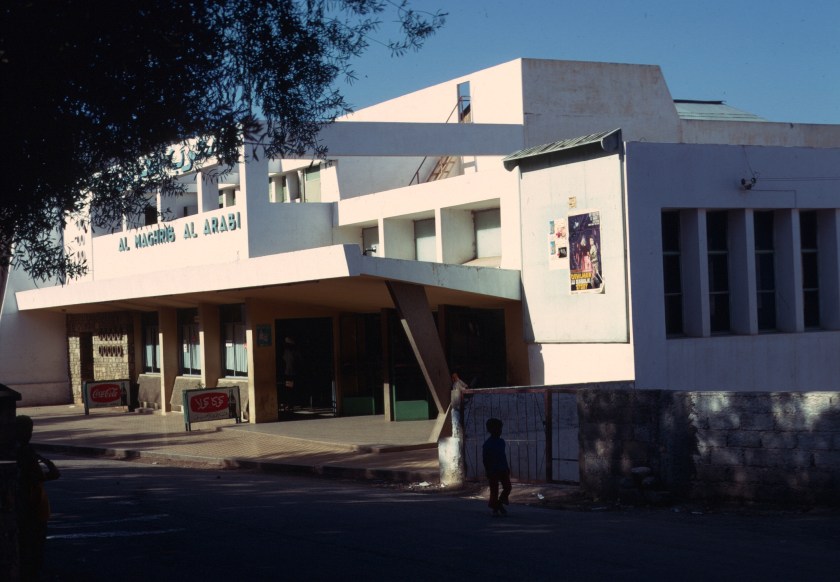
But I don’t want to sound like Edmund Burke, who regretted the decimation of the French aristocracy during  the French Revolution, but not so much the common people. Thomas Paine rightly reproached him for “Pitying the plumage, while forgetting the dying bird.” And thank you, Arthur Wilson, for using that quote in one of your history of political theory courses at college. I will never forget it!
The people I knew when I lived in Morocco were poor or lower middle class, and I knew people who died for lack of medical care and a great many who worked honestly to make just enough to get by. So please don’t accuse me of pitying the cedars and forgetting the people. The people took me in and took care of me. The cedars sheltered monkeys and boars.

Al Maghrib Al-Arabi

The Good, the Bad, and the Ugly

In the sixties, Sefrou had one movie theater, the Maghrib el Arabi, but it was great! On a hot summer night, the roof would retract, slowly and almost silently, and the cool evening air would pour in from a sky full of stars. I went to the movies whenever I could. I loved films, and, frankly, how many things could you do in a small provincial city where almost everyone went home to their families at night, tired from a day’s hard work? Not that the theater was an entirely respectable place. Now, whenever I watch the Italian movie, Cinema Paradiso, I’m always reminded of Sefrou, its movie theater, and the people I knew.

In those days the choice of films was mostly between Bollywood musicals and spaghetti westerns. Occasionally there was an Egyptian feature, beyond the comprehension of someone already struggling with Moroccan dialect,  and, sometimes, a recent American movie, and sometimes a classic. I remember watching High Noon, which for me was iconic and for my colleague puzzling, and, In the Heat of the Night, a contemporary drama about the civil rights struggle in the American South. The big cities had a much better choice of films. I saw Space Odyssey 2001 in the Theatre Mohammed V, not long after the film opened in the U.S. Needless to say, the Western movies were always dubbed in French.

But that was Rabat. In Sefrou, I still remember hearing, through the front windows of the house, the sounds of young men walking home through the empty street at night, a darkened medina street lit by an occasional street light, whistling the theme music from A Fist Full of Dollars (https://youtu.be/9uFlE1cO8Fc), and knowing they enjoyed it, but also wondering what they made of it. It was certainly more a part of their America than mine.

What makes us feel at home?

The CBS Evening News ended tonight with a feature on the harvest of argan nuts. Argan oil has become an exotic ingredient in soaps and cosmetics in the United States. I remember it as something the people of the Souss used in their cooking, and the goats in trees, which I have seen touristing in Morocco, just reminded me how unfamiliar and strange the Souss was to me, whereas any old picture of Sefrou feels familiar and comfortable as home.

Every student of French, from my generation at least, probably remembers “Nos ancêtres étaient les Gaulois,” the beginning text of a French history primer. Across the Francophonie, generations of young Africans and Asians must have puzzled over the history they were learning and wondered about its relevance.

Morocco Sefrou Miloud Soussi
Miloud Soussi, who had a grocery store in Sefrou. 1973.

When I left Morocco, the migration to Europe was important, and growing, and, possibly, changing from one of single male migrants, who sent back remittances to their families, to one of true emigrants who were taking their families and intending to settle down. If I am not mistaken, Moroccan migration to France dates from World War I, when a shortage of labour produced a temporary opportunity in the war industries.

Temporary migration of young men, for purely economic reasons, is a worldwide phenomenon, of course. In Morocco itself, the Swasa were well known for it (as were the Mzabis in Algeria and the Djerbis in Tunisia, also groups known for running small grocery shops.) Moving one’s family to France, however, is a different matter, and the calculus of considerations is more involved and deeper. Would one expect better treatment by the French after moving from a former colony to the métropole? Some migrants may be naive, but most know that their future may be difficult.

Many of my former neighbors did move to France, and I have since wondered often how they fared there. The younger, single migrants had a tough time, I am sure. I can remember, back in 1971, having a café au lait on a thoroughfare of the Left Bank, and, recognizing the waiter as a maghrebi, began conversing in Arabic with him. An Algerian, he was surprised and delighted to meet an American who spoke Arabic, and willingly suffered my poor command of Moroccan dialect to have a real conversation with me.

Just a few days ago, there was a short piece on NPR, which argued that part of the problem with the radicalization of disaffected Muslim youth in France can be partly attributed to the fact that these young men, born in France, could not identify with traditional French culture. French history has pretty much been a history of France till the Republic, with no role for Arabs, and containing little with which they could identify. Une histoire des autres, for sure. Furthermore, radio and TV do not often portray Frenchmen of Arab descent in high status roles such as doctors or scientists.

This makes me think of the sixties and seventies in America. At the time I served in the Peace Corps, African Americans were still fighting for rights that had been finally enshrined in law, but were not yet accepted by many white Americans. Part of the civil rights struggle involved building African American history and identity. At the time I thought some of the effort was forced and naive, but, after years of Black History months, black Americans and whites, too, have succeeded in creating a common history, ratified by popular textbooks. Perhaps “succeeded” is too strong a word, but back in the sixties I was a young, white, and ignorant of most things black, I knew more about La révolution tranquille in Québec than civil rights in Selma, Alabama. Slowly, but surely, African American history has developed and merged with mainstream American history. Today, American TV regularly portrays African Americans in positions of power, trust, and authority as does the American movie industry.

Culture usually includes a common, shared history, and those French, who are children of Arab migrants in France (or Arab migrants elsewhere in Europe), need to have a sense of their own place in their country’s history as well as society today. Lacking connections leads to alienation. The colonial history of France and the history of migrants is not a pretty one, but many North Africans served in France’s armies and contributed to France in other ways. In the U.S, with a history of slavery, the KKK, Jim Crow laws, and the violence and continued discrimination against Blacks that continues today, history has been rewritten. France has at least been largely free from the American kind of racism, where color bias is so strong that it has been compared to caste.

Efforts by academics in the U.S. to forge a world history are ongoing, and though plagued by the usual problems of the social sciences, they have been met with some success. European History, as taught in high schools and colleges, and sometimes presented as Western Civilization, used to be referred to derisively as “the history of old, dead white men.” World History advocates have challenged that perspective head on, including women’s gender roles and regional histories that eschew the North Atlantic perspective. The French speaking world, too, may need to work to create broader, more inclusive histories, and the effort should not be assumed to be a uniquely French one. Perhaps it is time for the French, and all of Francophonie, to revisit history, and find a place for the new generations who will repopulate Europe.

Walls

Something there is that doesn’t love a wall

I was first taught the poetry of Robert Frost in eighth grade, and watched him in 1960 at the Kennedy Inaugural, before I went off to New Hampshire and learned more about Frost firsthand. Over the span of my life, I have come to appreciate his poetry more and more. Mr. Trump would do well to reread The Mending Wall, and think about its message.

When I lived in Sefrou, the house I lived in abutted the city wall. When I looked through my bathroom window, I looked through the masonry wall of my house and then through four or five feet of the rubble that made up the city wall. Just outside my front door (an impressive wooden one with iron studs, a brass knocker, and a smaller door within the main door), was one gate of the wall. If the city were to be attacked, defenders could close the gate. This system worked pretty well in Europe until the time of the 100 Years War, when cannon and blackpowder made walls obsolete. In the four years I lived along the wall, the gate was never shut. The time of bled es-siba had long passed.

The gate by my house (just inside to right.) Liz Carpenter, Lady Bird Johnson's press secretary and daughter, 1969. My bathroom window is extreme upper right.
The gate by my house (just inside to right.) Liz Carpenter, Lady Bird Johnson’s press secretary and daughter, 1969. My bathroom window is extreme upper right.

Next to my house was a garden that also shared the wall, and created an open space between my house and the next house built along the wall. The garden was not cultivated or used for any purpose. From my rooftop one could see the whole inside face of the wall. It had holes that in other times were used to hold scaffolding that had been used to build and repair the wall. In the holes lived kestrel hawks, and in the late afternoons they would return from hunting and fly in graceful circles before entering their nests and going to sleep for the night. It was a pleasure to watch them. Looking in the opposite direction, toward the southeast, the snows of Jbel Bouiblane caught the same rays that illuminated the hawks.

In the past, not only cities had walls, but empires had them, too. The Roman Emperor Hadrian built a wall right across England to keep out the northern barbarians, today known as Scots. The Chinese built the Great Wall stretching miles and miles across northern China, and furnishing a name for endless Chinese restaurants. The Sultan Moulay Ismaïl, surrounded his capital, Meknes, with 25 miles of walls, some built by slaves. Modern empires have walls, too. Israel has erected what it calls a “separation barrier” between Israel and occupied Arab territories, but I think the word “wall” describes it better. The East Germans built a wall to separate the Soviet-controlled part of Berlin from that of the West. Walls never seem to go out of fashion, whether they are effective or not. Something there is in politicians that makes them want to put walls up, and wall people in or out, or even, sometimes, both.

It was strange to hear the presumptive Republican Party candidate, Donald Trump begin talking about building walls. The height of Trump’s wall depends on what speech he was making and varies, but in one of his last speeches, the wall reached 55 feet! Trump says he will build it along the Mexican border, and that the Mexicans will pay for it. They say they won’t, of course.

One of Trump’s early Republican competitors, and now a political ally of Trump, Governor Scott Walker of Wisconsin, has said that a wall on the Canadian border has to be considered, too. Well, I can sort of understand that. Canada is the only country that has ever beat the United States in a war, and, even if the Canadians aren’t very bellicose these days, we all know that they spread dangerous ideas such as socialism and national health care and poutine. Where I live, a chain of doughnut shops named after a Canadian hockey player, is taking over the fast food market. The Canadians even have two official languages, a really bad example for the United States, which doesn’t yet even have one. And while the United States has yet to make good on its pledge to take in 2,000 Syrian refugees, the Canadians have already accepted 25,000 and are ready to take in another 25,000!

All the cities of Europe once had walls. Most were demolished to provide room for urban growth and expansion, often replaced by a ring road such as the one surrounding Paris, where exits bear the names of former gates in the wall: Porte d’Orléans, Porte d’Auteuil, Porte de Clichy, etc. In smaller towns and cities, walls still stand as tourist attractions, and some such as those at Aigues Mortes represent unique examples of medieval military architecture.

In Morocco, the French colonial policy of building new towns separate from the existing Moroccan cities resulted in the preservation of old city walls, and many cities have them. For me, one of the first views of Rabat was crossing the Bou Regreg and seeing the walls surrounding the Casbah of the Udayas. The walls of Fes, Meknes, and Marrakesh are grandiose, but the walls of Sefrou are special to me. I would get out of a Grand Taxi across from the Bab elMkam, coming home from Fes after work, and walk along the streets outside the wall until I reached the gate outside my house, past the store owners and shopkeepers who were also my friends ad neighbors.


Beyond Maude Cary and Al Jessup

When I began the blog, I chose the Book Locker and Mme Miss Terri as subjects because the first was iconic, and the second was indicative of how we Peace Corps volunteers were struggling to make some sense of our surroundings, where things might not have always been what they seemed to be.
The book lockers faded away as the card board containers molded and broke, and, perhaps, because they may have represented a sharing of contemporaneous literature not universally admired. In 1968, the political winds blew through the Peace Corps offices just as they did everywhere in America. After the election of Richard Nixon in 1968, the New York Times Week in Review ceased arriving and in its place was Time Magazine.

IMG_2364
Don Brown, Dick Holbrooke 1970

Eventually we even got a political refugee, Richard Holbrooke, whose stated ambition, on one occasion anyway, was to drive along every paved road in Morocco. I don’t think it’s likely that he did that. There were a lot of paved roads in Morocco down which Peace Corps work didn’t take you. His interest was Vietnam, of course, and his second language was French. His knowledge of the French song was limited to Aznavour and I was smitten by Georges Brassens, so there was no meeting of minds there, and while I did like Aznavour, I doubt Dick even knew who Brassens was. We did not hit it off. He was impressed that I was an Ivy grad, but that didn’t hold much interest for me. I thought he was ambitious and shallow. He was ambitious. Others who knew him better can judge his intellect. But in fairness to Holbrooke, he went on to broker the Dayton Peace Accords, and halt the genocide that consumed the Balkans in the early 1990s.
This long digression ends with its primary subject, the mystery women who was no mystery to the Moroccans among whom she lived, and her successor, Al Jessup. None of us Peace Corps volunteers had any interest in spreading Christianity in Morocco. Most of us did not practice our own religions. A few volunteers even converted to Islam! We were in Morocco to help the country any way that we could, but our jobs had nothing to do with religion.
I have noticed, after writing my blog entries about Maude Cary, that American evangelicals have been pushing hard, trying to spread “la Bonne Nouvelle” in Morocco. Under the French Protectorate, there doesn’t seem to have been much of an effort to spread religion. France was a secular state, and it deferred to the nominal ruler, the sultan, as far as religious matters went. France wanted peace and had no interest in provoking any kind of unrest. Some French religious orders ran schools, orphanages, and training centers. After independence, the GOM discouraged missionary activities. The Maude Carys and Al Jessups faded away.
Today, however, American evangelical organizations are mounting an effort to enlarge the sphere of their missionary activities, and enlisting Congressmen to pressure the U.S. State Department. The U.S. Administration views missionary activities as contrary to the wishes of Morocco, and has not supported their requests. Morocco is a long standing ally of the U.S., with which it has enjoyed good relations for many years.
This is a tempest in a teapot, but reflects the rise of the religious right in America, and active attempts to reverse the traditional secular orientation of the U.S. Government. I find it extremely ironic that Americans are so frightened by extreme fundamentalist Islamic organizations, while ignoring the promotion of religious agendas at home. Unlike Morocco, which is almost homogeneous in its religion, and is headed by a ruler who claims the title Commander of The Faithful, the U.S., a nation of many immigrants, has a diversity of religious beliefs and a Constitution which forbids the establishment of an official religion.