
Anyone who has taken the A10 road from Marrakesh to Taroudant—and many tourists and Peace Corps volunteers have made this journey—has passed the Almohad mosque at Tinmel.
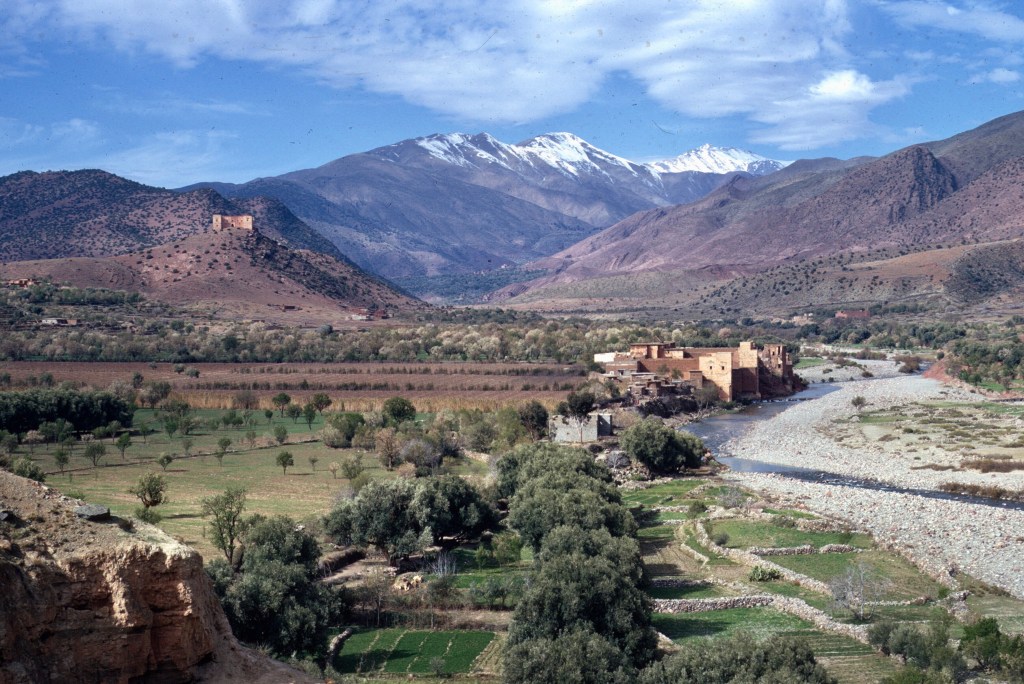
Filled with religious passion, the Berber tribes of this region swept out of their mountain fastness in the twelfth century and quickly conquered the empire of their predecessors, the Almoravids, extending their own control to most of Muslim Spain. Ibn Tumart, the dynasty’s founder, has been compared to St Bernard, founder of the Cistercian order of Catholicism. Puritanical, the Almohads ruled strictly, but as they settled down into urban centers, their own dynasty slowly was transformed by the cyclical process described by Ibn Khaldun, whose writings are precursors to modern historical and sociological inquiry.

During the time of their rule, the Almohads built three great minarets, the Koutoubia in Marrakesh, the Tour Hassan in Rabat, and the Giralda in Sevilla. These structures manifest grandeur, not only by their size, but by their simple but harmonious decoration.
The Almohads have left many monuments across North Africa and Spain, but the one that spoke to me most eloquently was the mosque at Tinmel. Human in scale, simple yet elegant in decoration, the mosque overlooked the birthplace of the dynasty, and was in the distant past a place of pilgrimage.

Although both the French and the Moroccans put some effort into its restoration, the mosque at Tinmel, just 6 kilometers from the epicenter of Morocco’s recent earthquake, did not survive. A thousand years of art and history perished in a moment.

Still, bemoaning the loss of this monument should not obscure the human loss of the most recent tragedy to befall Morocco. There was a village at Tinmel and my deepest sympathy goes out to the villagers of Tinmel as well as all the others of the region.
I have written elsewhere in this blog, and at more length, about Almohad monuments, and I beg the reader’s indulgence for the brief repetition. Morocco has a special place in my heart and the recent tragedy is truly heartfelt.
If you would like to know more about Tinmel, here is a link to a recent article from The Conversation, and an article from the New Yotk Times on the Tizi n’Test road.

 Morocco That Was
Dear Dave. I am an artist and friend of Peace Corps living in Sefrou. In addition, I am part of a relatively young association, SAMA, that focuses on Sefrou development ( economically, socially and environmentally) by co presenting an arts and culture program. Our area of activity is Sefrou medina and we always work under the theme of the local Multicultural heritage with the aim and strengthening a sense of belonging building in Sefrous future. As a quick intro I wondered if we may talk over zoom briefly to see if there is any interest in you contributing to our projects in the form of images which I see you have of sSefrou some 50 years ago. Many thanks for the blog and sharing your experience ces. Warm wishes Jess stephens ArtistCulture Coordinator.
Sent from Yahoo Mail on Android
LikeLike
Thank you, Jess. I will be in touch soon
LikeLike
https://mail.yahoo.com/d/folders/1/messages/32428
LikeLike
This is one of many ways to help with the earthquake relief.
LikeLike
It’s posts like this that will keep the memory of the mosque alive. Thanks for posting.
LikeLike