
Much of the northern hemisphere has experienced the hottest summer ever recorded. Indeed, as I wrote this in mid-October, a heat wave continued in Europe and Great Britain, and an extreme drought had caused a host of problems there. Here the temperature was 70°F.
Fifty years ago, when I was a graduate student, the world had more traditional climates and less extreme weather, but some scientists were already beginning to worry about the effects of greenhouse gases in the atmosphere. There were, of course, some extremely hot places even then.
In mid-summer of 1974, my travels in Iran took me to Bandar Abbas, an old port city near the mouth of the Persian Gulf. I arrived there by bus from Shiraz, where I had spent several days exploring the city and visiting Persepolis and the University of Pennsylvania archeological dig at Malian.

I was the only foreigner on the Shiraz bus, which drove through the night to avoid the scorching summer heat of the Iranian plateau. Most of my fellow travelers slept or listened to religious sermons on their cassette players. The Shah was still in power, but taped sermons were quietly, persistently, eroding his legitimacy. I dozed off and slept for much of the 8-hour journey. I awoke in the dawn hours as the bus descended to the gulf city of Bandar Abbas.

Within minutes, the hot, humid, suffocating atmosphere of the Gulf replaced the dry air of the plateau. The sensation was dramatic.
Though I did not remember it then, I now recall an introductory geography course taught by Professor Huke at Dartmouth. The class was large for the college, and the students, unless they loved geography, used it to fill the liberal arts distributive requirements. I took away very little from that class, apart from one of Huke’s off-color jokes, how inexpensive sea transport was, an anecdotal comment on Buddhism, and, what I remember most, the disparagement of Wengener’s theory of drifting continents. Plate tectonics was about to shake the scientific world, but the theory had yet to be widely accepted by geologists and geographers in the autumn of 1964. The continents really were adrift, though not quite as Wengener thought.
I also remember that the class, mostly white children of privilege, had a retired Navy man. He was Black, in his forties, and returning to school for a degree. Professor Huke, a former Marine, called him Chief and treated him fraternally as befitting a fellow member of the military.
Students were sometimes offered the chance to give presentations to the class. I gave one on transhumance in the Pyrenees after I had returned from France in 1966. I remember the Chief speaking about his service in the Persian Gulf. He had traveled the world and declared that the Gulf was the hottest, most uncomfortable place he had ever visited.
While in Iran, I spent three days in Bandar Abbas. An anthropologist whom I met at the American Institute in Tehran had given me the address of a former Peace Corps volunteer there. I contacted him. He had quit the Peace Corps and taken employment with a naval construction company. He kindly put me up at his traditional house and introduced me to his coworkers. I was quickly invited to dinner and their late-night card games. There was not a lot to do for non-Farsi speaking Americans in Bandar Abbas.
Except for the ex-volunteer, all lived in an air-conditioned compound. His traditional courtyard house was hot, humid, and stuffy.
The Chief had not exaggerated the heat and humidity of the Gulf. The temperature that August was 100° or more Fahrenheit with a humidity in the mid nineties. The heavy atmosphere stifled me. My very least effort led to profuse sweating, and the sweat clung to my body, never evaporating, never cooling. The feeling was an unrelieved clamminess, but from heat rather than cold.
On my last day there, I took a motorized dhow to Qeshm Island. Only there on the boat, on an open deck, on the waters of the Gulf, did I at last feel comfortable. The warm sea breezes were refreshing and cool compared to the stagnant, heavy air of Bandar Abbas. The passengers were congenial. Masked women smoked a water pipe and chatted quietly.
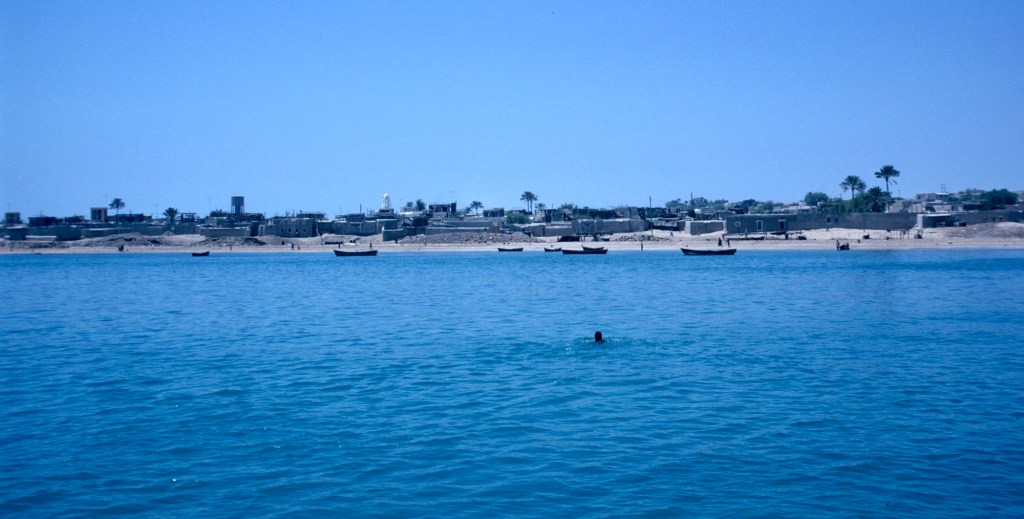
Qeshm Island, a kid dived in to help guide the boat to the dock. 1974
I met a Persian engineer, one of many Persians whom I encountered on the trip who had studied in America. Friendly and speaking excellent English, he invited me to stay in a guest house for Iranians working on projects on Qeshm, as there were no other accommodations. I thanked him, but declined. Now, in retrospect, I wished I had accepted the offer, but at that time I needed to return that same evening as I was leaving Bandar Abbas early the next morning.
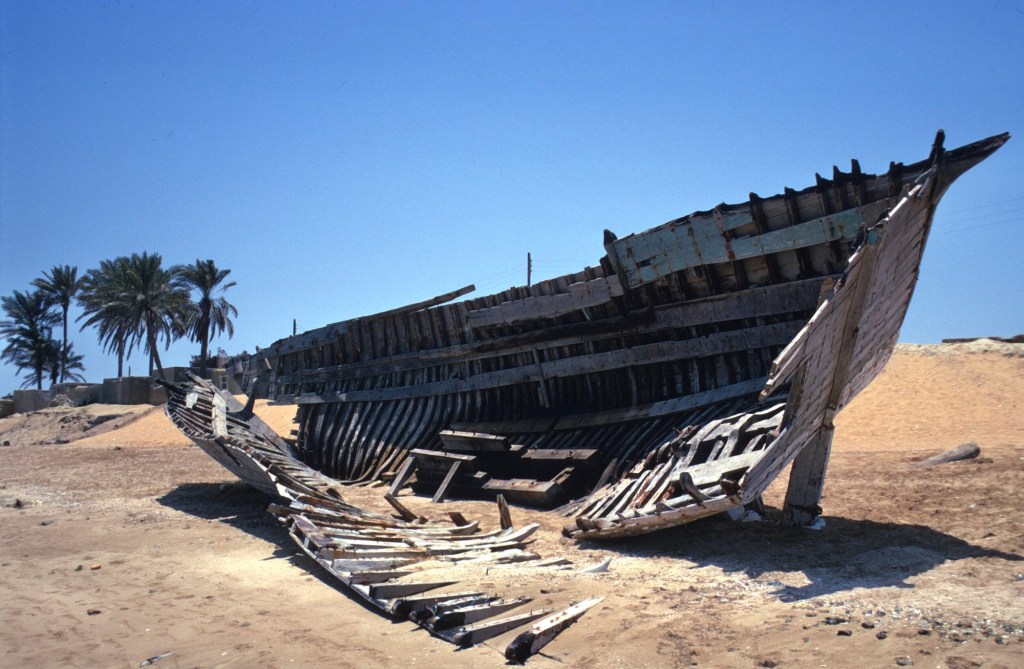
My schedule was tight, with much more travel in Iran ahead, and, at the end of the summer, a long train ride back across Turkey to Istanbul. Delays might mean that I’d miss my flight home from Istanbul, and, on a skimpy, student budget, that was simply something that I could not afford.

A recent newspaper article elicited these memories of my Gulf visit. Qeshm Island has just had the dubious honor of experiencing one of the highest heat indexes ever recorded anywhere, 158° F (70° Celsius.) Last year even higher levels, up to 165° F (73.9° Celsius), were recorded in July on the island.
I had lived in Morocco and traveled extensively there in the summer, but had never experienced heat like that of Bandar Abbes, where extreme temperature and humidity were combined. At the Ministry of Agriculture in Fes, where I worked, summer hours sometimes provided for early starts and long afternoon breaks, but the dry heat was manageable, nothing worse than what one used to find in Spain away from the coasts. My biggest problems were what to do with a four-hour lunch break and how to find a ride home, when work finally ended at seven p.m. and the last bus from Fes to Sefrou had already left.
Sefrou, where I lived, sat a thousand feet higher than Fes, and was more temperate than Fes, with occasional cool Middle Atlas breezes and many clear nights when the heat radiated back into the sky.
Humidity prevailed along the coasts of Morocco, but the heat was seldom excessive, especially along the Atlantic coast which benefitted from cool ocean currents. A summer in Washington was far more unpleasant than one in Rabat.
These days, with one’s own senses, you need not be a prophet to divine the future. Some in America continue to deny that the climate is changing, though the weather this year has brought new extremes and more powerful storm events, all fueled, the vast majority of climatologists agree, by the increasing energy in the atmosphere. I am encouraged by the fact that a majority of Americans now accept the scientific view that climate change is real, but the big oil companies and their shills have done their damage and the delay in coordinated government action around the world almost ensures that there will be a climate crisis by the end of this century, if not well before.
Having tasted heat, I agree with Robert Frost, that given a second choice, ice might be nice. Alas, there are no second chances once you are extinct, and there’s not likely to be much ice left in the near future anyway.
Robert Frost
Some say the world will end in fire,
Some say in ice.
From what I’ve tasted of desire
I hold with those who favor fire.
But if it had to perish twice,
I think I know enough of hate
To say that for destruction ice
Is also great
And would suffice.

 Morocco That Was
Great Blog -thanks. Did you ever know Rom Landau when you prepared for Morocco?
Did he speak with a British or Polish accent? on 2nd March there is to be a short ceremony of Laying Flowers on his grave in Marrakech to commemorate the 50th Anniversary of his death in that City.
Regards David Denison info@romlandau.org www.romlandau.org
LikeLike
165 degrees F? Wow, that’s hot. I am no climate change denier, but do recognise that the planet has been through many extreme changes in climate and ice caps have melted and invaded before. Cometary impacts have changed the climate in a very short space of time. But now it’s us who is in the role of destructive force. Sea levels have risen and receded even in the past tens of thousands of years and there are many discoveries of human civilisations being revealed which have been under water since before the last ice age. We are very small and recent in the timescales of the Earth, who may give a sigh of relief when we make the planet uninhabitable for humans. In general, our species in just too greedy and self-interested to stop ourselves from ending it all badly. It should be so simple: let’s stop trashing the planet and the fellow creatures we share it with… but due to our nature/leaders we aren’t managing to do that too well. I am not optimistic.
LikeLike