La Fête des cerises

Récemment un lecteur marocain de ce blog, qui m’écrivait de l’Alberta, m’a demandé si j’avais des photos que je pouvais partager de la fête des cerises.

Le Maroc, spectaculaire par sa beauté naturelle, est également un pays de spectacles. Quant à moi, le festival folklorique de Marrakech vient immédiatement à l’esprit, ainsi que les diverses célébrations de saints hommes et de confréries religieuses. Ceci étant dit, il existe au pays de nombreux festivals plus modestes et moins connus. Parmi eux, le festival des cerises de Sefrou, dont le premier date de 1920, est le plus ancien.
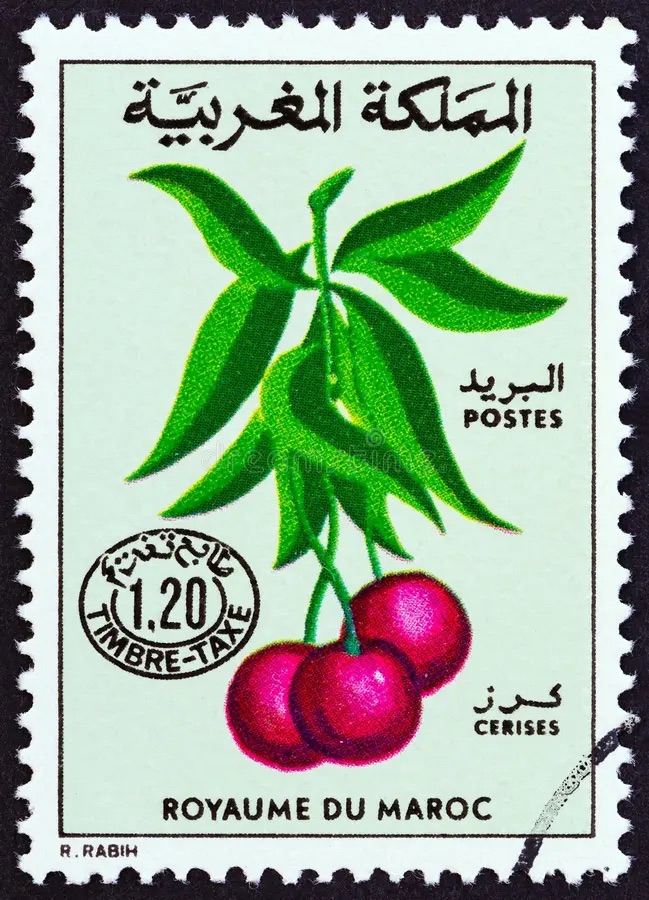
Sefrou, à seulement 28 kilomètres au sud de Fès, possède l’une des fêtes locales les plus connues, la fête des cerises. Cette ancienne ville, très proche de Fès, est traditionnellement le dernier endroit véritablement urbain au sud de Fès, sur une route autrefois connue sous le nom de treq es-sultan, soit la route du roi. Une grande route suit l’ancien itinéraire des caravanes, traversant le Moyen Atlas, descendant dans les plaines de la haute Moulouya, puis remontant pour traverser le Haut Atlas et aboutir à Tafilelt, berceau de la dynastie alaouite, à l’extrême limite du Sahara. Aujourd’hui, les touristes empruntent cette route pour atteindre les impressionnantes dunes de sable d’Erfoud, et les camionneurs transportent leurs cargaisons de produits manufacturés, de dattes et de safran vers et depuis Fès, en bravant les routes glissantes et enneigées des plateaux du Moyen Atlas.

Table d’orientation palais jamaï Fes : Cette table d’orientation, objet typiquement français, se trouvait dans les jardins de l’hôtel Palais Jemaï, sur les hauteurs de la ville de Fès, et indiquait les points de repère importants vers le sud. Une vue de l’Oued Agaï représente Sefrou, mais après l’inondation de 1950, la ville aurait pu être mieux symbolisée par ses jardins–ou ses cerises.

La ville, qui abritait autrefois une très importante communauté juive, est aujourd’hui visitée par de nombreux touristes juifs depuis l’établissement de relations diplomatiques entre le Maroc et Israël. Il existe plusieurs sites Internet consacrés aux Juifs de Sefrou, et la ville elle-même remonte à l’époque de la fondation de Fès, ou peut-être même plus tôt.

« Une ville enfouie dans les arbres » Carte postale ancienne avec une partie de la Kelaa au premier plan à gauche

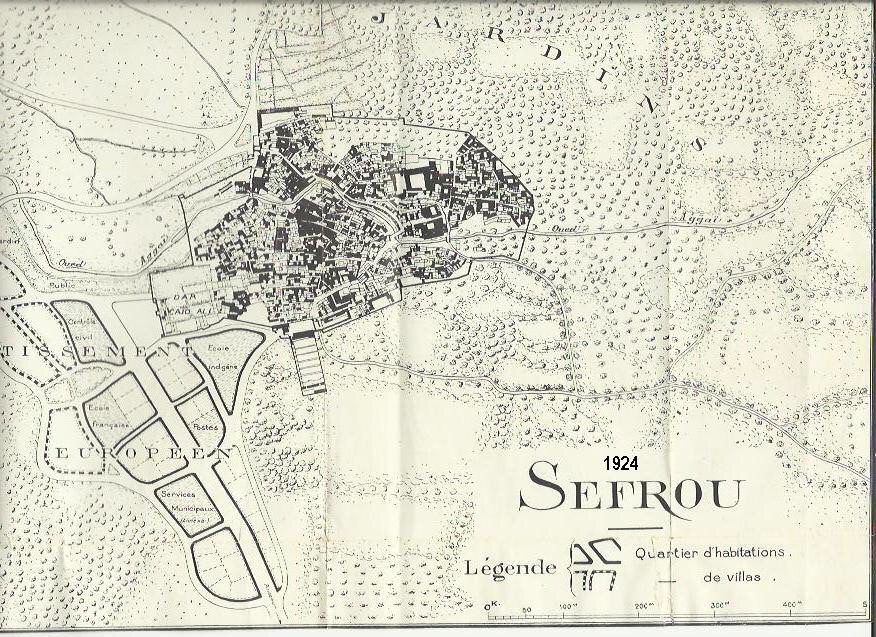
Un plan ancien de Sefrou montre presque toutes les structures de la ville enfermées derrière son mur défensif. Les Français développaient la zone située à l’extérieur du mur, à l’ouest, pour eux-mêmes. Ma maison, à l’intérieur du mur, n’avait pas encore été construite et son emplacement était encore un jardin. Plan de la ville de Sefrou. 1924

Peu de temps après mon installation à Sefrou en 1968, j’ai assisté pour la première fois à la fête des cerises de Sefrou. Gaylord Barr se trouvait déjà à Sefrou, où il travaillait à l’un des centres de travaux agricoles du ministère de l’agriculture, et Jerry Esposito enseignait l’anglais au lycée qui venait d’ouvrir, bien que Jerry ait peut-être déjà terminé son service et quitté le pays en juin. Carolis Deal et John Abel, qui avait initié dans une école primaire le poulailler dont j’ai pris la responsabilité, étaient eux aussi déjà partis.

Plusieurs autres volontaires se sont pointés à Sefrou pour participer cette année-là : Phil Morgan, Marc Miller et Steve Boeshar. Gaylord Barr, Marc Miller, et Phil Morgan, tous volontaire au sein de la cohorte Morocco X. 1968

La proximité de Sefrou avec Fès et la facilité d’accès ont fait du festival des cerises une attraction régionale majeure et, comme des volontaires demeuraient déjà à Sefrou, trouver du logement n’a jamais posé de problème.
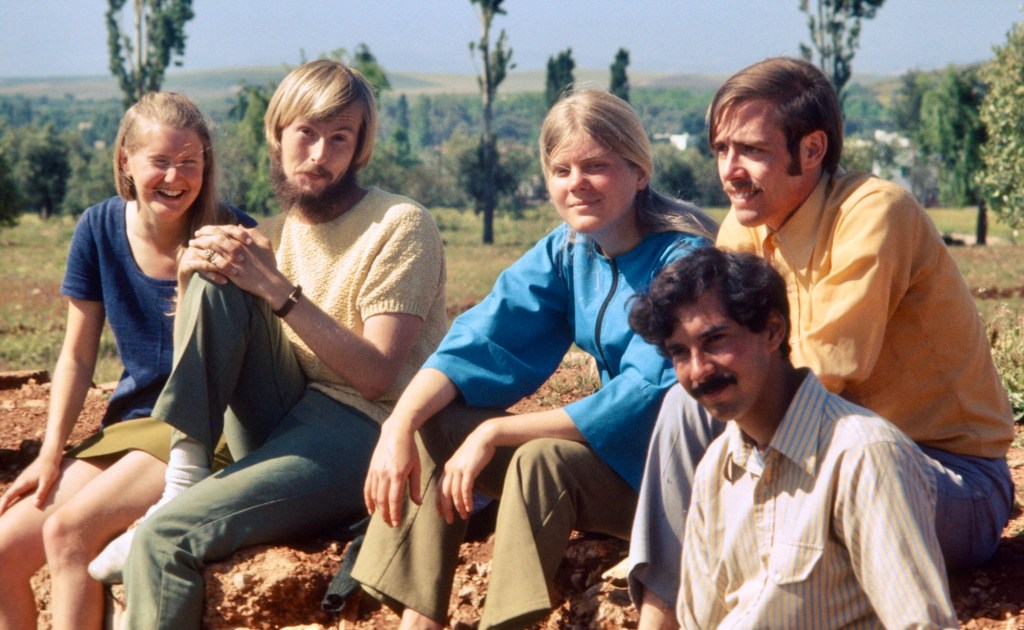
Jan, Ruth et Gaylord ont tous trois enseigné l’anglais au lycée. Pendant le festival de 1970.

Je ne savais pas grand-chose de cet événement, si ce n’est qu’il mettait en vedette les cerises. Les Marocains appellent les cerises hab el-moulouk, ce qui signifie l’amour des rois, et la variété locale, el-beldi, est réputée pour être particulièrement sucrée et savoureuse. Sefrou occupe une dépression montagneuse à une altitude suffisamment élevée pour que les cerises y prospèrent, mais la ville comptait de nombreux autres fruits et légumes dans les anciens jardins qui l’entouraient. Dans les vergers qui entouraient la ville, poussaient des oranges, des grenades, plusieurs variétés de figues et de nombreux oliviers. Personnellement, j’ai préféré les fraises locales aux cerises.
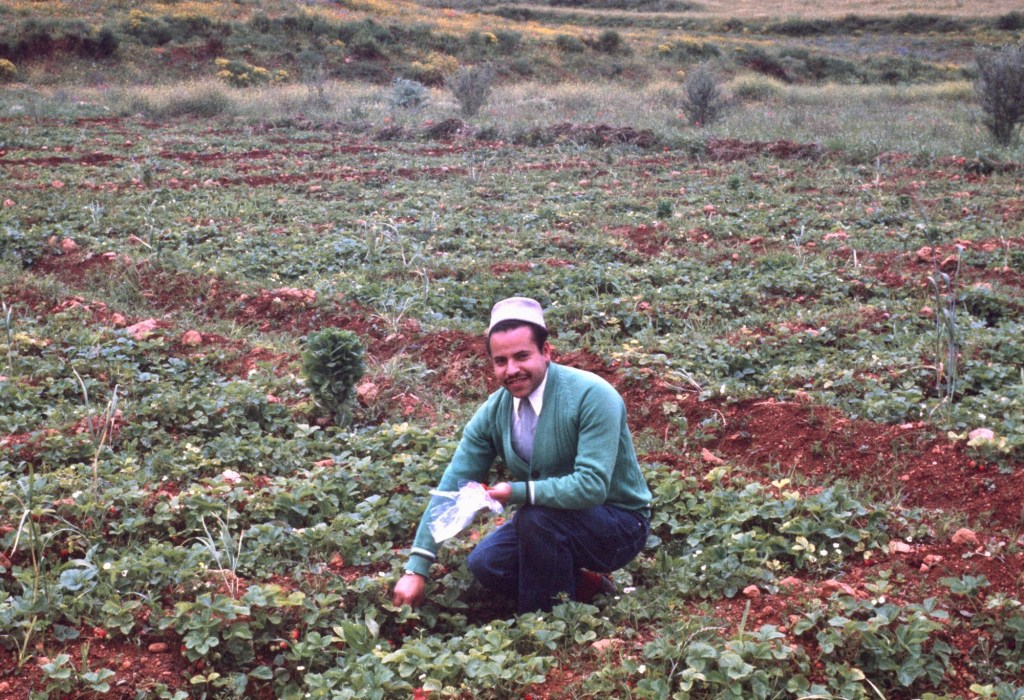
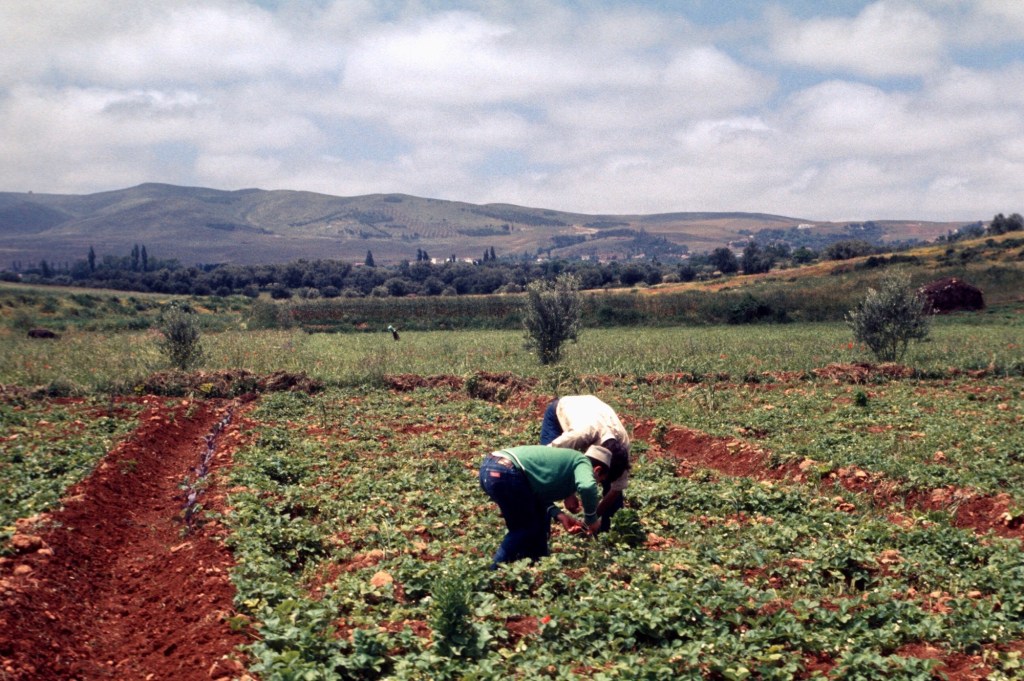
Cueillette de fraises au printemps. 1968
Ce champ se trouvait seulement à quelques minutes de marche de la médina. 1968
Cueillette de fraises avec Mohammed Chtatou et Ali Azeriah. À noter les oliveraies. 1970

De nos jours, la population de la ville a connu une augmentation fulgurante, doublant depuis l’époque ou j’y ai vécu, et la zone bâtie s’est étendue bien au-delà des murailles de la vieille ville. Cette croissance a surpris Gaylord Barr qui a fait un arrêt à Séfrou lors de son retour de l’Arabie saoudite en 1997. Dans mon souvenir, les zones extra-muros, à l’exclusion de la ville nouvelle, se limitaient essentiellement aux quartiers de Derb el-Miter, Habouna et Seti Messaouda. Je fais cette digression sur la démographie et l’urbanisation de Sefrou avant l’étalement urbain pour souligner à quel point il était facile de sortir de la médina et, en quelques minutes, de se retrouver dans les jardins qui entouraient la ville. Le vendredi, les femmes se promenaient en groupes, leurs petits enfants à la main, pour pique-niquer dans les vergers, manger des fruits frais, prendre l’air et, bien sûr, bavarder autour d’une tasse de thé. J’ai apprécié la proximité de la campagne et je faisais fréquemment des promenades au village avoisinant de Bhahlil, célèbre pour ses habitations troglodytiques.
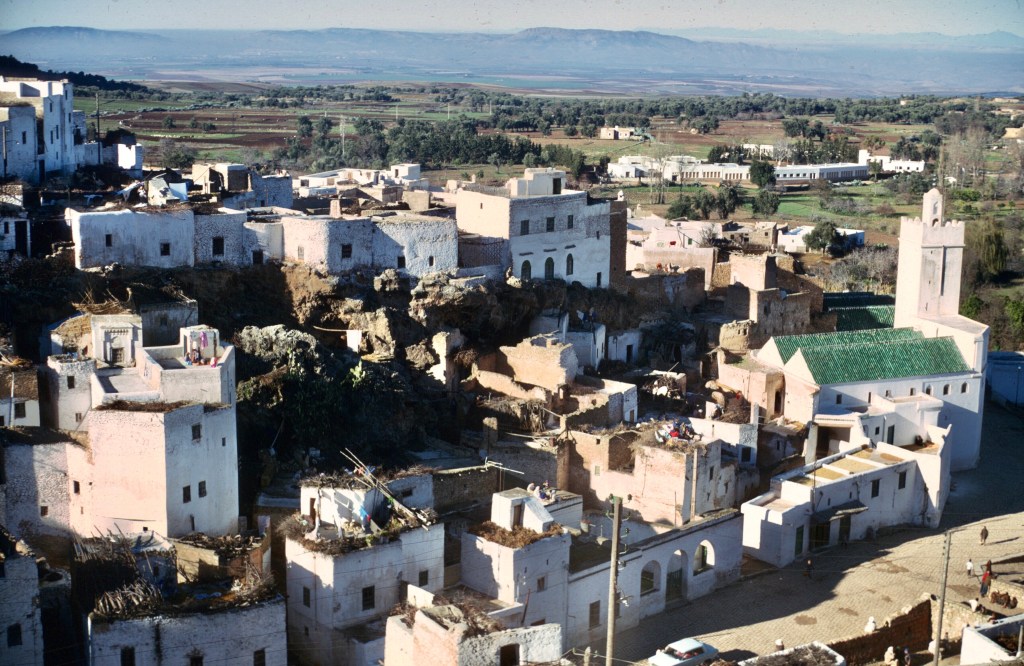
Vue du village de Bhalil vers le sud, en direction de la plaine du Saïs et de Fes. 1969

Promenade aux jardins, le long du mur de l’ancien cimetière juif. 1969

On parlait de Sefrou avant l’inondation. Je me demande s’ils parlent aujourd’hui de Sefrou avant l’étalement urbain, l’époque où tout le monde, à l’exception des riches, des puissants et des étrangers, vivait dans la médina et autour d’elle. Les jardins et les vergers de Sefrou caractérisaient la ville à cette époque, et les voyageurs la comparaient parfois à une oasis.
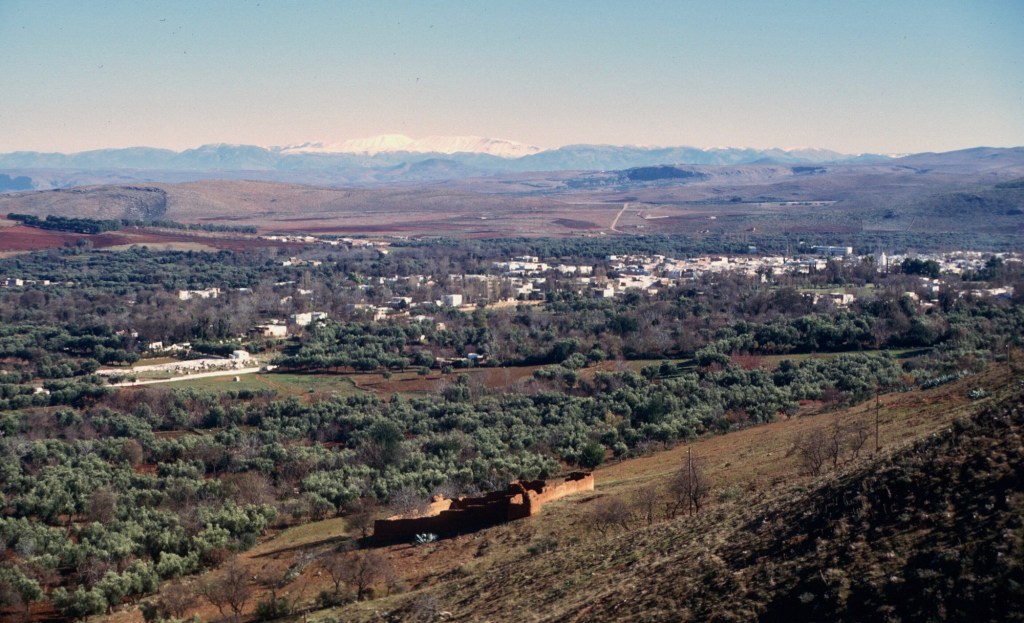
Vue vers le sud-est. Le cimetière juif est situé en bas à gauche de la photo. Sefrou occupe un bassin dont la majeure partie est entourée de collines. 1969

Le terme moussem a été utilisé pour décrire le festival, mais d’après ce que j’ai pu comprendre, la fête des cerises, créée vers 1920, se célébraient plutôt comme une foire agricole au sens européen ou américain du terme. Le mot moussem a souvent le sens d’un pèlerinage religieux sur la tombe d’un saint local, pratique fréquente au Maghreb. Il y avait plusieurs zawias, ou confréries religieuses, à Sefrou, ainsi qu’un marabout et quelques lieux sacrés aux yeux des habitants, mais je n’ai assisté à aucune célébration religieuse régionale de l’importante de celles que l’on trouve à Moulay Bouchta ou à Jbel Alam. Le festival des cerises est apparu comme un événement uniquement séculier dans un pays où la religion imprègne généralement la plupart des cérémonies publiques. La sélection d’une « Miss Cerise » et le défilé de la jeune femme m’ont semblé en contradiction avec les valeurs de l’islam.

Il y avait, bien sûr, les habituels dîners sous tente pour les dignitaires locaux que l’on trouve lors de toute célébration publique marocaine, ainsi que des marchands ambulants qui offraient toute sorte d’articles, de nourriture, de sucreries et de boissons. Les gens circulaient dans la ville nouvelle.

Femmes se reposant à l’ombre. 1968

Promenade parmi les tentes au bord de la ville nouvelle. 1968

Un porteur d’eau fait le plein à un robinet public. 1968

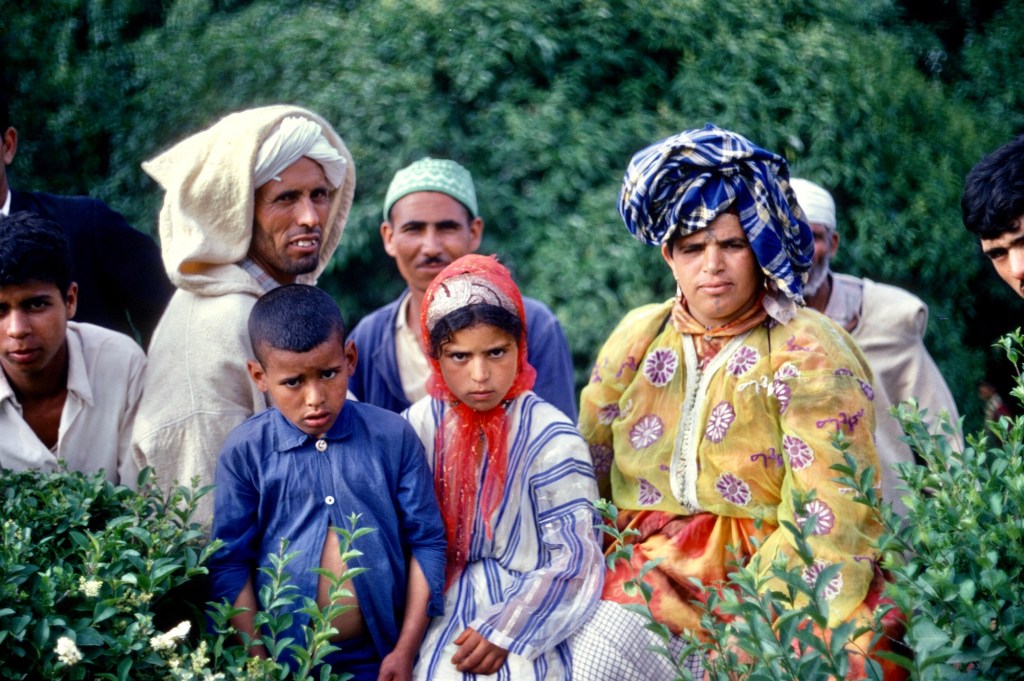
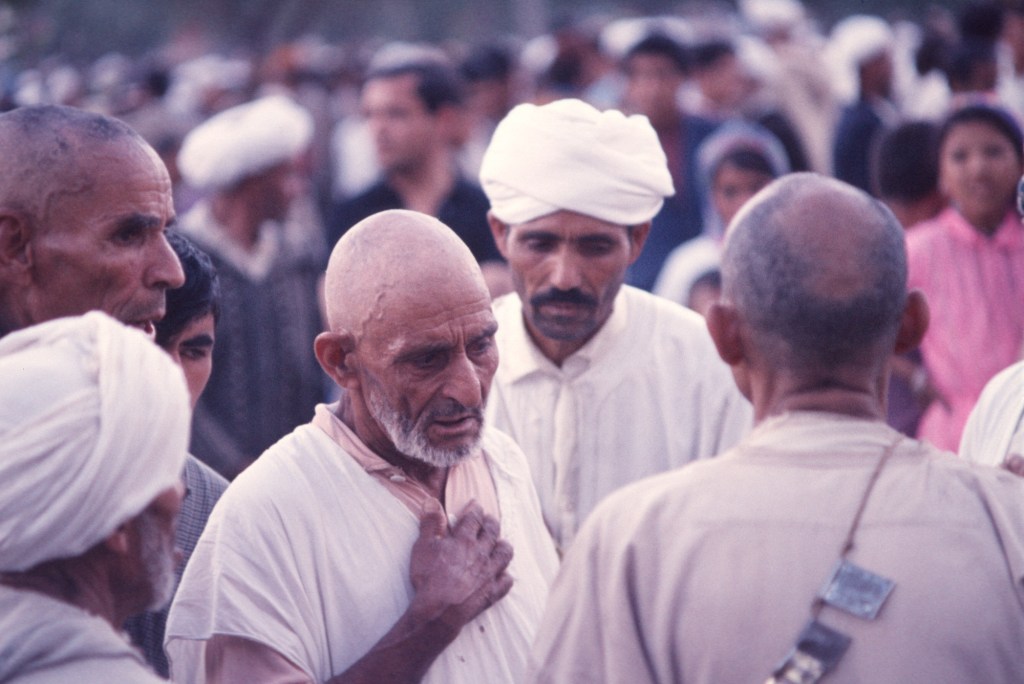
Différentes générations se regardent. 1968

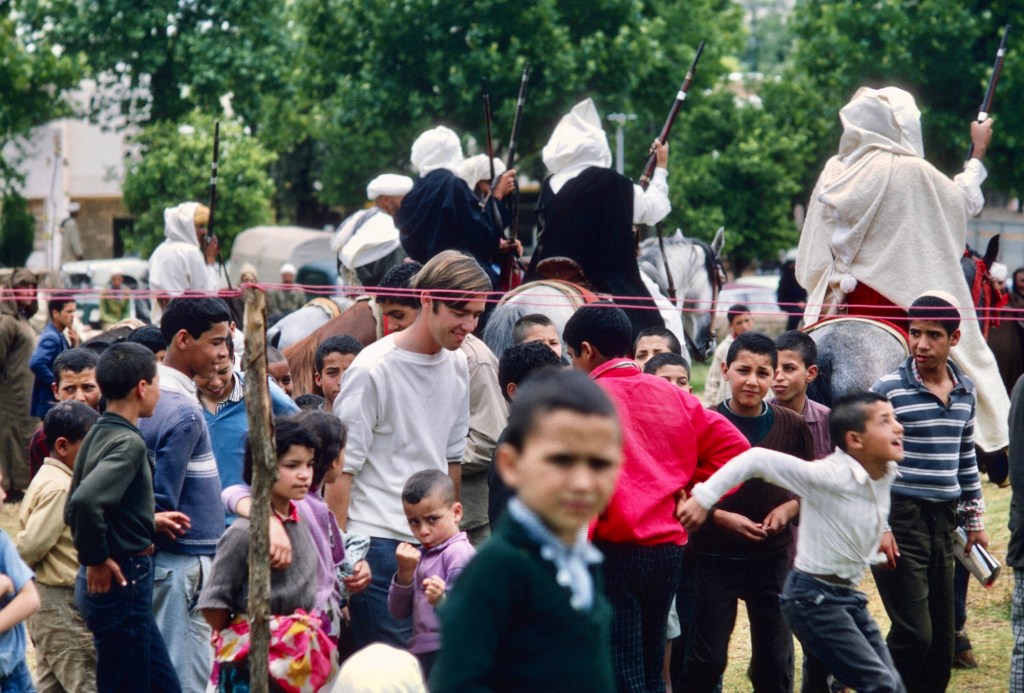
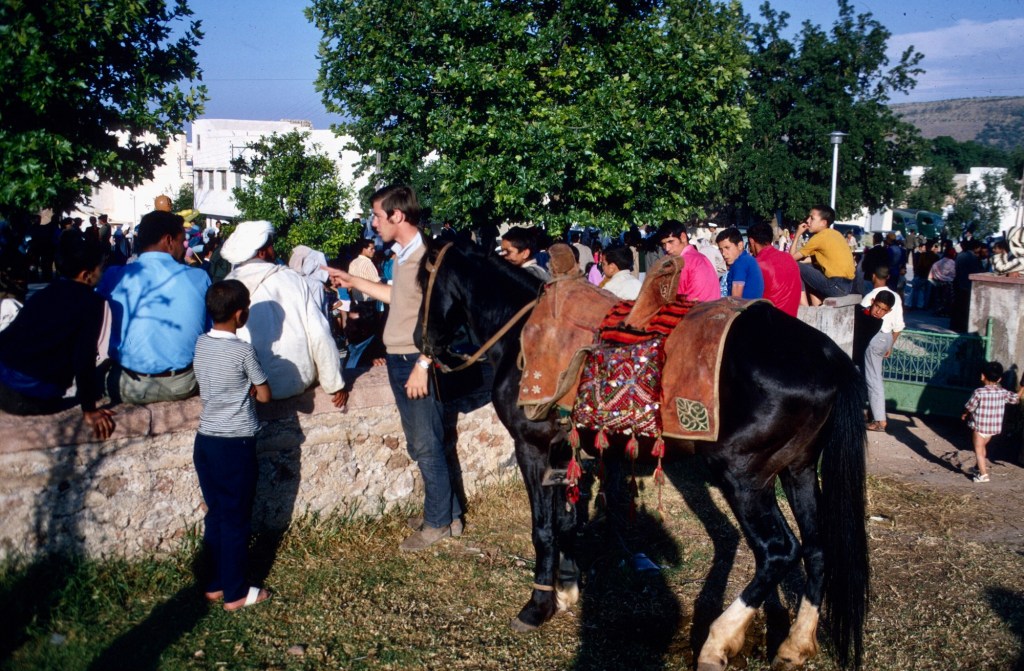
Gaylord se mêlant à une foule d’enfants…

…et discutant avec un cavalier berbère de sa monture. 1968

Les manèges offraient un plaisir particulier en dehors des grandes villes. 1968

Le long de la rue principale de la ville nouvelle, les gens se sont rassemblés pour regarder le défilé.  1970 ou 1973

La rue principale lors d’une journée d’été plus typique. L’effervescence de la vie urbaine régnait dans la médina et aux alentours. La ville nouvelle s’étendait sur les pentes à droite. Tout en haut, un fort français, des casernes et un marabout. 1969

Un jury composé de personnalités locales sélectionne une Miss Cherry, qui défile dans la rue principale de la ville nouvelle à bord d’un char. L’un des chars de cette première année comportait également des danseurs qui se produisaient au fur et à mesure du défilé.
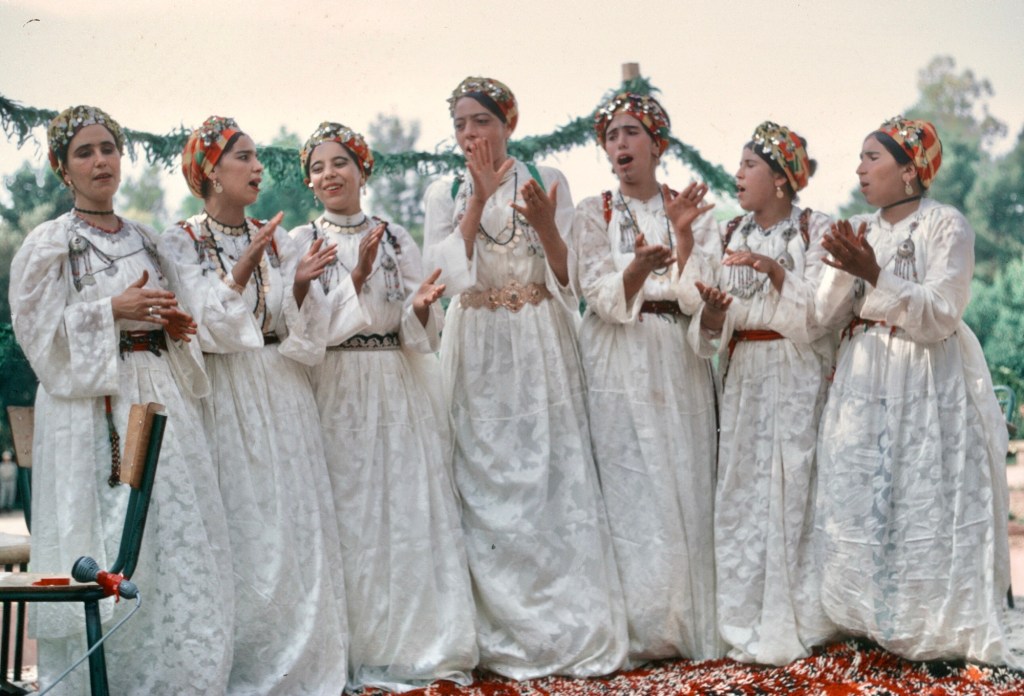
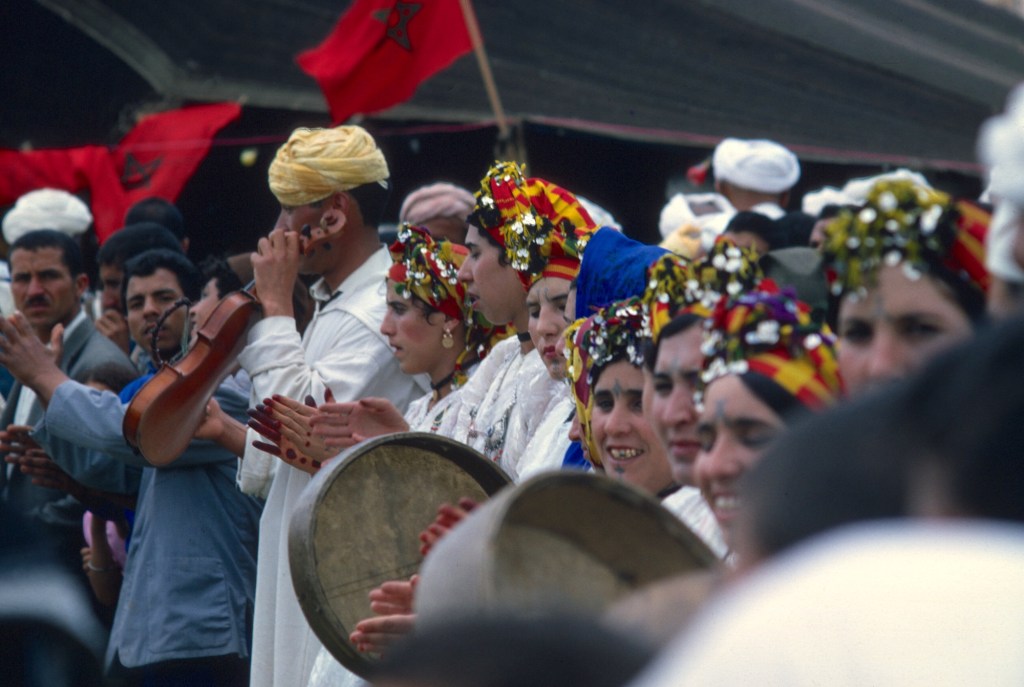
Danseurs professionnels du Moyen Atlas. D’après de nombreux Marocains, la danse ne constituait qu’une de leurs professions.Photo prise par Gaylord Barr. 1968

Les danseurs avec un musicien, à l’extérieur de la tente des notables. 1968

Danser pour la foule.  Photo par Gaylord Barr. 1968

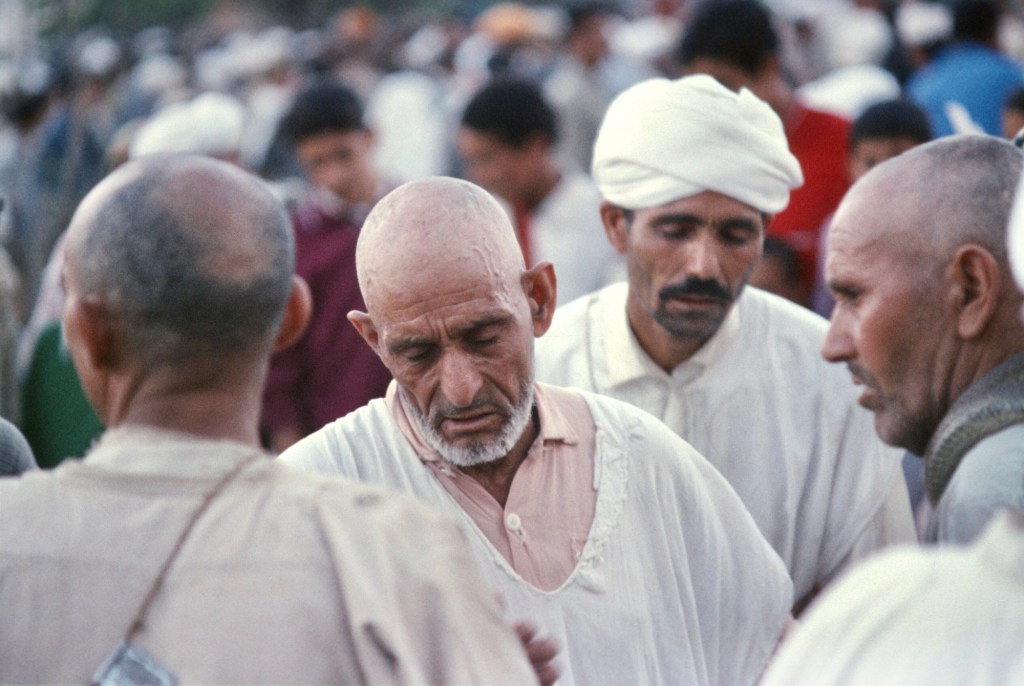
Les spectateurs 1968

Le défilé comprenait l’exhibition publique d’une femme, ce qui est tout à fait inhabituel dans un pays où les femmes se couvrent en public. La foule qui se pressait le long de la rue principale de la ville nouvelle faisait preuve de curiosité.
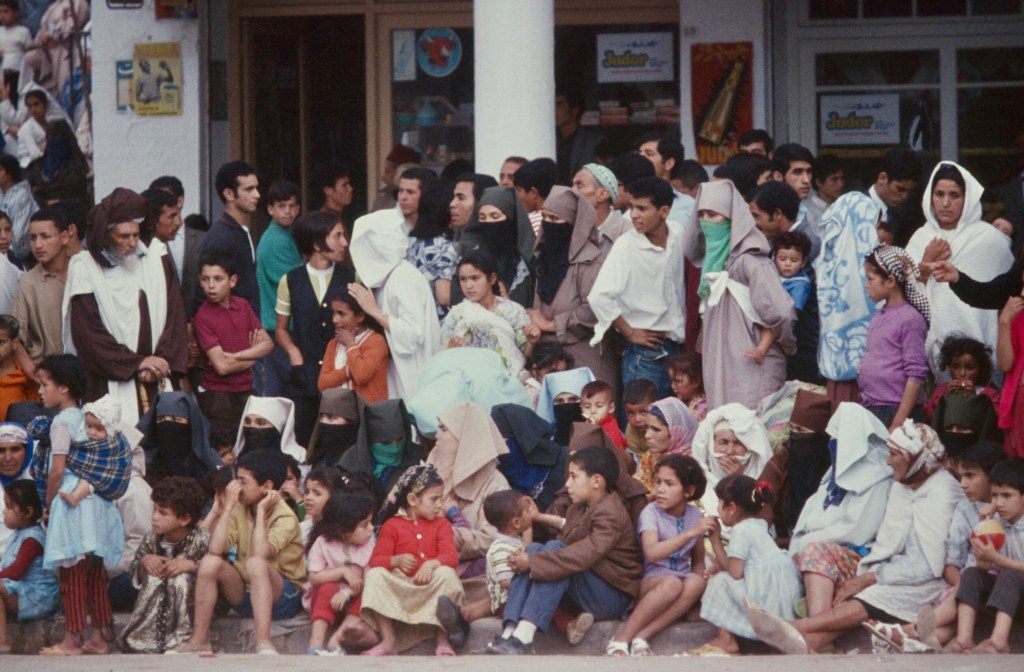
Les foules le long du parcours du défilé étaient denses et composées principalement de femmes et d’enfants. 1973

Le char du ministère de l’Agriculture 1970

.

L’affiche sur le char allégorique présente les avantages des charrues modernes. 1970

Un porteur d’eau offre des boissons à la foule. 1973

Miss Cherry. 1969 ou 1970

Femmes et enfants assis le long du trottoir. 1973

Le festival donnait l’occasion aux confréries religieuses de se réunir et de se livrer à leurs activités particulières, peut-être comme un divertissement pour les spectateurs, mais comme un rituel sérieux pour les participants.

J’ai toujours appelé ceux que j’ai vus Aissawa, ce qui aurait fait d’eux des membres de la confrérie soufie centrée à Meknès. Il existe à Meknès un grand sanctuaire avec un mausolée où repose le maître soufi Ben Aissa, également appelé shaykh el-kamal, le chef parfait. Un important moussem s’y déroule chaque année le jour de la naissance du prophète Mahomet, le Mouloud.

La cour devant le sanctuaire à Meknès à l’occasion du Mouloud 1976

Partie d’une procession Aissawa à Meknès 1976

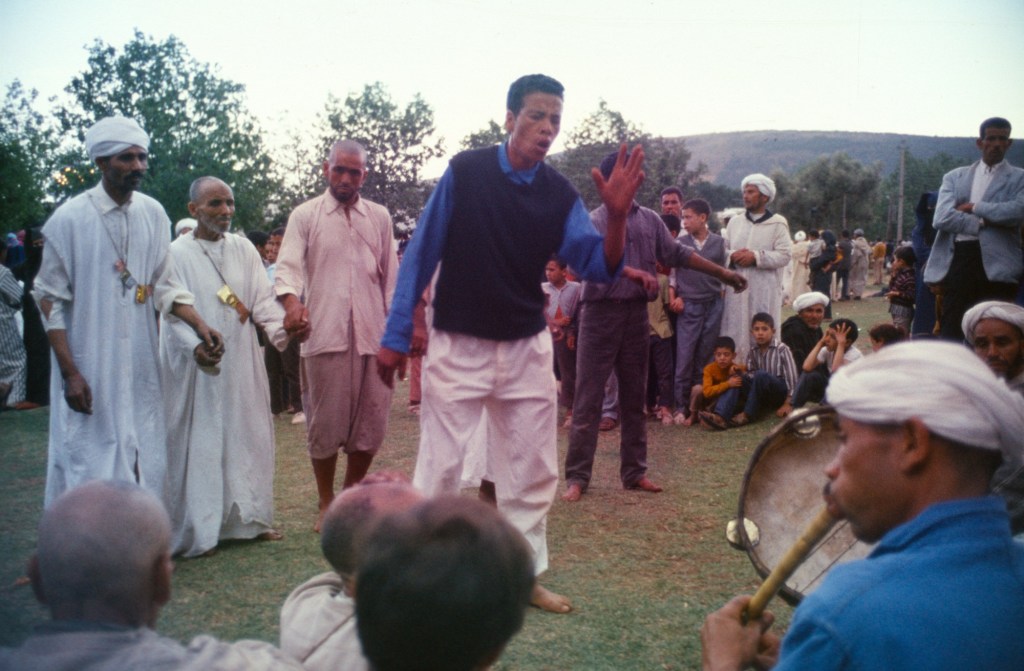
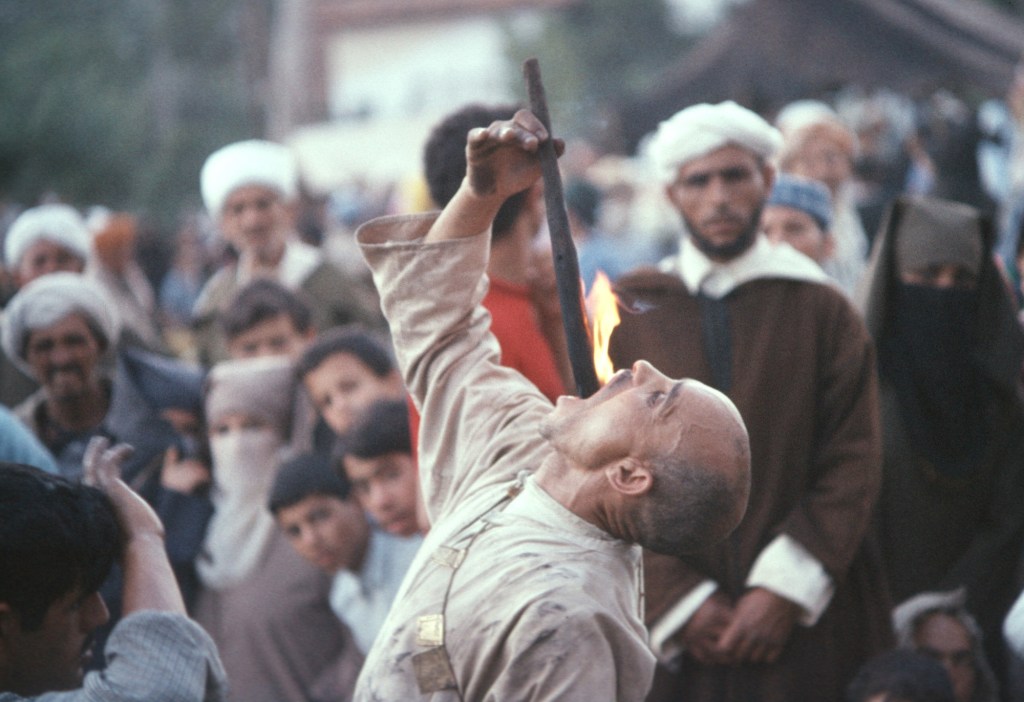
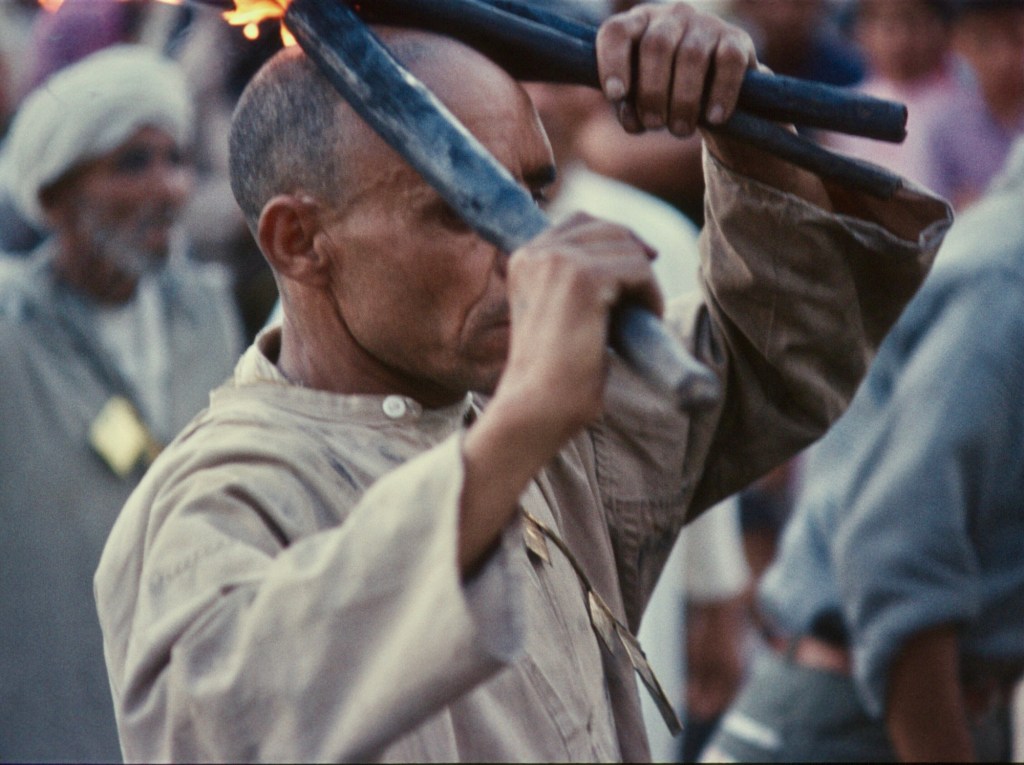
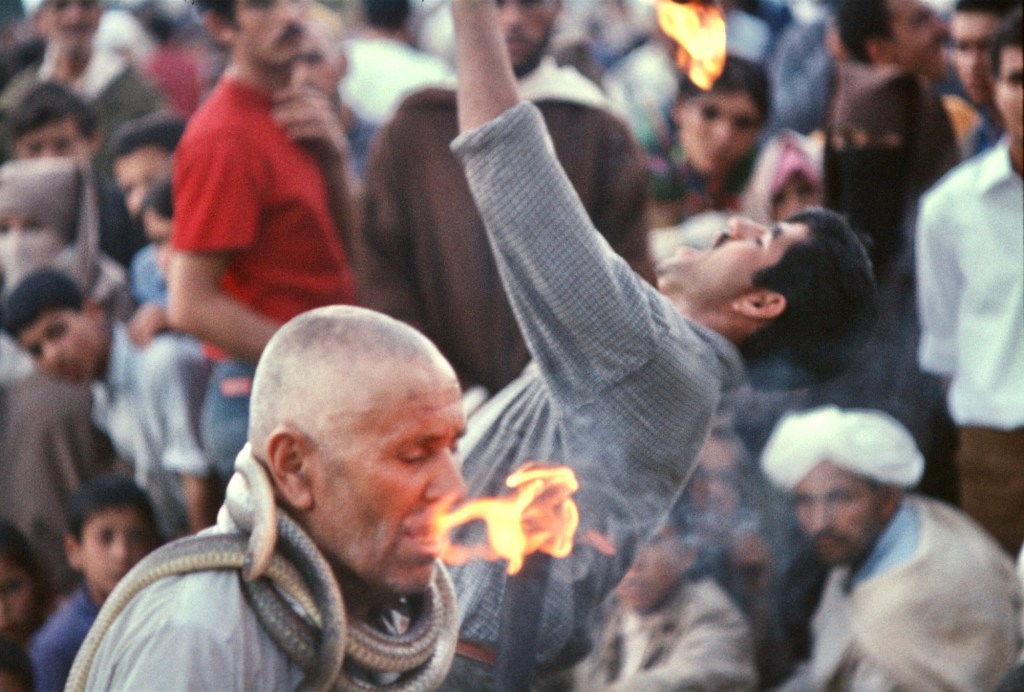
Lors du premier festival des cerises auquel j’ai assisté, un groupe d’Aissawa ou, peut-être, d’Hamadsha, qui mangeaient du feu et manipulaient des serpents mordants, ont dansé jusqu’à l’état de transe. Quelques-unes des photos montrent les visages écarquillés des spectateurs : ces spectacles étaient loin des rituels formels de l’islam de tous les jours !

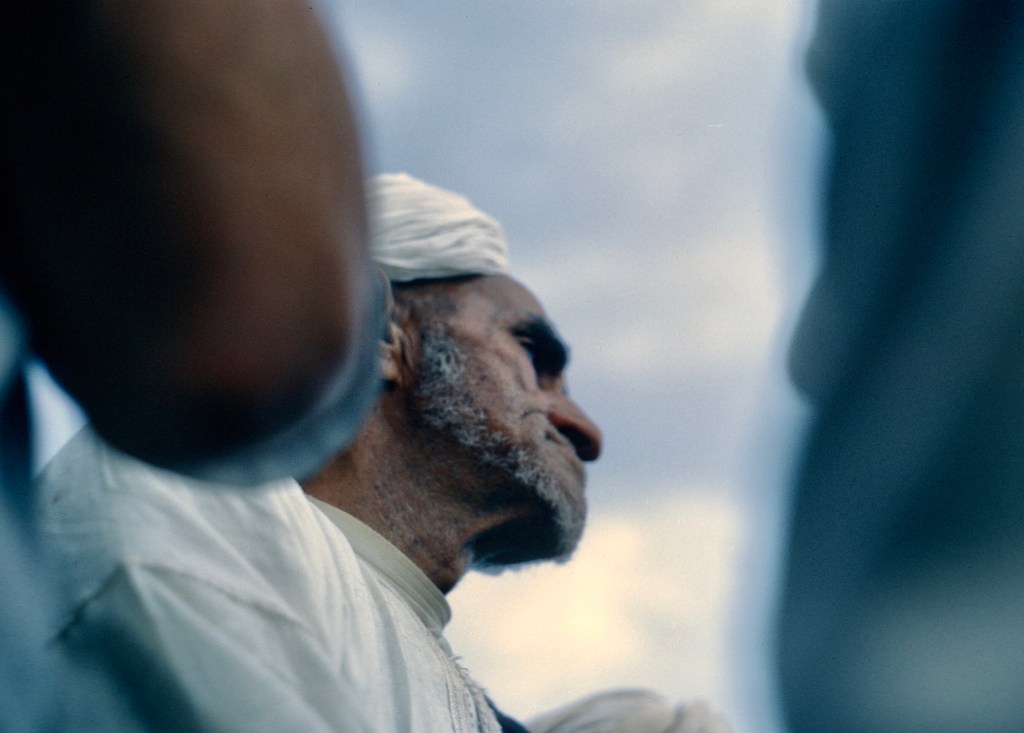
Les hommes dansaient en cercle, en chantant et en se frappant la poitrine. Photo de Gaylord Barr. 1968.
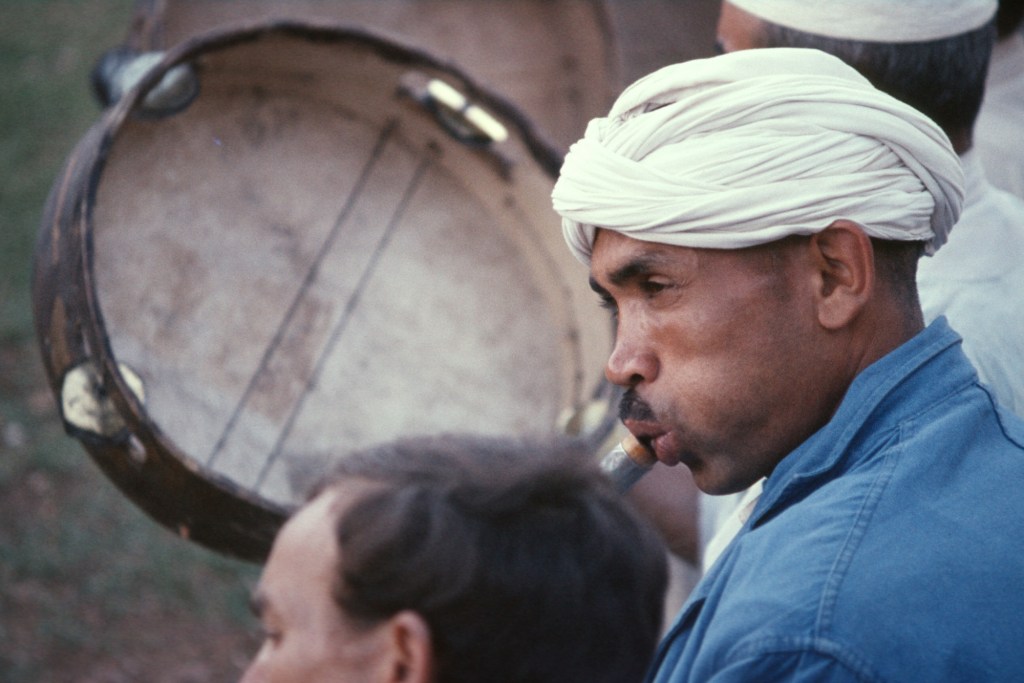
L’un des musiciens. Photo de Gaylord Barr. 1968
Les instruments étaient tous traditionnels. 1968

Les danseurs se relayaient pour se produire au centre du cercle. La plupart de ces photos ont été prises sur un film Kodak Ektachome. Cette photo a été bâclée lors du développement : le centre de l’image ne devrait pas être rose. Aujourd’hui, prendre des photos est D’une grande simplicité et, les pellicules n’étant plus utilisées à grande échelle, les appareils photo électroniques et les téléphones cellulaires peuvent capturer et stocker une quantité impressionnante d’images. Je prenais soit 20 ou 36 photos sur un rouleau de film, le film coûtait cher et sa sensibilité se limitait aux conditions lumineuses. 1968

Chants et danses. Les amulettes portaient des inscriptions religieuses. 1968

…à mesure que la musique continuait…

…la danse continuait. L’homme à droite a des serpents drapés autour du cou. 1968

Manger du feu faisait partie du rituel. J’adore le regard des spectateurs. Le groupe a commencé par demander à la foule des contributions ou des dons. 1968

Feu et serpents. 1968

Le feu était réel…

…et les serpents étaient sans l’ombre d’un doute bien réels. Je voyais le sang qui suintait des piqûres de serpents. 1968
Certains portaient des serpents et mangeaient du feu. Le spectacle était envoûtant et, si je n’avais par été occupé à prendre des photos, mon visage aurait pu montrer autant d’attention que celui des spectateurs sur ces photos. 1968

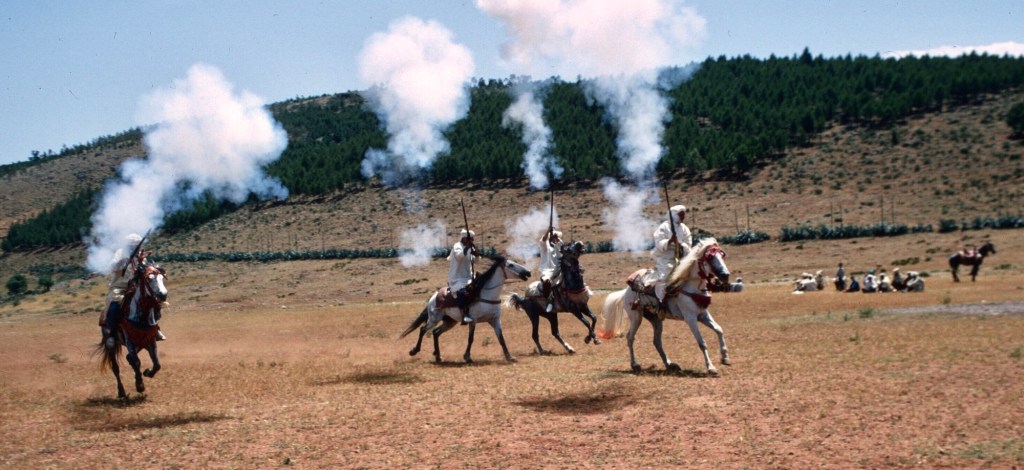
Traditionnellement le festival durait trois jours, mais je ne me souviens que d’une seule journée. L’année suivante, en 1969, je me trouvais peut-être ailleurs pendant le temps du festival. En 1970, j’y ai de nouveau assisté et cette année-là, il y a eu une fantasia, un spectacle traditionnel de jeux de poudre et d’équitation—le seul auquel j’ai assisté pendant mon séjour au Maroc. Enfin, le seul comportant des chevaux, car à Moulay Bouchta, un cortège d’hommes armé de vieux mousquets s’était rendu sur l’espace devant le sanctuaire et a offert un spectacle impressionnant.

Jeu de poudre devant le sanctuaire à Moulay Bouchta 1970

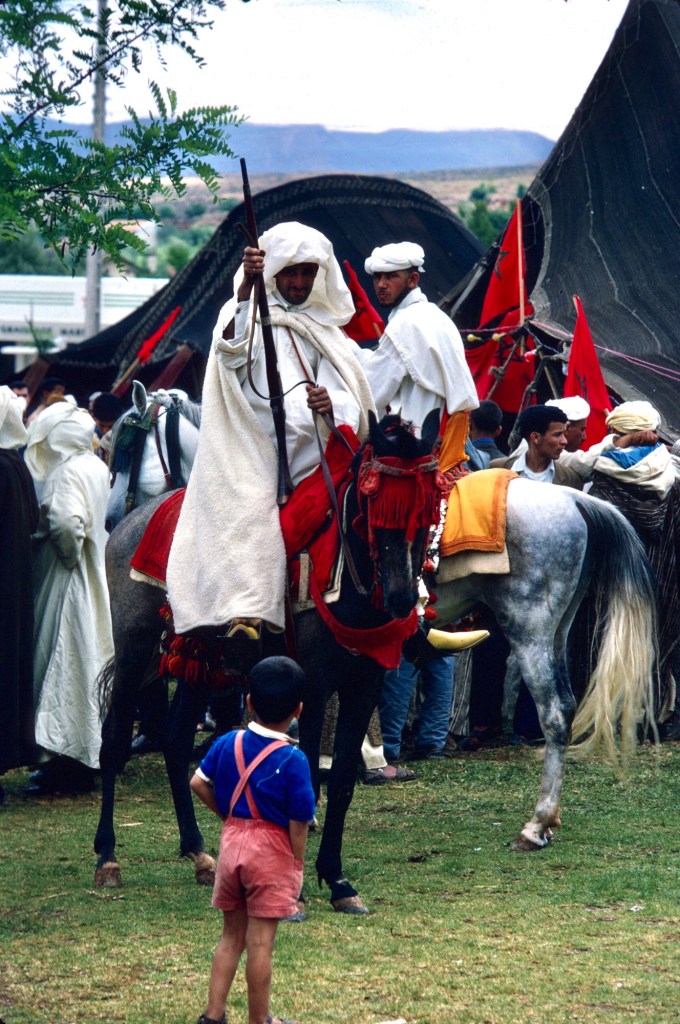
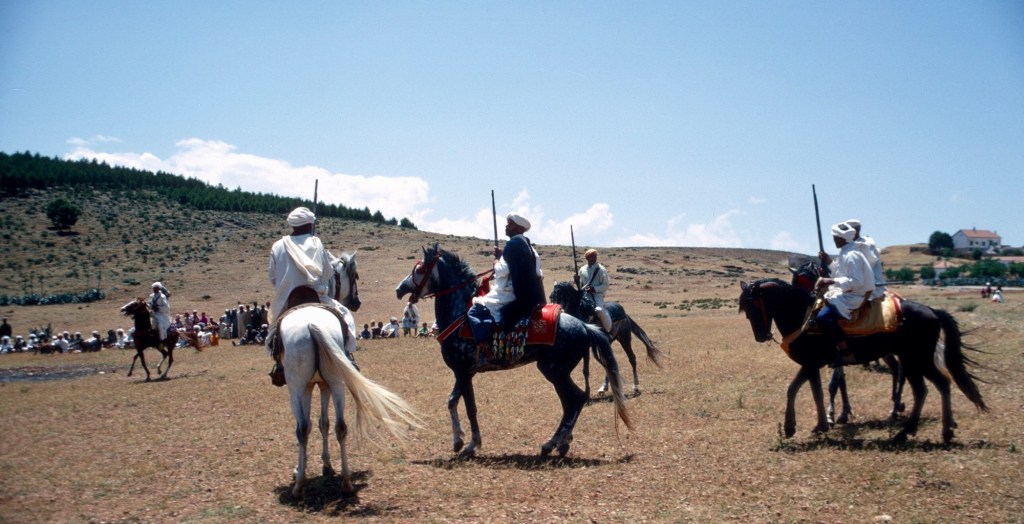
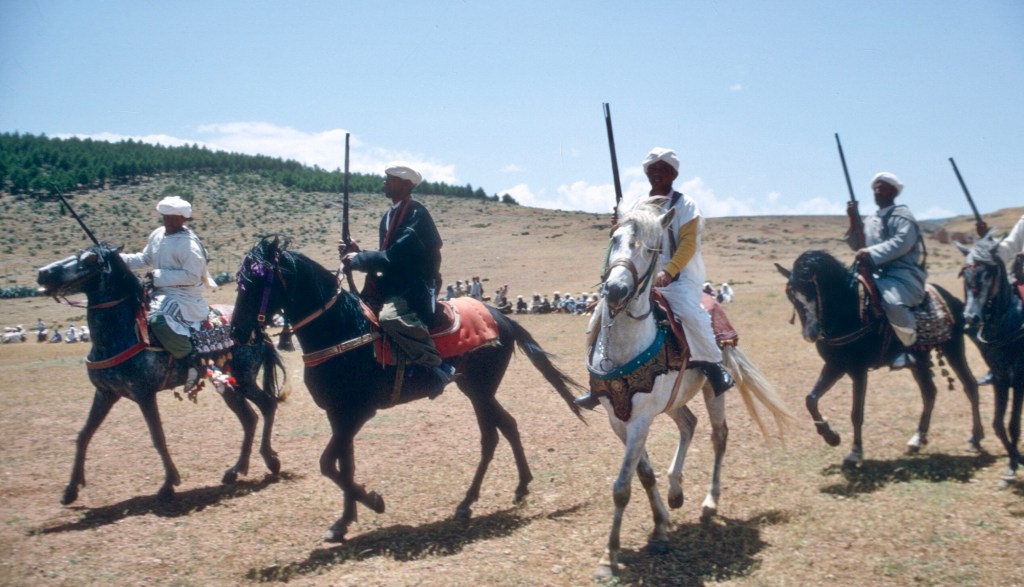
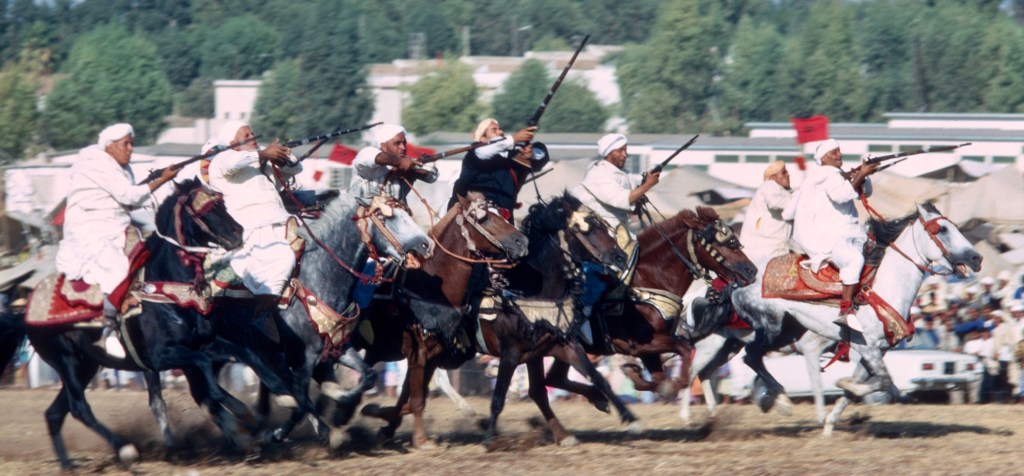
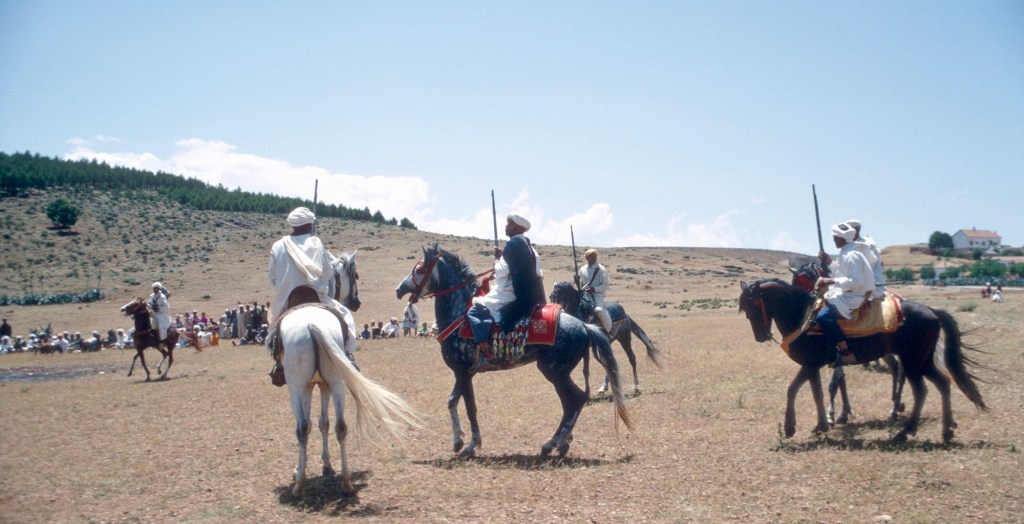
A la fête des cerises, les cavaliers alignaient leurs chevaux sur un terrain plat, les éperonnaient et galopaient le long du terrain en agitant leurs mousquets avant de tirer une salve en l’air.

L’un des cavaliers. Photo de Gaylord Barr. 1968
On se prépare pour la course. 1970

Chargement des mousquets 1970

Les cavaliers des tribus berbères environnantes sont fiers de leur savoir-faire équestre et leur beaux chevaux. 1970

.

Au galop le long du le terrain. 1970

Tirant leurs mousquets 1970

Pour ensuite recharger tout en se regroupant. 1970

Bon nombres des cavaliers étaient des hommes de tribu plus âgés et suffisamment riches pour s’offrir un beau cheval. 1970

Il y a eu plusieurs courses le long du terrain. 1970

Certaines courses comptaient plus de participants que d’autres. 1970

Les participants s’apprêtant à tirer. 1970

Déchargeant leurs mousquets au grand galop. 1970

Et produisant toujours des nuages de poussière. 1970

Les photos de ce billet présentent la fête des cerises telle que je l’ai vécue, à la fois en tant que nouvel arrivant dans le pays et en tant que personne ayant vécu à Sefrou pendant quelques années. Les foires d’État et de comté sont courantes aux États-Unis et au Canada, partout où l’agriculture est importante, mais je n’ai jamais visité la foire du comté de Niagara à Lockport, dans l’État de New York, près de l’endroit où j’habite. Les foires, ce n’est vraiment pas mon truc, même si assister à l’exposition nationale canadienne a été un moment fort de mon enfance, parce que j’aimais les manèges et la nourriture.

Le festival des cerises a été très divertissant. En juin, il faisait toujours beau. La ville nouvelle était bondée, les animations étaient intéressantes et des amis de tout le Maroc venaient nous visiter. Ceci étant dit, bien des années plus tard, maintenant que je suis de nouveau chez moi, je ne me rends pas au festival de la pêche à Lewiston NY, à seulement 12 kilomètres de chez nous, ni au festival de l’éperlan de Lewiston, un événement  beaucoup plus modeste célébrant le petit poisson savoureux qui remonte la rivière au printemps. Je trouve que les foires sont faites pour les jeunes, les exposants, les vendeurs et les marchands. Toutefois,  le festival des cerises est désormais reconnu par l’UNESCO comme faisant partie du patrimoine national du Maroc. Si vous vous trouvez dans le nord du Maroc en juin, je vous encourage à y participer. Au minimum, vous aurez le plaisir de voir des foules de Marocains s’amuser. À l’époque où je restais au Maroc, la vie était difficile pour beaucoup et les fêtes nationales ou locales s’avéraient des occasions de célébrer avec des amis et avec la famille. Je m’imagine qu’à cet égard, rien n’a changé du tout.

The Cherry Festival

Just recently, I was asked by a Moroccan reader of this blog, who wrote from Alberta, Canada, if I had photos that I could share of the Cherry Festival.

Now, Morocco, spectacular for its natural beauty, is also be a country of spectacles. For me, the Marrakesh Folk Festival comes to mind immediately, along with the various celebrations of holy men and religious fraternities although there are many other culture and sports events. Still, there are many smaller festivals that are less well-known. Among them, the Cherry Festival in Sefrou is the oldest, having been founded in 1920.

Sefrou, only 28 kilometers south of Fes, has one of the best known local festivals, La fête des cerises. This ancient city, very close to Fes, has traditionally been the last truly urban place south of Fes, on a road formerly known as the treq es-sultan, the king’s road. A major highway follows the old caravan route, crossing the Middle Atlas Mountains, descending onto the plains of the upper Moulouya River, and then rising again to cross the High Atlas Mountains to end in the Tafilelt, birthplace of the ruling Alouite dynasty, on the very edge of the Sahara. Today tourists travel that highway to reach the impressive sand dunes at Erfoud, and truckers carry their cargos of manufactures and dates and saffron to and from Fes, braving slippery snow-covered roads on the Middle Atlas plateaus.

This table d’orientation, a very French object, stood in the gardens of the Palais Jemaï hôtel high above the the city of Fes, and pointed out important landmarks to the south. A view from the Oued Agaï represents Sefrou, but after the flood of 1950, the city might have been better symbolized by its gardens—or cherries.

Once a home to a very large Jewish community, many Jewish tourists now visit the city since the establishment of diplomatic relations between Morocco and Israel. There are several websites dedicated to documenting the Jews of Sefrou, and the city itself dates back to the time of the founding of Fes or perhaps even earlier.

“A city buried in the trees.” Early postcard with a part of the Kelaa in left foreground.
An early map of Sefrou shows almost all the city’s structures enclosed by the defensive wall. The French were developing the area outside the wall to the west for themselves. My house, inside the wall, had not yet been built and its site was a still a garden.

Not long after I moved to Sefrou in 1968, I attended Sefrou’s Cherry Festival for the first time. Gaylord Barr was already in Sefrou working at the Ministry of Agriculture CT (Centre des travaux agricoles). Jerry Esposito, who had been teaching English at the newly opened lycée, may have completed his service and already left the country by time of the festival in June. Carolis Deal and John Abel, who had started the primary school chicken coop that I took over, also had left.

Gaylord Barr, Marc Miller, and Phil Morgan, all Morocco X volunteers. 1968

Several other volunteers showed up in Sefrou to attend that year: Phil Morgan, Marc Miller, and Steve Boeshar.

Sefrou’s proximity to Fes and easy access made the Cherry Festival a major regional attraction, and, with volunteers already living in Sefrou, accomodation was never a problem for the visitors.

Jan, Ruth, and Gaylord all taught English at the lycee. During the 1970 festival.

I knew little about the event, other than it featured cherries. Moroccans call cherries hab el-moulouk, which mean the love of kings, and the local variety, el-beldi, is reputed to be especially sweet and flavorful. Sefrou occupies a mountain depression at a high enough altitude for cherries to thrive, but the city had many other fruits and vegetables in the old gardens that surrounded it. In the orchards grew oranges, pomegranates, figs of more than one variety, and many olives trees. I really liked the local strawberries more than the cherries.

Picking strawberries in the spring. 1969
This field was only a couple of minutes walk from the medina.
Picking strawberries with Mohammed and Ali. Note the olive groves. 1970

The city population has more than doubled since I lived there, and the built-up area has spread far beyond the old city’s walls. The growth surprised Gaylord Barr who stopped in Sefrou on a trip home from Saudi Arabia in 1997. In my memory, the extra-muro areas, excluding the ville nouvelle, were mostly limited to the Derb el-Miter, Habouna and Seti Messaouda quarters. I make this digression into the demography and urbanization of Sefrou before the sprawl simply to underline how easy it used to be to walk out of the medina, and, within a few minutes, be in the gardens that surrounded the city. On Fridays women would walk in groups, small children in hand, to picnic in the orchards, eating fresh fruit, getting some fresh air, and, of course, gossiping over tea. I loved the proximity to the country and took frequent walks to the neighboring village of Bhahlil, famous for use as caves for dwellings.

A stroll to the gardens, along the wall of the old Jewish cemetery. 1969

People used to talk about Sefrou before the flood. I wonder if they now talk about Sefrou before the sprawl, the time when almost everyone, save the rich and powerful and foreigners, lived in and around the medina. The gardens and orchards of Sefrou characterized the city in those days, and sometimes travelers not unsurprisingly likened the city to an oasis.

A view looking southeast. The Jewish cemetery is located in the lower left of the photo. Sefrou occupies a bassin, with hills surrounding most of it. 1969

The term moussem has been used to describe the festival, but from what I can gather, the Cherry Festival, created around 1920, was celebrated more as an agricultural fair in the European or American sense. The word moussem often has the meaning of a religious pilgrimage to the tomb of a local saint, common in the Maghreb. There were several zawias, or religious brotherhoods, located in Sefrou, as well as a marabout and a few special places sacred to the locals, but I never witnessed a regional religious celebration on the scale one finds at Moulay Bouchta or Jbel Alam. The Cherry Festival appeared to be a uniquely secular event in a country where religion permeated daily life and most public ceremonies. The selection of a “Miss Cherry” and parading the young woman struck me as at odds with Muslim values.

There were, of course, the usual tented dining facilities for local dignitaries that one would find at any public Moroccan celebration as well as hawkers of wares, foods, sweets, and drinks. People from the medina and the countryside circulated in the ville nouvelle.

Women resting in the shade. 1968
Strolling among the tents on the edge of the ville nouvelle. 1968
A water carrier refills at a public tap. 1968
Different generations regard each other. 1968
Gaylord in a crowd of kids.…
…and chatting with a Berber horseman about his mount. 1968
Amusement rides were a special treat outside major cities. 1968
Along the main street of the ville nouvelle, people gathered to watch the parade. 1970 or 1973
The main street on a more typical summer day. The hustle and bustle of city life was in and around the medina. The ville nouvelle spread up the slopes to the right. Perched at the very top was a French fort and military barracks and a marabout. 1969

A jury of prominent locals selected a Miss Cherry, who was paraded down the main street of the ville nouvelle aboard a float. One of the floats that first year also featured dancers performing as they were carried along.

Professional dancers from the Middle Atlas. Dancing was only one of their professions according many Moroccans. Photo by Gaylord Barr. 1968
The dancers with a musician, outside the tent of the notables. Photo by Gaylord Barr. 1968
Dancing for the crowd. Photo by Gaylord Barr. 1968
Spectators.

The parade included the public display of a woman quite unusual in a land where women covered themselves in public. The crowds along the main street of the ville nouvelle were curious.

The crowds along the parade route were dense and mostly women and children.
The float of the Ministry of Agriculture.
The poster on the float shows the benefits of modern plows.
A water carrier offering drinks to the crowd.
Miss Cherry. 1969 or 1970.
Women and children sitting along the curb.

The festival did offer the opportunity for religious brotherhoods to perform, perhaps as entertainment for the spectators, but as serious ritual for the performers.

I have always referred to those I saw as Aissawa, which would have made them part of the Sufi brotherhood centered in Meknes. A large shrine with a mausoleum where the Sufi master lies, Ben Aissa, who is also referred to as shaykh el-kamal, the perfect leader, exists in Meknes. An important moussem takes place there every year on the day celebrated for the birth of the Prophet Mohammed, the Mouloud.

The courtyard before the sanctuary in Meknes on the Mouloud.
Part of an Aissawa procession in Meknes.

In the first Cherry Festival that I attended, a group of Aissawa or, perhaps, Hamadsha, who ate fire and handled biting snakes, danced themselves into a trancelike state. A few of the photos show the wide-eyed faces of onlookers: these performances were far from the formal rituals of everyday Islam!

The men danced in a circle, chanting and beating their breasts. Photo by Gaylord Barr. 1968
One of the musicians. Photo by Gaylord Barr. 1968
The instruments were all traditional.
Dancers would take turns performing in the center of the the circle. Most of these shots were on Kodak Ektachome film. The processor botched this one: the center of the image should not be pink. Today it is so simple to take photos and, with film no longer widely used, electronic cameras and cell phones can capture and store a truly enormous amount of pictures. I had either 20 or 36 pictures on a roll of film, the film was expensive, and its sensitivity was limited to bright conditions.
Chanting and dancing. The amulets held religious writings.
As the music continued…
…the dancing continued. The man on the right has snakes draped around his neck.
Fire eating became part of the ritual. I love the looks on the spectators’s faces. They group began by asking the crowd for contributions or donations.
Fire and snakes.
The fire was real…
…and the snakes were certainly real. I could see blood oozing from the punctures of the snake bites.
One could carry snakes and eat fire. The show was mesmerizing and, if I hadn’t been taking photos, my face might have shown as the same rapt attention as the faces of the spectators in these photos.

The festival traditionally lasted three days, though I only remember one day. The following year, 1969, I may have been away during the festival. In 1970, I once again attended. That year there was a fantasia, a traditional display of powder play and horsemanship—the only one that I ever witnessed while living in Morocco. Well, the only one with horses, because at Moulay Bouchta a procession armed with old muskets walked to the space before the shrine and put on an impressive display.

Powder play before the sanctuary of Moulay Bouchta.

At the Cherry Festival, the riders lined up their horses on flat ground, spurred on their steeds, and galloped down the field waving their muskets before firing salvos into the air,

One of the riders. Photo by Gaylord Barr. 1968
Getting ready for the ride.
Loading muskets.
Getting ready.
Galloping down the field.
Firing their muskets.
And then reloading while regrouping.
Many of the riders were older tribesmen, wealthy enough to keep a beautiful horse.
There were several runs up and down the field.
Some charges had more participants than others.
Getting ready to fire.
Discharging their muskets at full gallop.
And always producing clouds of dust.

The photos in this blog piece present the Cherry Festival as I saw it, both as a newcomer to the country, and then as one who had lived in Sefrou for a couple of years. State and county fairs are common in the US and Canada, wherever agriculture is important, but I have never visited the Niagara County Fair, in Lockport, NY, close to where I live. Fairs are not for me, though attendance at the Canadian National Exposition in Toronto, Ontario, was a highlight of my childhood because I loved the amusement rides of the midway and the foods.

The Cherry Festival was great fun. In June the weather was always fine. The ville nouvelle was crowded. The entertainment was interesting. And friends visited from all over the country. That said, years later, at now home again, I do not go to the Peach Festival in Lewiston, NY, just 12 kilometers away, nor to Lewiston’s Smelt Festival, a much smaller affair celebrating a small but tasty fish that runs up river in the spring. I think that fairs are for the young, the exhibitors, and vendors and merchants. But the Cherry Festival is now recognized by UNESCO as a part of the national heritage of Morocco. If you happen to be in northern Morocco in June, you should think of attending. At the very least, you will have the pleasure of seeing crowds of Moroccans enjoying themselves. When I lived in Morocco, life was difficult for many and holidays were opportunities to celebrate with friends and family. I imagine that in that respect nothing has changed at all.