MOROCCO BOUND

MOROCCO X: PEACE CORPS TRAINING IN HEMET CALIFORNIA

Reed Erskine, author and photographer.

PROLOGUE

In the summer of 1967, gas was 33 cents a gallon. The average annual income was $7,300. A war was raging in Vietnam, its American death toll having mushroomed, for the first time that year, to nearly 1,000 American lives a month. Race riots had broken out in Detroit, Newark, Tampa, Buffalo, and Memphis. I was negotiating, in my 20th year of life, the uncertain territory between being a boy and becoming a man.

Fellow baby boomers, including one of my college roommates, had flocked to San Francisco for the first and last “Summer of Love”; meanwhile I was working a summer job at Montreal’s Expo ’67, bussing tables at the India Pavilion restaurant.

At the end of my sophomore year in college, I had applied to the Peace Corps, stirred by the adventurous idealism of a national service founded only six years before by a president who had captured our imaginations with the possibility of being, in some small way, an agent of peace and understanding.

I had nearly forgotten my Peace Corps application until I got back from Montreal, and heard that the government had been asking friends and neighbors for character references on my behalf. It took a moment to realize that my Peace Corps application was being digested in the bowels of officialdom.

A letter arrived, proposing Peace Corps service in Micronesia. Head filled with images of palm-fringed islands in the sun, I called in to accept, only to be told that the program had been filled. The next program offered a post in Andhra Pradesh, India, but that fell through as well. As I was beginning to reconsider the entire project, I was assigned to Morocco X, an agricultural program.

Looking back over the five decades gone by since that mid-October day in 1967 when our cohort of 43 men and boys came together in Hemet, California for three months of training, I had come to think that memories of that brief time had been all but lost beneath the accretion of intervening years.

When I discovered David Brooks’, “The Morocco That Was” blog, I was moved to revisit my own Morocco X experience, and, in rummaging through my meager memorabilia , discovered a cache of correspondence and journal entries that offered a few vignettes of our time in Hemet. I am setting down this account in the hope that those who were part of our shared experience might add their own memories to this blog, and help fill the remaining gaps in my recollections.

THE PLAN:

Morocco X was conceived as an ambitious agricultural project intended to aid and expedite a USAID Program to introduce a new and improved strain of wheat, known generally as “Mexican Wheat” to Moroccan farmers.

We volunteers were to be stationed at the numerous centres de travaux, small agricultural extension offices scattered across rural Morocco. Often sited in remote locations, the “C.T” were staffed by extension agents who dispensed aid and information to small family farms. The agents distributed seed stock, introduced modern techniques, pesticides, fertilizers, and provided access to modern, labor-saving machinery, such as tractors, plows and combines to farm communities, who were still relying on methods little changed since the Middle Ages.

Our mission, as volunteers, would be to coordinate with our USAID and Moroccan counterparts to get the new Mexican Wheat to our centres, set up demonstration plots, and introduce an agricultural revolution that could dramatically increase yields by eliminating two devastating problems facing wheat growers.

Wheat “rust”, a parasitic fungal infection on the stem and leaves of the plant, weakens its host, reducing quality and yield. As if the threat of “rust” was not enough, “lodging”, the tendency of the ripe wheat to fall over before harvest, leaving large swaths of wheat fields flattened to the ground, could also jeopardize the success of an otherwise abundant crop.

In 1944, an Iowa farmer and plant pathologist, Norman Borlaug, had begun to find a solution to wheat rust infestation. For the next decade, he and his colleagues crossbred thousands of wheat strains from around the world to create a rust-resistant wheat. The resulting hybrid was still vulnerable to toppling under the weight of its ripe heads, until Borlaug crossed it again with a Japanese dwarf strain to create a short-stemmed, semi-dwarf wheat, resistant to both lodging and rust.

Borlaug’s genius and dedication won him a Nobel prize in 1970, and should have provided Morocco X with a seminal role in the great endeavor of thwarting the dire Malthusian prediction of mass starvation as population growth outstripped agricultural output. This heady prospect, that might have cast us as servants to the survival of the human race, was, like so many hopes and dreams, on a collision course with the ultimate reality of our mission in Morocco.

PEOPLE & PLACE:

On a warm mid-October afternoon in 1967, 43 prospective volunteers for the tenth Morocco Peace Corps program, having passed initial application and vetting processes, arrived in Hemet, California. Most of us came from the Atlantic and Pacific coasts of the Lower 48, with a few from the Midwest, and at least one, that I can think of, from the South. We ranged in age from 19 to 38. An overwhelming majority came armed with undergraduate degrees, a few having pursued or obtained post-graduate degrees. One or two of us had less than four years of college. No one had, as far as I could tell, any agricultural background. Without exception we were white Caucasians which, in 1967, was not surprising.

In those days, Hemet was a nondescript sprawl of a town, set in a semi-desert valley just beginning its evolution from a patchwork of irrigated alfalfa fields and orchards, into America’s first planned retirement community, which offered mobile home sites in a subdivision zoned for residents over the age of 55.

Sierra Dawn Estates, promoted by Art Linkletter, had preceded our arrival in Hemet by only a few years. Its wide, straight streets, bordered by tidy, double wide mobile homes, fronted by startlingly green Sta-Rock “lawns”, had just begun to transform the “Grapes of Wrath” desolation of Hemet into a working-class, suburban Valhalla.

Hemet’s role in the American dream went unnoticed by us new arrivals. We were billeted at a desolate migrant labor camp in an abandoned pecan grove on the ragged edge of town. We remained largely unaware of the Hemet or its inhabitants, whose population would not exceed 10,000 souls until the 1970 census.
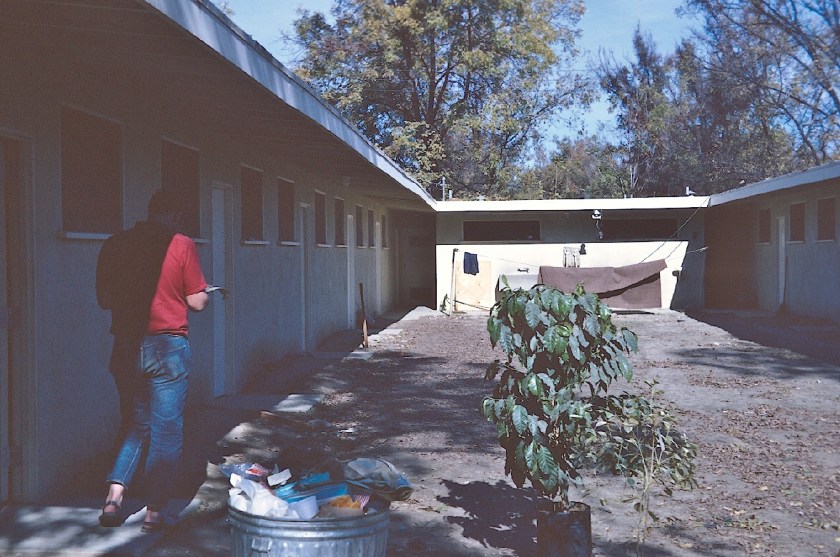
The migrant labor camp was U-shaped, with staff quarters on the left, showers at the end, and volunteers’ quarters and classrooms on the right.

Our initial concern was adjusting to our spartan accommodations, a one-story line of dormitory rooms on a concrete slab, separated by a dirt courtyard from an identical set of rooms, which served as classrooms. Meals were taken in a large wooden building on the other side of the road. Both residential and classroom wings were bridged at one end by a shared bath facility. We were four to a room, in each corner of which we found a steel frame cot and thin mattress. A door and two windows completed the decor.
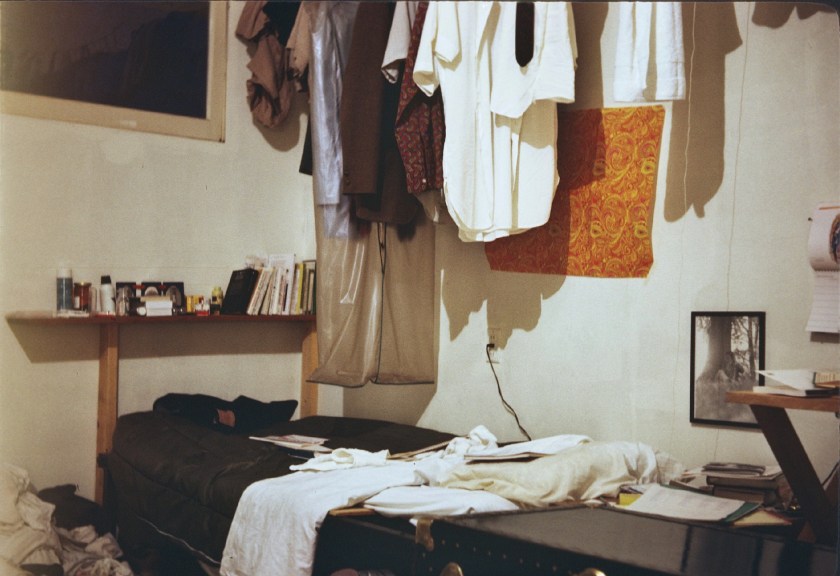
A cot in a corner. Each room had four. There was no heat.
The main classroom. The languages classes were in other smaller rooms.

Our other concern was the punishing curriculum, 28 hours a week of immersion language classes, 15 hours a week of basic agronomy, and 12 ½ hours a week of something called “Area Studies”, which consisted of instruction in the essential aspects of Moroccan customs and etiquette. Beyond the classroom, there were field trips to olive groves, date plantations, and the irrigated, industrial-scale agriculture sites of the Imperial Valley.

Behind our barracks were a few acres of open field, where we were assigned individual irrigated plots to plant and cultivate. Our education included instruction in the production of adobe bricks, and rammed earth wall construction. Our six-day weeks, with morning, afternoon and evening classes, made for a grueling schedule, but we were left to our own devices on Sundays and holidays, which included, in our case, Thanksgiving, Christmas and the arrival of the New Year.

The days got shorter. Our struggles with an incomprehensible language, trying to find warmth enough for slumber under thin blankets through bone-chilling nights, as roommates snored and mumbled in their dreams, plus the seemingly random attrition of our numbers, all conspired to sap morale. We were becoming a brotherhood of shared hardship, but our camaraderie was, by necessity, tentative, as we were soon to be dispersed either by dreaded “de-selection” from the program, or when we were to be dispatched to solitary assignments across rural Morocco.

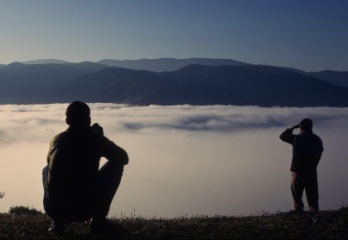
Trainees and two of our trainers in a moment of contemplation.

A palpable sense of shock went through our ranks when one of us was drafted out of training. While education was an acceptable grounds for draft deferment, Peace Corps deferments were up to individual draft boards who didn’t always view trainee status as entitled to deferment. A few trainees left the program early for personal reasons, and a case of pneumonia sent at least one trainee home for medical reasons. By the end of training, our original 43 trainees had become a contingent of 30 volunteers, who, having endured the rigors of training, might succeed the ultimate test of surviving, and hopefully thriving, on their own in Morocco.

PAINS & PLEASURES:

Our 12 weeks of training in Hemet have left a few memorable impressions intact to this day, basic sustenance being one of them. The food provided by the training organization, the anonymously titled “Development & Resources Corp.”, was so bad that two months into training, it nearly provoked a mutiny. In one of my letters home, I described it as 40% fat and 50% carbohydrates. The cost of our upkeep, per head, was rumored to be $3.50 per day. After all, the more D&R spent on us, the less would be left for the company. On the bright side was the mid-morning visit by the Taco Truck, whose coffee and crunchy fare were often the high points of our day.

A giant plow with an opposed pair of blades in the Imperial Valley.

Language training, all 336 hours of it, was brutal, but our Moroccan teachers were tireless, effective, and patient. In retrospect, it must have been much harder for them than it was for us. We spent hours on the pronunciation of sounds that don’t exist in English: glottal stops, unfamiliar consonants, tricky vowel sounds, and extravagantly rolled R’s.

Our lazy, middle-of-the mouth, American English was no match for a language that demanded agility from the tip to the root of the tongue, lips and deepest recesses of the throat. We learned just enough darija, as Moroccan dialect is called, to learn some more. Our crash course in the language endowed us with the gift of comprehending, if only a little, the complexities of life in a culture very different and distant from our own.

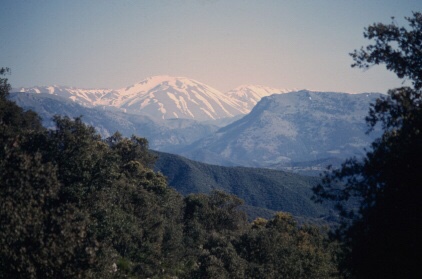
In spite of our six-day work weeks, Sundays and holidays provided free time for all kinds of recreation, as long as it didn’t involve spending money. I’m not sure when our $75 a month salary kicked in, but our circumstances were, at the time, necessarily miserly and monastic. After weeks of admiring Mt. San Jacinto, rising to nearly 11,000 feet above the Hemet Valley, a small group of us decided to make the ascent. We were mostly naive easterners, and set out traveling light, without much food or water. It didn’t take long to figure out the error of our ways.

We ran out of water well before arriving at the summit, where the lone occupant of the Forestry Service fire lookout station studiously ignored our parched entreaties for water. Not all of our number succeeded in making the descent unaided, and our group had to separate, hoping to summon aid when one of us got to the town of Idyllwild at the foot of the mountain. Fortunately, another group of visitors, descending single file on a bunch of sturdy saddle mules, happened on our exhausted comrade and delivered him to the trail head. It was a sobering reminder, that despite our youthful energy, there were limits.

The program included, inexplicably, two horses, corralled in a small enclosure behind our barracks. They seemed to share the boredom of our long days off, and I found that the old gelding, Bub, enjoyed excursions in the sandy dry river bed that ran along the San Jacinto foot hills. It became a solitary source of joy to bridle up Bub, straddle his wide warm back, and set out for nowhere in particular. He was capable of a sweet rolling canter, but had an alarming tendency to stumble. Riding bareback, thin winter sunshine casting our long shadows on the valley floor in the cool waning days of 1967, was a singular pleasure.

Bub and his friend.

On a less pleasant note, were the visits to the local doctor’s office, where we lined up to be injected with an endless variety of immunizations and vaccinations, each with its own level of discomfort. The last of these puncture parties featured the dreaded Gamma globulin shot, 5 cubic centimeters of thick amber liquid with the consistency of motor oil, delivered to the gluteus maximus. This slug of extra antibodies rendered us temporarily impervious to all manner of pathogens.

“Deselection” was the official euphemism for being rejected from training, which could happen at any point if the staff determined that a trainee was lacking in either the aptitude or attitude for two years of service in Morocco. The most dreaded kind of deselection could occur at the very end of training, leaving the rejected volunteer to pack up his hard-won education and move on.

For some reason we trainees were asked to assess our peers, as if we could judge each others’ chances of success going forward, but ours was not to reason why. On the last day, one of our more flamboyant and likable trainees, a California dude, was sent home, which left us in a state of sadness mixed with relief at having gotten through the ordeal, anticipating a return to the comforts of home and family for three days before convening at JFK, at last, Morocco bound.

POST SCRIPT:

Arriving in Morocco, we had two more weeks of training and orientation before heading out to our assigned posts. One of our assignments involved trying out the most basic of Moroccan agricultural practices, guiding a traditional wooden plow behind a mule. It was a humbling experience. The only metal part of this ungainly tool was a flat iron blade that scratched a shallow furrow into the earth. We had brought with us a brand new iron moldboard plow. Its curved blade, first designed by Thomas Jefferson, and later patented at the turn of the 19th century, not only cut a furrow, but turned the soil over like a breaking wave.

The traditional Moroccan plow was about two centuries behind the times, and the improvement, in our eyes, was striking. We proudly presented the new plow to the farmer who had participated in the demonstration. He seemed mildly appreciative, but somewhat nonplussed by this newfangled gadget, just as his American counterparts had greeted the introduction of the same newfangled moldboard plow with equal skepticism 167 years earlier.

Morocco X, was never to realize its potential. The Mexican Wheat, and the USAID Program to introduce it was delayed. Our volunteers in the field became redundant onlookers in a bureaucratic system that was barely functional to begin with. Our language skills, while appreciated, were inadequate in an administrative environment that relied heavily on the French language, as Morocco had only gained independence from the French protectorate in 1956, eleven years before our arrival.

A kindly Belgian agronomist in the Taza Provincial office offered me a place as his assistant in a UN Funded program to introduce modern techniques of bee-keeping to farmers in the Rif mountains. Honey was a popular commodity and a valuable cash crop. Apiculture was a good option for farmers who lacked enough arable land to provide for their families. After a month of training with an old Belgian pied noir, who bellowed “praise God” every time I was stung by the ferociously aggressive African bees, I finally had a mission whose only drawback was its seasonality. To fill in the winter off-season, I became an English language teacher at the local Taza Lycée.

Morocco X was officially disbanded at the mid-service conference. Some volunteers who had found work at the more active provincial agricultural centers, or other more specialized areas of endeavor, would stay on to finish their two-year term of service, or even extend for a third year. The rest were offered a plane ticket back to the States or transfer to other programs.

An “Evaluator”, sent from Washington to ascertain the nature of Morocco X’s thwarted ambitions, observed, in a moment of candor, that he had never seen such a promising group of volunteers so poorly tasked or deployed.

As the philosopher Kierkegaard observed, “Life can only be understood backwards; but it must be lived forwards.” The Morocco X experience may have been an exercise in blind optimism, and the futility of good intentions, but for many of us the struggle to start life from scratch in a foreign culture demanded an intensity of self-examination and self-realization that gave us the will and the way to a larger sphere of life, “lived forwards”.

For some of us the experience was a gateway to careers in education and international development, for others the experience opened the door to experiencing a world we could not otherwise have imagined. Morocco X, whatever its faults, changed each of us in profound and simple ways that have resonated throughout life that “can only be understood backwards”.


Authored by Reed Erskine, Morocco X Volunteer

Khadija

In the middle of the first snow storm of the winter, with the temperature near or below 0° F and wind chills 20 or 30 degrees lower, every reason to stay indoors is a good one, though I did walk to the road to get the Sunday morning newspaper. Niagara County has issued a traffic advisory, counseling drivers to stay off the roads unless it is absolutely essential. Even Lucky, our male cat, who normally demands to be let out early so he can pad around, sniffing out the intruders of the night before and marking his territory, only went out once. The snow was deep and very cold, and when Lucky ran back in after five minutes, he never asked to go out again. As storms go, this was a good one, but we have certainly seen much worse. Our driveway has been plowed for us, so we are not housebound except by choice. These few days of winter are ones that one enjoys best inside. Winter has settled in for awhile, so why shouldn’t we?

We subscribe to a number of magazines, and often they go unread, piling up in unvisited corners of the house. I try to keep them as long as I can, imaging that I will find some time to read them, but I often end up only skimming them or tossing them unread.

Settling in with the storm, I picked up the latest issue of the New York Review of Books,which had just arrived. The first article was a review, by a Mexican writer, of Alfonso Cuarón’s new movie, Roma. If you are a fan of the movies, you will probably have noted that this autobiographical film about the life of a nanny in a middle class Mexican household has garnered critical acclaim, and is an Oscar contender. The reviewer related her own life directly to the movie: she had grown up in a similar situation. Indeed, it was common for those who could afford it to take on nannies and cooks from impoverished rural areas. These women ended up as primary caregivers to children of others, while sometimes their own children lived far away in their native villages. This was the best they could do. They traded abject poverty for meager positions where loneliness and mistreatment and neglect were common. Any love they gave and received was often only from the children for whom they cared. This is one of the themes of Roma.

For Americans, the live-in nanny is an unusual profession, and only wealthy Americans can afford one. I grew up in a generation of stay-at-home moms, but today two-wage earner families are the norm, and childcare is a common problem. With mobility often a requirement for employment, Americans change residences frequently, and often live far from their own parents and other relatives. Day care and more makeshift arrangements are expensive, and many parents look forward to the time when their children finally begin school, when the need for day care is reduced to a few after-school hours. In Europe au pair girls often fulfill the role of the nanny, trading pay for a chance to learn a foreign language and culture, but, like nannies, au pairs in America are expensive and rather exotic.

In poor societies, lack of employment means that women will often take jobs as domestic servants. This was the case in Morocco, even though there was a strong bias against work outside the home, and women who did it were looked down upon. Rules of modesty were necessarily abandoned by a woman working outside in another’s home Sometimes a poor country relative was taken in, and often treated much as a Cinderella. Many of the French coopérants hired bonnes, maids, to help them. Working for foreign non-Muslims didn’t help a woman’s status, but it was better than nothing. In France, having a bonne was perhaps more common than for an American woman to have hired help, and the word maid, in American English, certainly has strong associations with upper-class living.

Khadija pouring tea. Photo by Don Brown, 1969.

When I began my work at a primary school chicken cooperative in the Habouna neighborhood of Sefrou, I replaced two volunteers who had employed a young woman to clean for them. Her name was Khadija, and she came daily. At the end of the summer of that same year, another Morocco X volunteer, Gaylord Barr, proposed that we rent a house in the medina, the old walled part of town. He moved out of a small European style house high above the ville nouvelle, the French-built new town. It was a long, steep walk to his house, and the house was far from everything. I moved out of the little block building in the yard of the school garden, a dwelling that I can easily say had the least privacy imaginable outside of a bidonville or a medina tenement. It was coveted by the chaoush (a kind of page or messenger), and, in the end, he got it. In addition to better housing, both of us looked forward to living within the medina walls. At the time, we naively thought of that as being in the authentic Morocco. In fact, it was the Morocco of the poor. Today, the medina of Sefrou is degenerating into a slum, and there have been calls to preserve it.

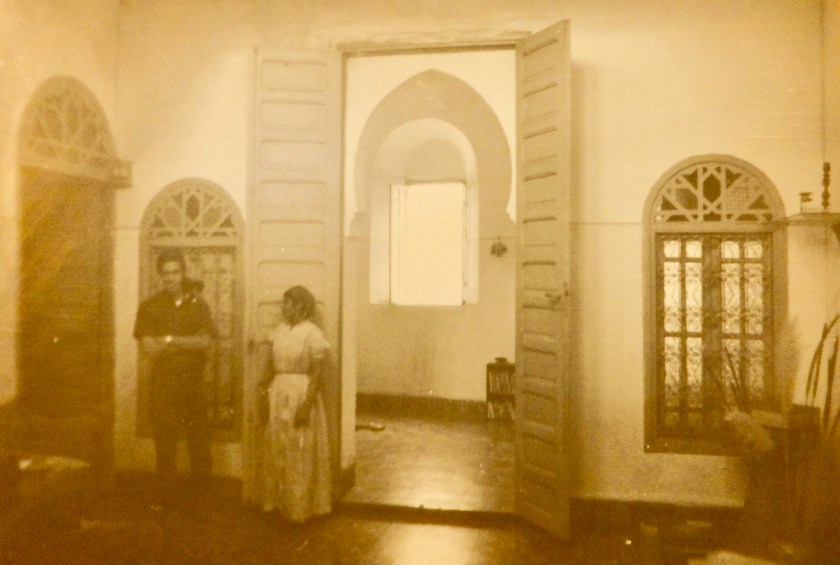
The Sefrou house was the last door on the left. Khadija is standing in the street. The gate pierces the city wall.

With the two of us in a substantial house, we needed help, and, with two Peace Corps allowances, modest as they were, paying for it was not difficult. So Khadija came to work for the two of us. Hiring help was not an uncommon practice among volunteers, but not every volunteer had a maid to clean and cook, nor did everyone want one.

Gaylord, Samira the cat, on his shoulder, Khadija. Looking toward the street side.

I never asked Khadija how old she was, and though she had an identity card with a birthdate, it might have been wrong. I think she was about my age, or possibly slightly older.

Poor Moroccan women tended to age quickly. She was not an old woman in any case. Her surname was Demnati, which suggests that her family was from the place of that name. I remember her husband, Ali, talking about the famine in Marrakesh, and Demnat is not far from Marrakesh.

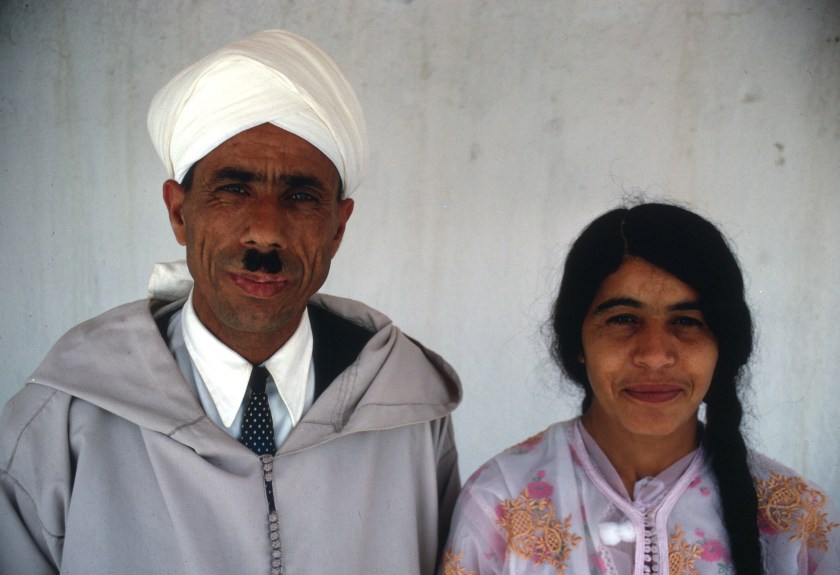
Khadija and Ali

She did not speak Berber, as far as I know, though she would not have had any occasion to do so in our house. Ali had served in the French army in Vietnam, and sympathized with American soldiers at the time. Indochina was not a fond memory. He lived on his military pension, and it was not much, so Khadija’s wages contributed substantially to the family income. He had been married before, because he had a son, Mohammed, who lived with them. The three of them shared a house in the medina, with two or three other families. Khadija had no children of her own.

Khadija and Mohammed

Khadija had no formal education, and could not read or write, which was not unusual considering her generation and social class. She had no trouble with arithmetic or handling money, however. Since Khadija spoke no French, her employment was limited further, but the volunteers of Morocco X were trained in dialectical Arabic, so Khadija’s daily language was fine for us, and speaking with her gave us constant practice as well as information about what was going on in the world. We never attempted to teach her English.

Khadija’s duties were limited, though it might not seem so as I list them. She would shop, bake bread, cook, do laundry and clean house.

Lunch on the roof

She made lunch, and there was usually enough for dinner in the evening. She usually arrived about 8:00 in the morning. Once I began working in Fes, I would only see her on weekends or on holidays, but I knew there would be food waiting when I arrived home, often at seven or eight in the evening.

If we had guests, she would work extra time. When Khadija needed time for something personal, she was always able to take it.

From the point of view of a Moroccan domestic, she had a good job. I think we paid more than the going rate, about $20.00 per month, and we were not demanding. When she made bread for us in the morning, she made her own bread, often I suspect, with our flour, but that was okay with us. When there was extra food, she could take it home for her family, and we gave her things we did not need and took her to Fes to the dentist and doctor when needed.

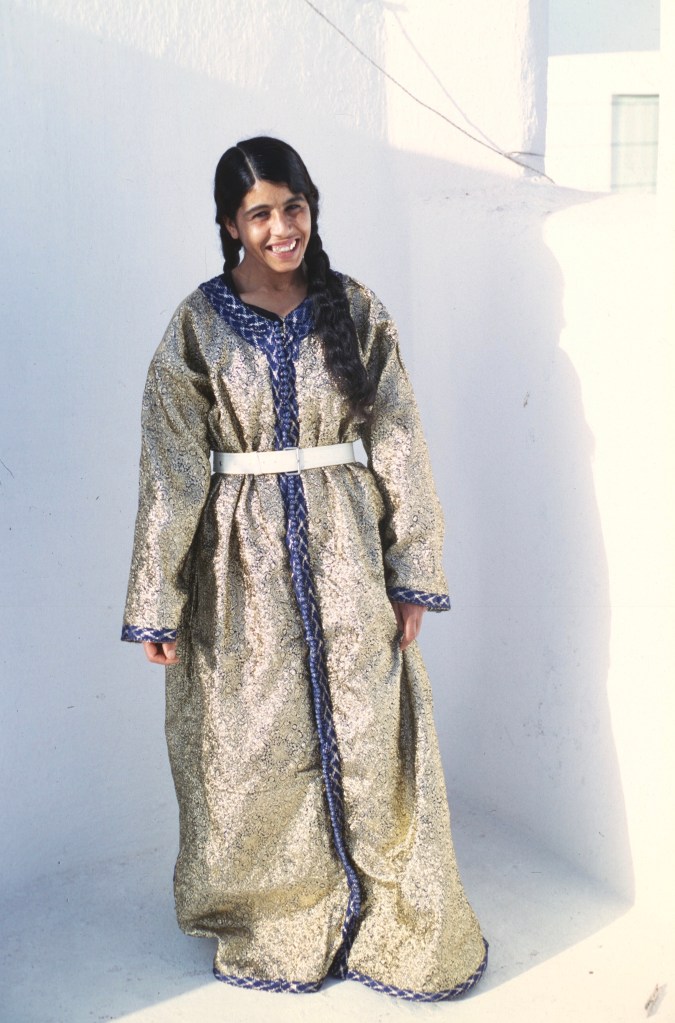
In a new dress.

She in return did us favors. When we had women visit, she would take them to the hammam (the public baths) or to fortune tellers or whatever women’s activity they were interested in.

With Liz Carpenter, Lady Bird Johnson’s press secretary, and Carpenter’s daughter

She also took care of the numerous pets: cats, doves, canaries, tortoises, hamsters. Changing the cat litter, which was straw, was a nasty job, although the cats eventually helped out by using the roof of the room on the terrace, to which there was no easy access, as a giant cat box!

Washing dishes on the roof.

Khadija did laundry (and rugs) in a large galvanized tub on the roof where the laundry was also hung to dry. Gaylord and I sometimes used this tub to take baths, when we couldn’t get to the neighborhood hammam.

The neighborhood hammam. The left side was reserved for women.

It was just large enough to sit in, if you crossed your legs. I’d put a couple of kettles on the stove, drag the tub to the bathroom, which was the only room on the ground floor, and mix the hot and cold waters. The house had no hot water, and I don’t recall anything in the bathroom except a Turkish toilet, though there was probably a tiny wash basin. After a bath, you just dumped the bath water into the toilet hole. You were warm as long as the water in your tub stayed warm, and until the kettles ran out of fresh rinse water.

Khadija cooked from the room we called a kitchen, though it had no running water. The water was on the landing, at the main level of the house, that marked the division between the stairs that led to the roof and those that went down to the bathroom and front door. This was where dishes were washed though I think there were sunny days when pots and pans were done on the roof.

Washing clothes on the roof.

Since the stove sat on a cupboard, the food was cooked standing, but much of the preparation was done as Khadija sat on the floor. As a poor woman, her cooking repertoire was probably limited, but I have never eaten as well since, and she could make all the standard Moroccan fare.

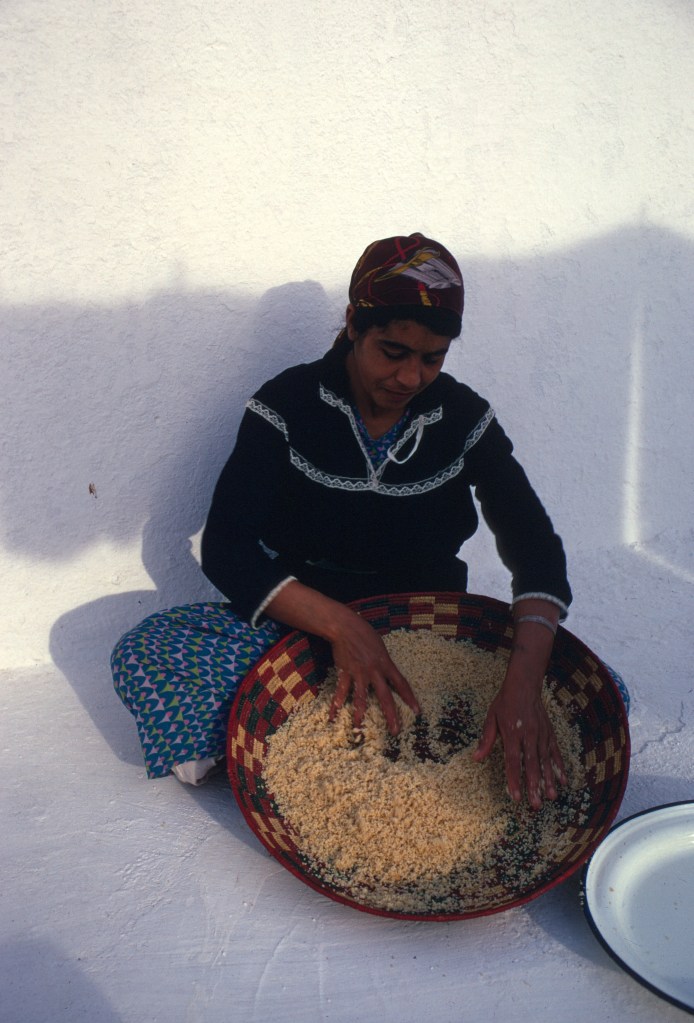
Preparing couscous. It didn’t come out of boxes.

On Aid es-Seghir we would visit her house to break the fast. One year we joined in buying a sheep with her for Aid el-Kbir, and it was kept on the roof. We called it Messaoud, an ironic name, and for the several months it lived above us, I could hear the the patter of its hooves.

With Messaoud.

It was playful too, and would chase you if you encouraged it. After keeping it a couple of months, it was almost like a pet. If it were possible to later describe your pet as delicious.

A sad end, but Messaoud was sacrificed in remembrance of the sacrifice of Ibrahim.

Khadija was really a kind of nanny. She took care of us in good health and in sickness, and did her best giving advice about dealing with the life about us as well as the supernatural. Moroccans, often superstitious, worried about the evil eye and malicious spirits. Khadija warned us about pouring hot water down the drain (it would anger the jinn that lived there) and leaving our clothes in disarray when we went to sleep (jinn would wear them and bring illness to the owners.)

She was an intermediary with our neighbors and shopkeepers too, and I am sure she helped us develop relationships with some of them. I don’t know if Khadija loved us with the love the nanny in Roma had for her employer’s children, but the affection she showed was real, and we often treated her more as a friend or a parent than as a servant. I sure she was often exasperated too, by the stupid things we did.

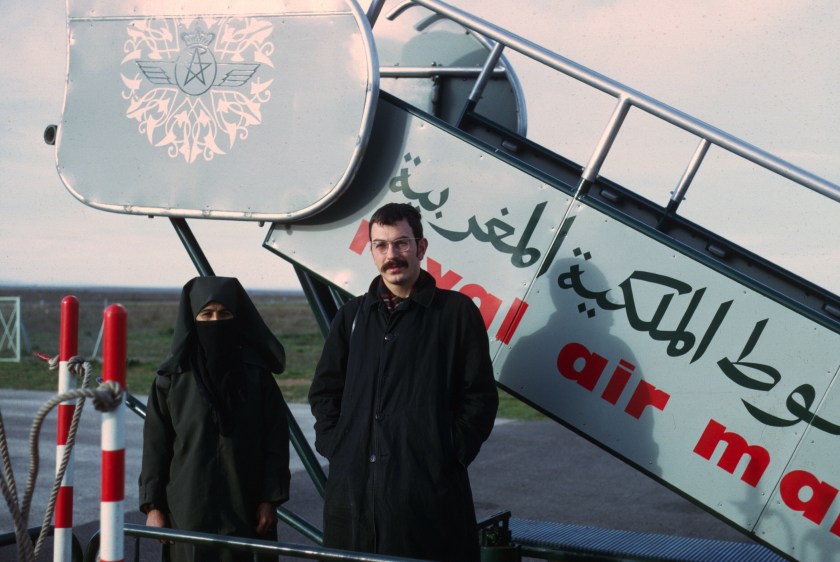
With me in 1970, at the Fes airport.

I left Morocco in the late summer of 1971. Gaylord had reenlisted for another year of teaching at the Lycée Sidi Lahcen Lyoussi. Returning from Tunisia, he contracted typhoid, and had to be evacuated to a U.S. military hospital in Spain where he spent a couple of months. During that time, Khadija watched the house and took care of the pets. Before Gaylord left in July 1972, he used some of the money he had saved to invest in a business in which Khadija would be co-owner, but, according to Khadija, her partner absconded with the stock and she ended up with nothing. It was tough for a woman to enforce her rights.

In 1973 I returned to Sefrou for a few months, and rented a place to live. I hired Khadija again. Gaylord visited Sefrou in the late 1990s, and saw her again too. She was working for a French national in the ville nouvelle, and hoping Gaylord, on his way home from Saudi Arabia, would give her money. He was put off by her behavior and complained bitterly about it to me in his description of his visit. I was frankly surprised.

Looking back, I wish I had got to know Khadija better. She might have had it easy working for us, but she had a hard life, as most of the people of her social status did. I felt for her then as I do for her now. If I had planned to be an anthropologist, I would have had four years to document her life. In retrospect, I marvel at how little I knew about her. I never learned how she married, who her friends and relatives were, and how she practiced her religion. Gaylord knew her far better than I, but he has sadly gone. I also would have liked to help her more than I did, but when I left Sefrou that chapter of my life ended. There was no easy way to stay in touch with someone who could not read or write, and the computer era had yet to dawn.

Toubkal 50 ans plus tard

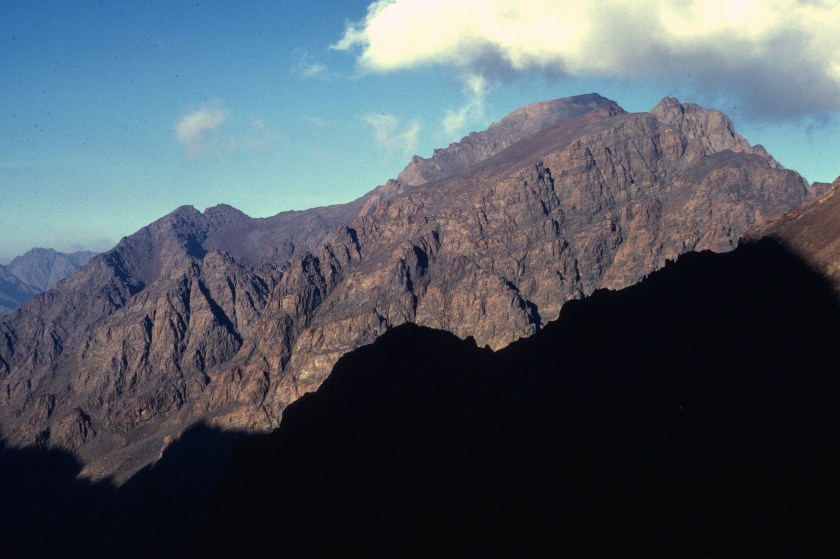
Toubkal au coucher du soleil

Environ une semaine avant Noël, un article sur le tourisme a paru dans le Washington Post (Tourists are ruining these destinations. Here’s where you should travel, instead.) offrant des possibilités de voyages moins courus en remplacement de certaines destinations très populaires qui sont de plus en plus coûteuses et bondées. On a proposé, par exemple, un autre site au Pérou pour remplacer Machu Picchu.

Au cours des cinquante dernières années, l’expansion du transport aérien a rendu accessibles et abordables des régions autrefois éloignées des sentiers battus. La mention de Machu Picchu m’a rappelé un souvenir.

Au milieu des années 1960 quand j’étais à l’université, Chuck, un étudiant dans la chambre attenante à la mienne dans Cutter Hall, avait été au Pérou. Il se peut que sa famille y restait. Les visites au célèbre site Inca étaient moins fréquentes et plus difficiles que de nos jours. Il m’a raconté comment lui et un ami sont arrivés tard à Machu Picchu, ont regardé l’arrivée de la nuit dans les montagnes, et ensuite se sont installés dans leurs sacs de couchage. Tout seuls au milieu des ruines, « la cité perdue des Incas » leur appartenait. L’expérience était presque spirituelle et ils attendaient impatiemment l’aube.

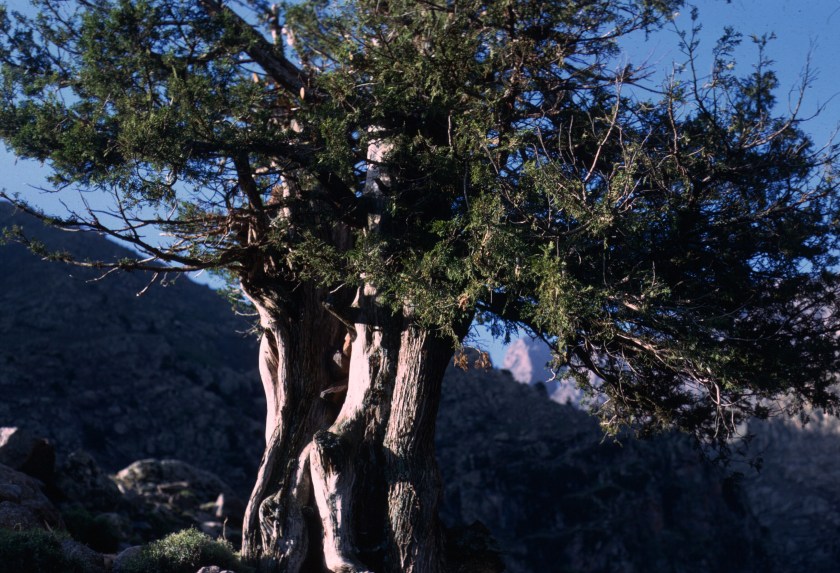
Un thuya en route vers Tazaghart

Quand ils se sont réveillés le lendemain, par contre, l’aube ne leur a pas apporté ce à quoi ils s’attendaient. Dans un vacarme considérable, une équipe de cameramen préparait un tournage, Le secret des Incas, mettant en vedette Victor Mature, acteur de films de série B dont la notoriété reposait sur les rôles qu’il jouait dans des films bibliques des années 1950.

Or, en toute honnêteté, je n’ai pu trouver un film de ce titre mettant en vedette Victor Mature; il s’agissait peut-être de Le secret des Incas avec Charlton Heston ou même d’un autre navet encore plus insignifiant. Quel que soit le film qu’on tournait lors du réveil de Chuck et de son ami, Machu Picchu s’est avéré tout sauf « une cité perdue ».

J’aurais préféré que ce soit un film de Victor Mature. Cette star américaine avait une réputation d’acteur médiocre à tel point qu’à l’université Harvard, les étudiants lui ont décerné le prix de Pire acteur de l’année, et ce plus d’une fois. Bon prince, Mature l’acceptait de bonne grâce. Une fois en Californie il avait fait une demande pour devenir membre dans un club de golf, demande qui a été rejetée « parce il était acteur », ce à quoi il a répondu avec indignation : « Je ne suis PAS acteur, et j’ai soixante-quatre films qui le prouvent. »

Dans la liste de nouveaux sites à visiter se trouve le mont Toubkal en remplacement de l’Everest. Le camp de base du mont Everest est devenu une destination très fréquentée par les randonneurs. Autrefois le simple défi de se rendre à la base des montagnes constituait l’un des dangers et l’une des difficultés de l’ascension des 8 000 mètres des sommets himalayens. Les récits des premières ascensions témoignent des difficultés des approches et racontent des histoires de porteurs qui abandonnent, de passages à gué dangereux et de forêts de rhododendrons infestées de sangsues.

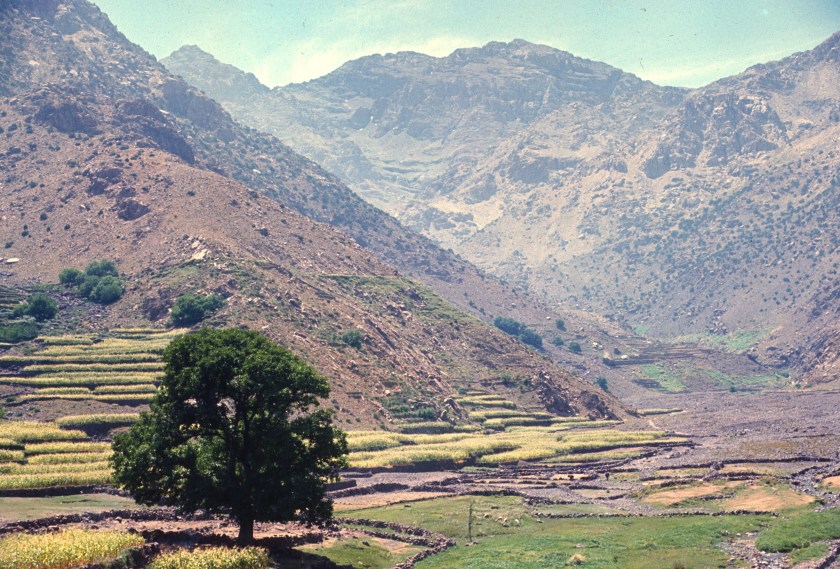
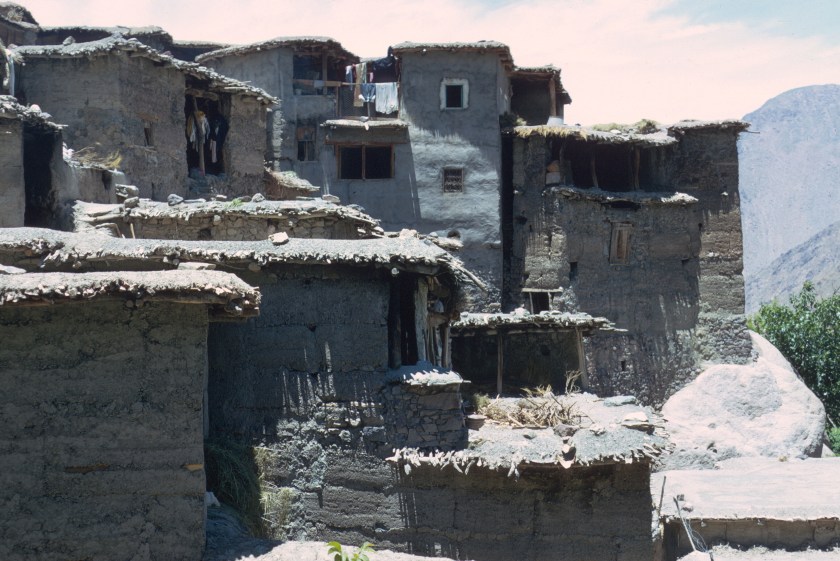
Maisons typiques dans la région du Toubkal

De nos jours, quiconque qui jouit d’une bonne santé et a les moyens de payer le billet d’avion, peut trouver le moyen de s’y rendre à pied et ce n’est donc pas surprenant que certaines parties de l’Himalaya soient débordées. En Europe pour les pistes populaires, les alpinistes doivent faire la file et la France vient d’annoncer des limites (200 personnes par jour) pour ceux qui veulent grimper au sommet du mont Blanc.

Or, le Toubkal se situe à une tout autre échelle que celle de l’Himalaya et présente des paysages différents. Le sommet du Toubkal est des milliers de mètres plus bas que le camp de base de l’Everest et, si vous voulez voir de la neige au Maroc, il faut y aller pendant une saison autre que l’été. Ceci dit, une visite au Toubkal coûte relativement peu cher et, se trouvant à une courte distance de Marrakech, est d’accès facile. Ayant passé du temps dans cette région du Haut-Atlas, je n’hésiterais pas à en recommander les paysages. On peut se rendre facilement à la base du Toubkal à pied ou à dos de mulet, en quelques heures plutôt que jours, et la plupart des randonneurs peuvent composer avec l’altitude modeste du Toubkal.

Malheureusement, peu de temps après la publication de l’article mentionnant le Toubkal, deux jeunes femmes scandinaves qui faisaient du camping près d’Imlil ont été brutalement assassinées. La police marocaine a rapidement mis la main au collet des suspects et, selon la presse, certains des responsables impliqués avaient prêté serment à l’État islamique.

Depuis une vingtaine d’années, le Maroc, à l’instar des autres pays du Maghreb, a vécu des attaques terroristes, mais elles ont été peu nombreuses. Le tourisme constitue une source de revenus importants pour le pays et la protection et la sécurité des visiteurs étrangers a toujours été une préoccupation prioritaire du gouvernement marocain.

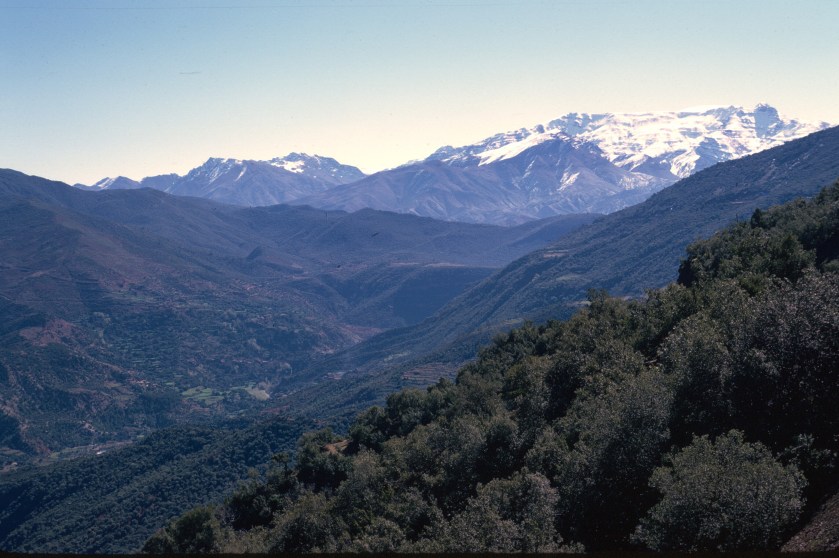
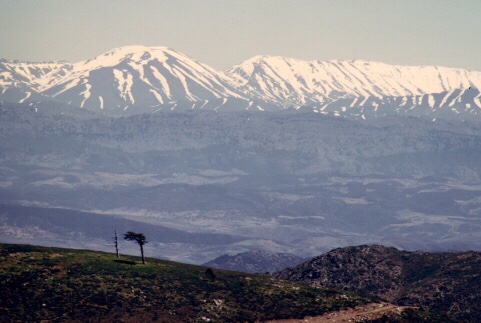
Vue vers l’est à partir du chemin Tizi-n-Test, Angour et Tazaghart

J’ai vécu au Maroc peu de temps après son indépendance de la France. À cette époque, la tolérance religieuse envers les non-musulmans était variable et dépendait de plusieurs facteurs, mais peu de Marocains avaient des croyances comparables à celles des islamistes radicaux de nos jours. Les Marocains, à l’aise dans leurs convictions et dans leur religion, abordaient les non-musulmans avec confiance. Après tout près d’un demi-siècle de régime colonial et des siècles de conflit avec des puissances chrétiennes et musulmanes, des conflits qui avaient plus à voir avec la concurrence relative aux terres et au commerce qu’avec la religion, les Marocains s’étaient forgé une identité propre. Les Marocains que j’ai connus, plus jeunes et mieux instruits, semblaient moins religieux que leurs aînés et se moquaient souvent des croyances populaires, mais ils étaient tout de même convaincus d’avoir la véritable religion, à part quelques athées autoproclamés qui prenaient soin d’en parler tout discrètement. Pendant les sept ans où j’ai vécu au pays, j’ai été témoins de bien peu d’incidents de préjugés religieux. Celui dont je garde le plus vif souvenir est arrivé au Jbel Alam pendant le moussem de Moulay Abdessalem ben Mechich, quand une jeune femme a fait exprès pour s’en prendre à moi et à un ami. Elle trouvait que nous n’avions pas d’affaire là et elle l’a dit avec force, mais ses sentiments n’ont pas trouvé d’écho chez les centaines d’autres participants et finalement elle a été emmenée par ses amis ou par sa famille.

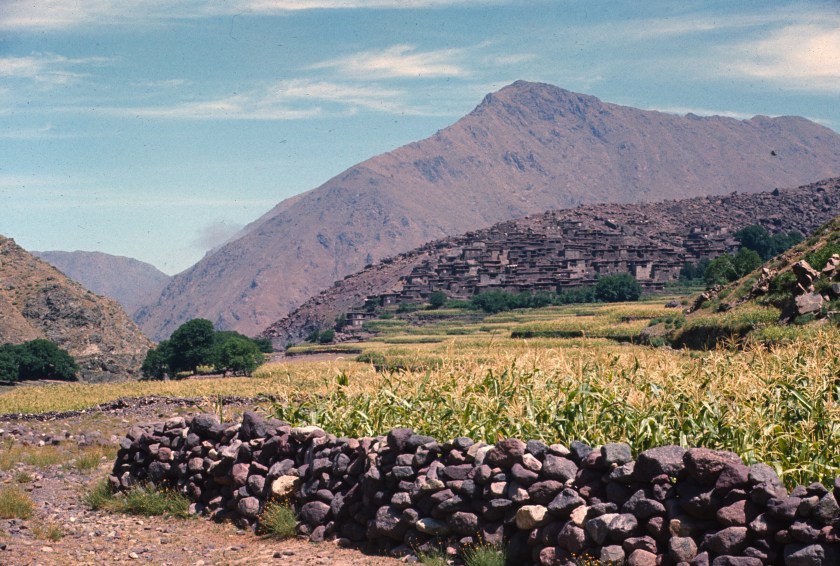
Chemin menant à la base du Toubkal à Aremnd

Il se peut que les Marocains soient devenus plus conservateurs depuis les cinquante dernières années. L’Arabie saoudite travaille fort pour exporter sa version de l’islam partout dans le monde musulman et, à grand renfort d’argent, a connu du succès. Les Saoudiens que j’ai rencontrés quand je voyageais en Arabie saoudite ne cachaient pas leur mépris pour l’islam marocain qu’ils considéraient infesté de magie noire, de sorcellerie et de vénération de saints. De plus, ils dénonçaient l’attachement des élites marocaines à la langue et à la culture françaises.

Vue d’Akioud à partir de la partie occidentale de la crête du Toubkal, tard dans la journée

L’islam radical offre un débouché séduisant aux pauvres, désenchantés et sans emploi qui ne peuvent autrement exprimer leurs opinions politiques. Un terme ironique en langue arabe, « armée des oisifs » désigne cette source de recrues jeunes et vulnérables prêtes à tout sacrifier pour des causes spéciales.

L’islam est une religion politique et dans les pays musulmans, la séparation de la religion et l’État n’existe pas. Il n’y a pas de pays musulmans laïques. Par contre, il existe bien d’autres façons d’aborder l’islam à part celle des Saoudiens. Le Maroc, quels que soient ses défauts, a toujours fait preuve de modération et de tolérance.

Vue donnant sur Tachdirt lors d’une journée enneigée en mars.

Durant le protectorat, le Club alpin français a construit des refuges de montagne dans la région du Toubkal. Au fil des ans, le tourisme s’est développé et plusieurs compagnies privées, généralement françaises ou britanniques, offrent des excursions et des randonnées, non seulement près du Toubkal, mais aussi dans d’autres pittoresques régions montagneuses de l’Atlas. Grâce au tourisme étranger, Imlil s’est développé et a prospéré.

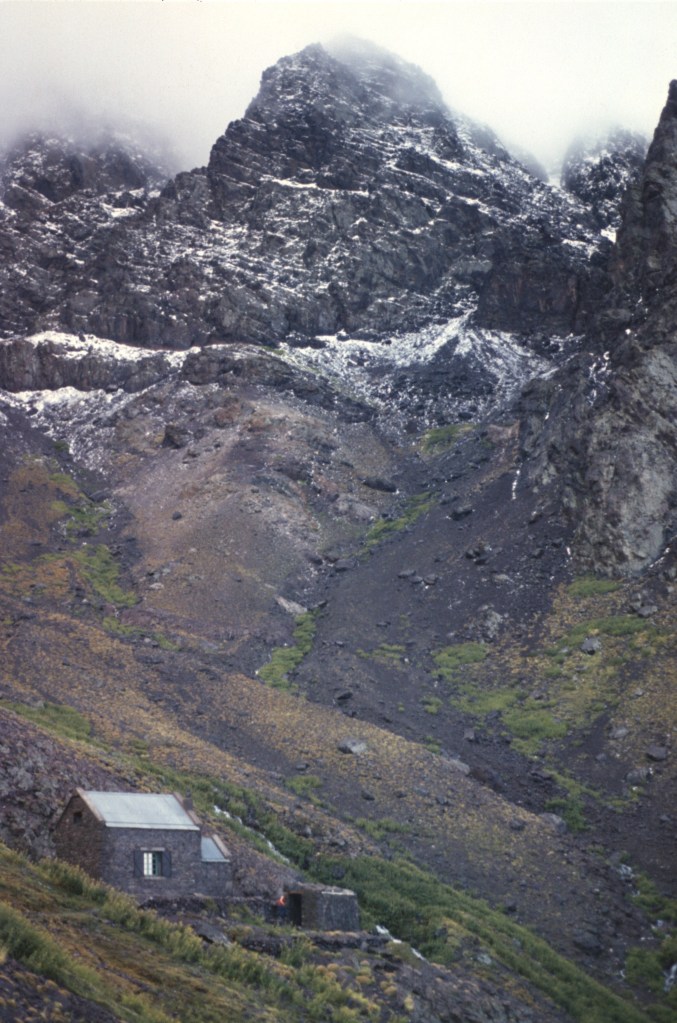
Refuge de Lépinay en face de Tazaghart

Si vous prévoyez un voyage au Maroc, je vous encourage à y aller sans souci. Mon seul bémol : pour de jeunes femmes, où que ce soit dans le monde, faire du camping seule constitue un risque. Je conseillerais aux femmes de voyager accompagnées de compagnons masculins, en groupes organisés ou bien de rester dans un refuge de montagne. Coucher sous une tente seule peut s’avérer dangereux. Ceci dit, depuis quelques années il y a eu plus d’attaques terroristes à l’intérieur des États-Unis qu’au Maroc; les incidents récents ne devraient pas vous dissuader d’y faire une excursion.

Treq es-slama! (Bon voyage!)

morocco h atlas tsoukei copy

                           Crête de Tsoukine au coucher du soleil


Auteur: David Brooks

Traduction: Jim Erickson


Toubkal 50 Years Later

Toubkal as the sun sets.

A week or so before Christmas, a travel article appeared in the Washington Post (Tourists are ruining these destinations. Here’s where you should travel, instead) that offered less crowded travel alternatives for some very popular and increasingly pricey and crowded destinations. For example, another Pre-Hispanic site was proposed as a replacement for Machu Picchu in Peru.

Over the last 50 years, the growth of air travel has made many formerly remote areas both accessible and affordable. The mention of Machu Picchu brought up a memory.

When I was in college in the mid-sixties, Chuck, the student in the room adjoining mine in Cutter Hall, had been in Peru. Perhaps his family lived there. Travel to the famous Inca site was less common and more difficult than it is today. He recounted how he and a buddy arrived late, watched evening arrive in the mountains, and then settled into their sleeping bags. Alone among the ruins, they had the “lost city of the Incas” to themselves. The experience was almost spiritual. They could hardly wait till dawn.

A Thuya, en route to Tazaghart.

When they awoke in the morning, however, the dawning day was not what they had expected. With considerable commotion, a film crew was setting up for a movie shoot, The Last of the Incas, staring Victor Mature, a B-film actor whose claim to fame was his role in the biblical epics, popular in the 1950s.

Now, in all fairness, I couldn’t find a film of that name with or without Victor Mature in it, so perhaps the movie was the Secret of the Incas with Charlton Heston or something even more forgettable. Whatever the film being shot, when Chuck and his friend awoke, Machu Picchu was a long way from being “a lost city.”

I wish it had been a Victor Mature movie. The American star, Mature had a reputation as a mediocre actor, and at Harvard, the students fêted him with Worst Actor of the Year Award, more than once. He took this all in good humor. He once applied for membership in a golf club in California, and was rejected “for being an actor.” His indignant reply was: “I am not an actor, and I have sixty-four films to prove it!”

The list of spots featured in the article included Mt. Toubkal as a replacement for Mt. Everest. The Everest base camp in Nepal has become a popular trekking destination. Part of the difficulty and danger of climbing 8,000 meter Himalayan peaks had once been simply getting to the base of the mountains. Early ascents certainly attest to the difficulties of the approaches, and accounts were sprinkled with descriptions of porters quitting, dangerous river fords and leech-filled rhododendron forests.

Typical houses in the Toubkal area.

Nowadays anyone fit, and with the airfare, can find a means to hike in, and it should come as no surprise that parts of the Himalayas have been overrun. In Europe climbers have to queue up on popular routes, and France has just announced limits on those climbing to the summit of Mont Blanc.

Now Toubkal is a different scale altogether from the Himalaya, with a different kind of scenery. The summit of Toubkal is thousands of meters below the Everest base camp, and should you want to see snow in Morocco, you had better visit in a season other than the summer. That said, a Toubkal visit is relatively inexpensive, and it is a short ride from Marrakesh and quite easily accessible. Having spent time in that area of the High Atlas, I would not hesitate to recommend the scenery. Getting to the base of Toubkal is easily done by foot or by mule, in hours, not days, and most hikers can deal with the modest altitude.

Sadly, within a week or so of the article mentioning Toubkal, two young Scandinavian women camping near Imlil, were brutally murdered. Moroccan police quickly captured suspects, and, according to press reports, some of the perpetrators involved had pledged allegiance to ISIS.

In the last 20 years or so, Morocco, like the other countries of the Maghreb, has experienced terrorist attacks, but these have been few and far between. Tourism constitutes a major source of revenue for the country, and the safety and security of foreign visitors has always been a major concern of the Moroccan government.

Looking east from the Tizi-n-Test Road, Angour and Tazaghart.

I lived in Morocco not long after its independence from France. In those days, religious tolerance of non-Muslims varied depending on many factors, but few Moroccans held beliefs comparable to today’s radical Islamists. Moroccans, secure in their faith and comfortable with their religion, dealt confidently with non-Muslims. After nearly a half century of colonial rule, and centuries of conflict with neighboring Christian and Muslim powers, conflicts which involved competition for land and trade far more than religion, Moroccans knew who they were. The younger, more educated Moroccans whom I knew seemed to be less religious than their elders and often poked fun at folk beliefs, but there was no question in their mind as to the true religion, apart from a few self-proclaimed atheists who would only talk privately and cautiously. In the seven or so years I lived there, I experienced few incidents of religious prejudice. The one I remember most vividly was on Jbel Alam, during the moussem of Moulay Abdessalem ben Mechich, when a young woman went out of her way to attack me and a friend. She did not think that we belonged there and was vocal about it, but her shouted sentiments were not echoed by the hundreds of others on that crowded mountain top and she was led away by her friends or family.

Route to the base of Toubkal at Aremnd.

Moroccans may well have become more conservative over the last 50 years. Saudi Arabia has worked hard to export its own concept of religion around the Muslim world, and, with an abundance of money, has had success. The Saudis I met while touring Saudi Arabia made no secret of their disdain for the religion in Morocco, which they saw full of black magic, witchcraft, and saint worship, and disparaged Moroccan elites for their attachment to the French language and culture.

Akioud. Late in the day, from the west ridge of Toubkal.

Radical Islam offers a tempting outlet for individuals, often poor, disenchanted, and unemployed, who really cannot otherwise express their political opinions. The “army of the idle”, an ironic Arabic term, is always there, a wellspring of young and impressionable recruits for special causes.

Islam is a political religion, and in Muslim countries, there is no separation between religion and the state. There are no secular Muslim countries. On the other hand, there are many other ways to view Islam apart from that of the Saudis. Morocco, whatever its deficiencies, has traditionally exemplified moderation and tolerance.

Looking toward Tachdirt on a snowy day in March.

The French Alpine Club built comfortable huts in the Toubkal region during the Protectorate. Over the years, tourism has grown, with many private companies, usually French and British, offering excursions and treks, not just around Toubkal, but in other scenic mountain areas of the Atlas. Imlil has grown and prospered with the foreign tourism.

The De Lépiney hut, facing Tazaghart.


If you are planning a trip there, I encourage you to go without worry. My only caution is this: young women camping alone anywhere in the world involves risk. I would suggest traveling with male companions, an organized group, or else staying in a mountain hut. Tenting alone may invite trouble. That said, there have been many more domestic terrorist attacks in the United States over the last few years than in Morocco, so don’t let recent events put you off of a Moroccan excursion.

Treq es-Slama! (Have a safe journey.)

A ridge of Tsoukine, at sunset.

Remembrance

I just came in from helping my wife spread mulch around her young arborvitae trees. Arborvitae are a species of Thuya, a genus also found in the Atlas Mountains. In the United States, they are often referred to by the Latin name given to the tree by Jacques Cartier, the early French explorer who explored the St. Lawrence River, and gave Canada its name, too. His sailors, sick, possibly from scurvy, drank a tea made from the branches of the plant. The tea brought them back to health, so Cartier named it arborvitae, the tree of life. Today, few people suffer from scurvy, but one can still drink beer flavored by conifers.

The sky is overcast and dark, and, as I was finishing my task, snow began to cover the yard. Despite major snowfalls and bad weather along the East Coast, we are just getting a dusting here. In November, snow falls regularly, but we seldom have snow cover till around Christmastime. Just south of us, along the Pennsylvania border, the higher elevations receive much more, a boon to skiers and hunters. The ski stations need the colder weather more than snow since they utilize snow-making machines; there is no sense making snow when it just melts. For hunters, snow makes the woods quieter, and once an animal has been shot, snow makes it much easier to track.

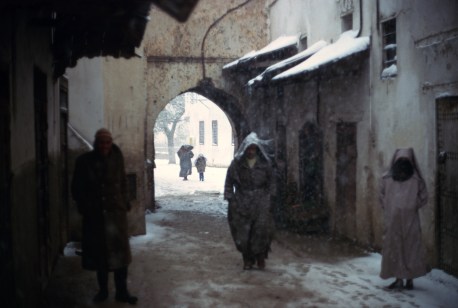
In Sefrou, it only snowed a couple of times during the four years that I lived there, but a couple of thousand feet higher, snows were common, and heavy snowfalls occasionally blocked the main road south, which was known as treq es-sultan, the Sultan’s road, the route connecting Fes with the Tafilalt. Really heavy snowfalls often resulted in trucks sliding off the road. The trucks seldom had snow tires, and their drivers did not always know how to drive safely on the snow-covered highway. I am sure that they thanked God every time they passed safely through the mountain snows.

Path from Sefrou to Bhalil on a rare snowy day.

Thanksgiving is next week, a holiday celebrated to give thanks for the blessings of being an American. The early settlers, called Pilgrims in New England, faced a harsh winter and, having survived, thanked God for his grace and mercy. The tradition I was taught in elementary school emphasized the role of the Native Americans, some of whom kindly helped the Pilgrims, who were unfamiliar with the plants and animals of the New World. Fortunately for the Pilgrims, Native Americans did not perceive them as a band of asylum seekers, greet them with hostility, and send them back across the Atlantic. The United States has always depended on immigrants to fuel economic growth, and has a long history of welcoming immigrants, with the shameful exceptions of the Chinese and Japanese.

My father’s family origins are in 18th century England, but my mother’s are much more recent. Her parents, Frank and Anna Cortese, had emigrated separately from the Mezzogiorno near the end of the nineteenth century. They did not seek asylum, just a better life and opportunities for their family. He was from Calabria, she, from Abruzzo. Sometimes when they argued he would call her a peasant. He came from a region with cities and thought Abruzzo was backward. She took that as the worse of insults, and got really angry, but most people remember her as a sweetheart.

Anna and Frank Cortese and Aunt Pat, Uncle Frank’s wife, about 1950.

They met in Philadelphia, early in the twentieth century, married, had children, moved to Western New York, and had still more children. A set of twins perished during the Spanish Flu epidemic of 1919, another child died as an infant, but eight others, four brothers and four sisters, survived to become adults.

All four brothers fought in the Second World War. The brothers in order of birth were Frank, Anthony, John, and Alfred, the baby of the family.

Article from the Niagara Falls Gazette.

Al, despite his short stature, was also quite the athlete.

Al, the whirling dervish.

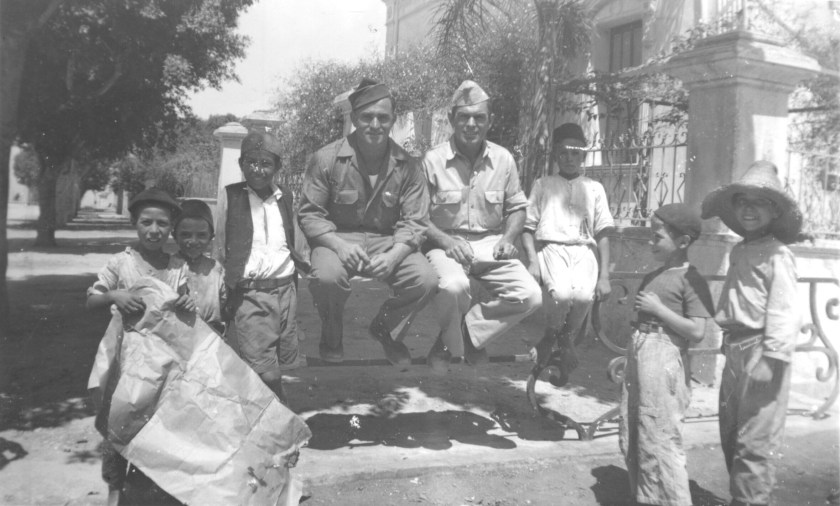
Frank was the senior brother, and already fairly old when the war began. He had helped raise his siblings, and was still unmarried. He joined the army as a construction engineer, and was sent to North Africa.

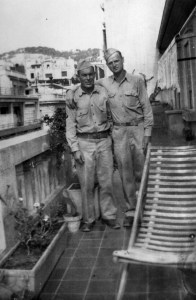
Frank, with buddy, in Oran or Algiers.

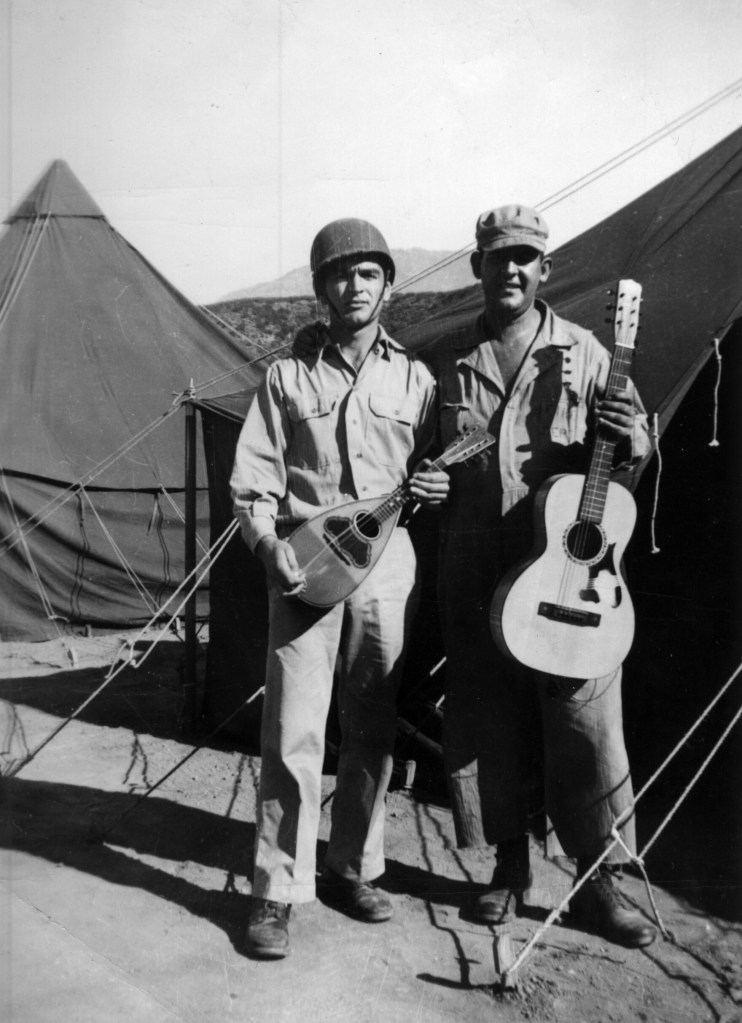
Anthony joined the army but left shortly due to sickness. He died of cancer in 1952.

Anthony, on left, with his mandolin.

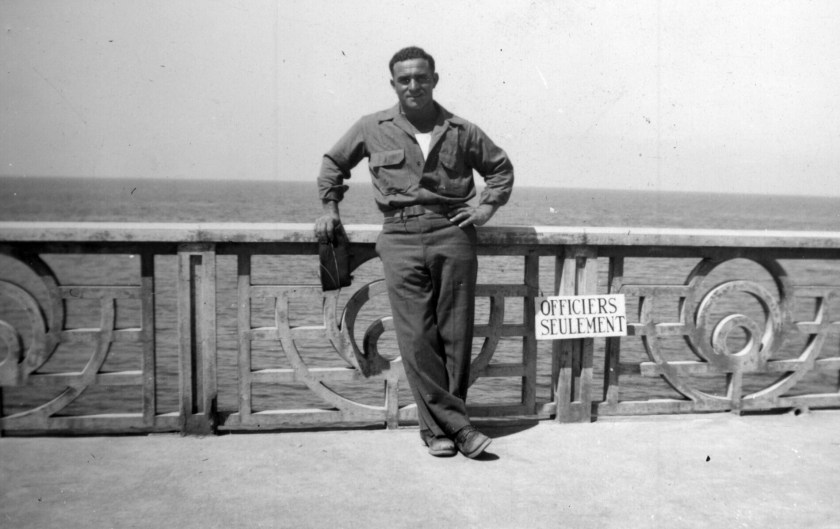
John also joined the army and became a medic, and he too was sent to North Africa.

John wasn’t an officer. Photo taken either in Morocco or Tunisia.

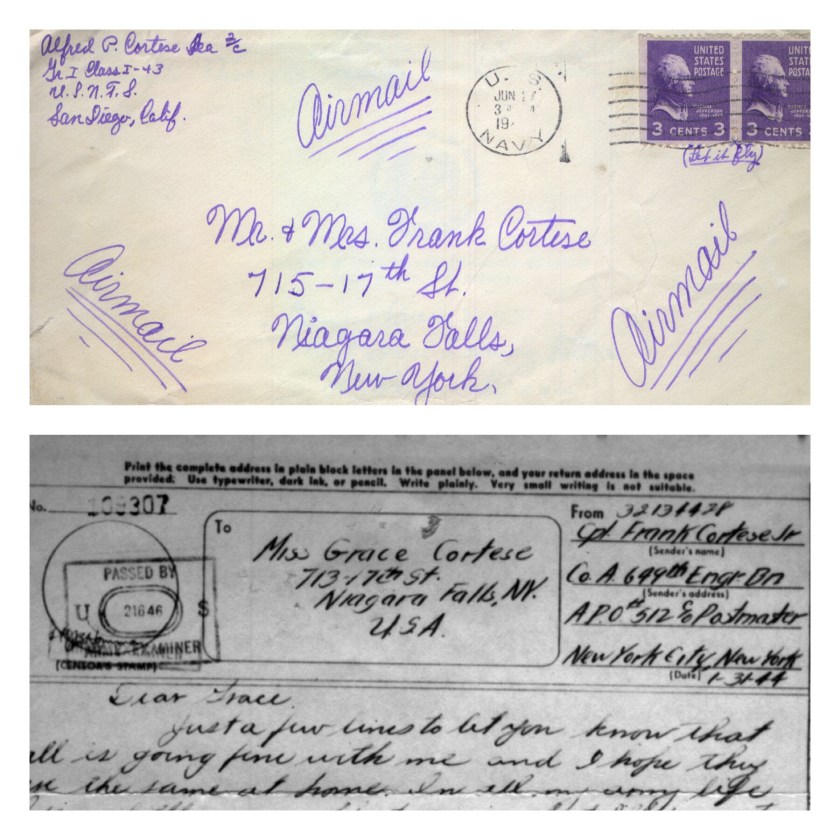
Alfred joined the Navy, and was assigned to a ship in the Pacific theater. He was someone who enjoyed a good joke. One of his first letters home, while still in training, contained real “fake” news.

Frank knew that his little brother, John, was in North Africa, and he tried for a long time, fruitlessly, to find him. His rank wasn’t high enough to get the military brass to pull strings, and wartime censorship made communication almost impossible. In the meantime, John was wounded in North Africa and received a Purple Heart. Frank and John finally met up in Italy toward the end of 1943.

John and Frank in Italy. 1943.

Both could understand Italian, but probably spoke a broken, amalgam of dialects that their uneducated parents used to communicate with in America. Having visited Italy, albeit under the clouds of war, their experience made them happy to have been born in America.

The brothers dutifully wrote their parents and sisters, and supported the family with their military salaries. I believe that my uncles supported their parents from the time each was able to work. My grandfather’s occupation was listed in the census as shoemaker, and I doubt he made much money during his lifetime.

Grandpa with his dog, Brownie.

The sons’ letters are full of questions about family and friends and what was happening in Niagara Falls. Frank asked, among many things, about the family dog, Brownie.

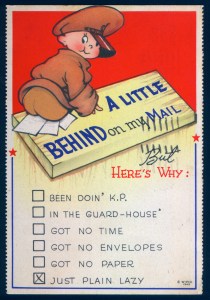
Humorous postcards were common until the men went overseas. On the back of this one, John apologizes for not writing as often as he wished.

The letters contained virtually nothing about their experiences in the war. Happily, they all returned home safely, married, raised families, and enjoyed civilian life as grown men, older and wiser than the boys they were when they had gone off to war.

Most of the letters were addressed to their sister Grace, who lived with her parents. Grace was third of the four Cortese sisters.

A letter from training and a V-Mail. V-Mail was heavily censored, and contained little news, just reassurances that they were alive.

Grace’s older sisters, Philomena (whom everyone called either Mamie or Jenny) and Mary, were already married in 1941. Her younger sister, Rose worked at Bell Aircraft making P-39s. Rose was my mother.

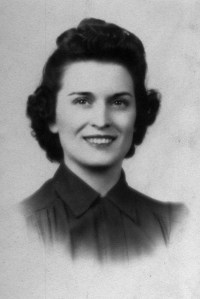
Frank Sr. was illiterate, so Grace was the translator and interpreter. Grace worked at Kimberley Clark during the war. She was outgoing, athletic, someone who seemed to know everyone, everywhere.

Grace in the 1940s.

Not only did she she write her brothers all through the war, she maintained an extensive and steady correspondence with many other local servicemen, and kept voluminous scrapbooks of clippings from the local newspapers with every mention of a serviceman from Niagara Falls, whether she knew him or not!

A sample page from Grace’s scrapbook. Most pages were not as sad as this one. Many contained marriages.

Going through her scrapbook pages the other day, I noticed she also included among all the war materials, a few articles on murders, presumably by organized crime. The Italian community no doubt knew the victims as friends or neighbors or maybe even relatives!

The immigrants from Southern and Eastern Europe faced considerable discrimination from other Americans, including the descendants of Irish and German immigrants of the mid-nineteenth century. Until the second half of the twentieth century, for example, Italians in Niagara Falls were excluded from elite clubs and organizations to such an extent that they banded together and formed a club of their own, The Century Club, so named because every member contributed 100 dollars for its creation. Today it is gone, demolished, and the Niagara Falls Country Club will happily accept applications from anyone who can afford the entry fee!

An assiduous correspondent, Grace kept up the morale of those she wrote by filling them in on what was happening in their hometown. Who could do it better than Grace? Grace was a bit of a gossip and busybody, but she had a heart of gold. The brothers sent letters and cards while in the States, but once overseas they had to rely on heavily censured V-mai.

Eventually my Aunt Grace married one of them, Peter Lozina.

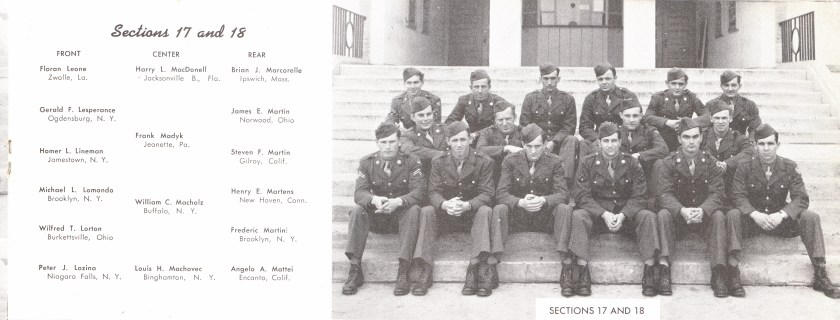
Pete is in the first row, extreme right.

Peter was the son of Croatian emigrants who kept a tavern on old East Falls Street in Niagara Falls. Pete enlisted in the Air Force and was sent to Tyndall Field in Florida to train as a gunner for the B-25 medium bomber.

For years, a plaque hung on the wall of their dining room, thanking Pete for his brave service. As a child, I saw it everyday, but never really understood what it meant.

An official commendation.

Uncle Pete had flown 70 missions over Italy, and returned safely, but he never talked about his war experiences. Years later, having read Catch-22, I finally began to appreciate what a hero he had been. 70 missions was not uncommon for B-25 crews, but it was nothing to sneeze at either. The B-25 was a medium bomber, and most of its missions were short range, and often lasted less than an hour.

A B-25 bomber. Note the turret and guns. Source: San Diego Air and Space Museum Archive.

On the other hand, B-25s often flew at lower altitudes, making them vulnerable to anti-aircraft fire. Uncle Pete was a gunner. He never talked about it, but he had been shot at.

Frank and John passed through North Africa on their way to the invasion of Italy, and, Pete probably did too, since France was occupied and Spain remained neutral. Before I left for Morocco in 1976, I spent Christmas Eve with my relatives at the house of Uncle Bill and Aunt Mary. Until it became too much for them, Bill and Mary would host a party, during which seven fishes would be served, a southern Italian regional custom. People would gather at their house for drinks and Christmas cookies, and the few who were religious would cross Military Road at midnight to attend mass at the Prince of Peace church. Often there was a poker game, because many of the relatives loved cards, but most of all everyone just enjoyed eating and talking and being with family and friends. After midnight, people ate and presents were unwrapped and little by little the guests departed.

I remember talking with my Uncle Frank. He had been impressed by the modern design of buildings in Oran, and didn’t remember North Africa as poor or backward. However, the interaction of military forces with local people was limited. When I read Carlton Coon’s recounting of his exploits as a member of the OSS, it was obvious that North Africans were simply not part of the narrative, except for some Rifians with whom Coon dealt. In much French and English literature, North Africans appear much in the same way as they do in Camus’ novels, shadows in the background. It is much the way American blacks are treated in prewar media.

Americans celebrate Armistice Day as Veterans Day, a day dedicated to all who have served in the nation’s many wars. My uncles and aunts are all gone today. All that remains are memories of them. Children of immigrants, they served their country bravely and with honor.

Jours de gloire

Le 11 novembre on célèbre Veterans Day (Jour des anciens combattants) aux États-Unis et le jour du Souvenir au Canada.

Pendant que beaucoup de pays rendent hommage à leurs soldats morts et se souviennent des sacrifices consentis, ce jour me rappelle que les Français et les Britanniques ont recruté des troupes dans leurs anciennes colonies, dont le Maroc.

Y a-t-il des célébrations dans ces pays aussi? Des mercenaires, à qui on a beaucoup promis mais qui ont peu reçu, ont eux aussi versé leur sang. Je n’ai jamais rencontré des Marocains qui ont combattu dans la Première ou la Seconde Guerre mondiale ni dans la guerre civile espagnole, mais la dame qui cuisinait pour moi, Khadija, était mariée avec un homme qui avait servi en Indochine.

Ali et Khadija. Sefrou, 1968.

Pour Ali, l’expérience était affreuse. Le conflit était dénué de sens, sa santé a été compromise et il a fini par recevoir une pension dont l’indexation n’a jamais suivi le taux d’inflation une fois que le Maroc avait obtenu son indépendance.

Les États-Unis acceptent maintenant des recrues si ces personnes ont une carte verte et si elles sont résidentes, mais l’armée américaine ne s’engage nullement à les aider à obtenir la citoyenneté. En Afghanistan et en Irak, les forces américaines dépendaient d’interprètes locaux, des hommes qui risquaient leur vie, à qui on a promis une protection, mais à qui maintenant on refuse l’asile.

Jusqu’à la fin de la Renaissance, les armées permanentes étaient rares ou inexistantes. La plupart des dirigeants levaient leurs troupes parmi la noblesse, ou engageaient des mercenaires comme dans l’Italie de la Renaissance. Rome constituait peut-être une exception notable, mais pendant la moitié de son histoire, il était une dictature militaire. Ce n’est qu’à l’avènement de l’État-nation que l’idée d’une armée permanente prend racine. Les puissances impériales, toujours en conflit les unes avec les autres, ont trouvé encore une autre ressource à exploiter. Les troupes coloniales ont combattu férocement et avec bravoure, mais pour des causes qui n’étaient pas les leurs et pour des promesses qui n’ont pas été tenues. Beaucoup étaient illettrés ou presque, et, en ce qui a trait au Maroc, peu ont laissé autre chose que des récits oraux que personne n’a trouvé digne de mettre par écrit. Aujourd’hui, nous devrions les honorer, eux aussi.

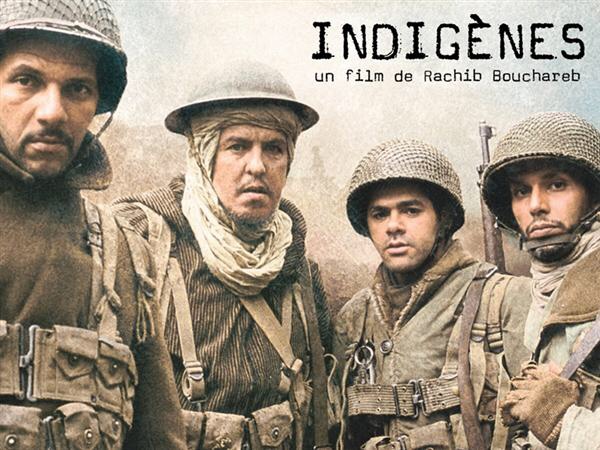
L’illustration provient du film Indigènes qui suit un groupe de soldats algériens et marocains dans la Seconde Guerre mondiale. La version anglaise de ce film français porte le titre Days of Glory, titre ironique, bien entendu.

Auteur : David Brooks

Traduction : Jim Erickson

Days of Glory

Monday is Veterans Day in the United States, and Remembrance Day in Canada.

As many nations of the world recognized their war dead and remembered the sacrifices made, I was reminded that the French and British raised troops in their former colonies, Morocco among them.

Are there celebrations in those countries, too? Mercenaries, who were promised much, but received little, also shed their blood. I never met any Moroccans who fought in WWI or WWII nor in the the Spanish Civil War, but the woman who cooked for me, Khadija, was married to a man who had served in Indochina.

Ali and Khadija

For Ali, the experience was miserable. The conflict had no meaning, his health suffered, and he ended up receiving a pension that never rose with inflation, once Morocco had achieved independence.

The U.S. now accepts recruits if they have a green card and are residents, but the U.S. military makes no promises about helping those who serve become citizens. In Afghanistan and Iraq, U.S forces depended on locals as translators, men who put their lives at risk, who were promised protection, but who are now being denied asylum.

Until the end of the Renaissance, standing armies were rare or nonexistent. Most rulers raised troops through their nobles, or mercenaries were hired as in Renaissance Italy. Rome may have been a major exception, but for half its history it was a military dictatorship. Only with the arrrival of the nation state did the idea of the standing army take hold. Imperial powers, alway in conflict with each other, found yet another resource to tap. Colonial troops fought fiercely and bravely, but for causes that were not theirs and for promises that were not kept. Many were illiterate or nearly so, and, as far as Morocco goes, few left little more than oral histories that no one thought worthy to collect. We should remember them, too, today.

The illustration is from the film entitled Days of Glory, which follows a group of Algerian and Moroccan troops in WWII. The title is ironic, of course

The Book Sale

Saturday, November 3, 2018.

Last night daylight savings time ended, and we gained an hour of sleep. Sunset comes early now.

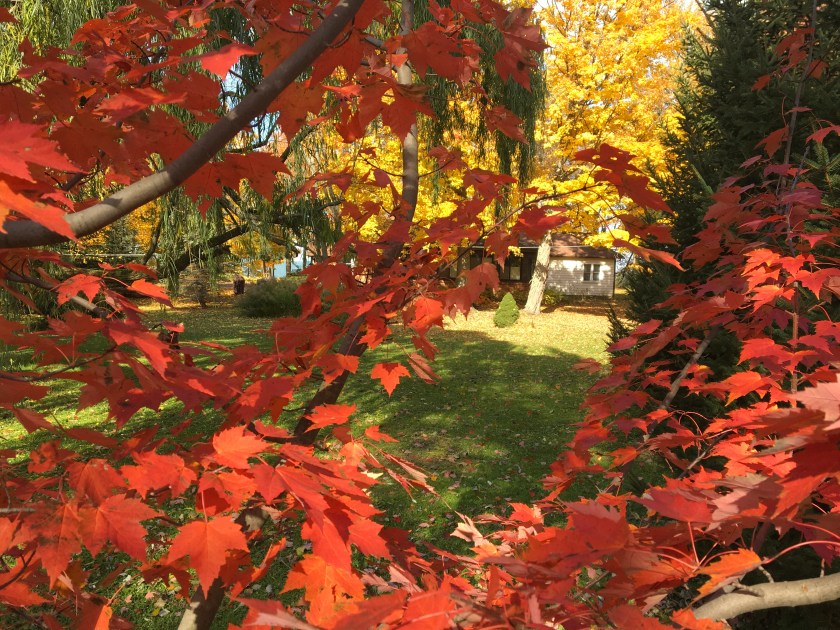
Fall has definitely arrived. The trees have carpeted our lawn with leaves and the lake is now far too cold for a swim. The ocean-going freighters transiting the lake are mostly headed for the St. Lawrence.

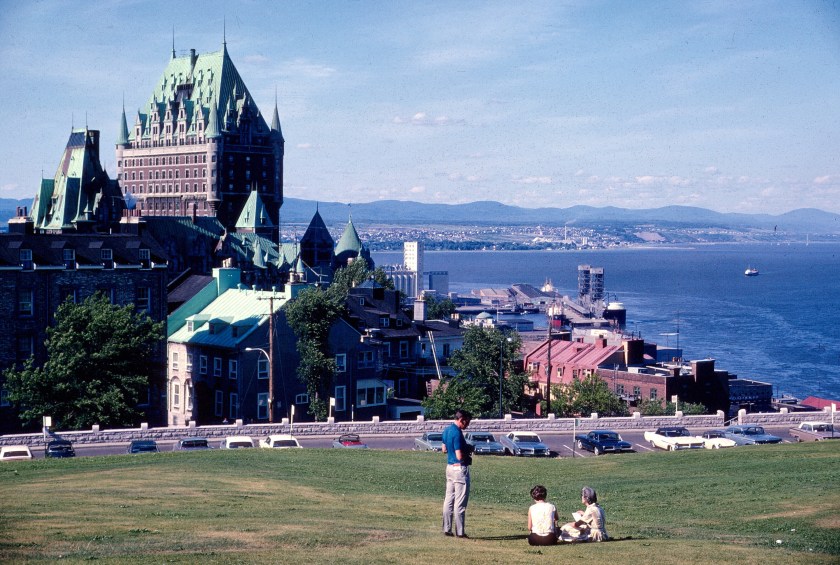
The St. Lawrence River looking downstream, taken years ago from near the Plains of Abraham. Québec City.

My friend, Jim, who lives in Québec may see them a few days from now. In about a month and a half, all traffic will cease and the St. Lawrence Seaway locks will freeze, closing the system until late March.

The yard and the lake.

In Morocco, there was not much of an autumn. Mediterranean climates have basically two seasons, a cool wet one and a dry hot one. Winter crops start appearing as soon as it rains, and a brief spring appears in April and May. By June the field crops have been harvested and everything dries out, except where there is irrigation, until the winter rains. Many of the deciduous trees are evergreen, losing their leaves throughout the year. In Sefrou, the ashes and platanes (plane trees) lost their leaves, but not much else. Still, here and there, trees did provide a bit of color.

Liz blowing leaves from the gutters.

Liz and I spent the day cleaning leaves out of the gutters. As I write, a fire is burning in the fireplace, fed by beechwood from trees we had to cut down last fall. Fall is a busy season. We put away the lawn furniture, repeatedly clean the gutters of leaves, and try to mulch the fallen leaves, or otherwise dispose of them. Trees are lovely, but dealing with masses of leaves is not easy.

Next year we will have to take down an old oak. This fall, we found chicken-of-the-woods mushrooms growing on it.

Chicken-of-the-Woods on one of our oaks.
Chicken-of-the-Woods. This edible mushroom is parasitic and will weaken the tree.

Sadly, the roots of this tree shelter a beautiful trillium, which blooms every spring. Perhaps we can leave a large section of the trunk standing, and keep the trillium and the mushrooms for a while longer.

Our trillium and some trout lilies. The latter cover the yard in the spring. The trillium is the official flower of the Province of Ontario, and is often used as a symbol there.
The house and rear yard.

Fall also marks the time when the Friends of the Youngstown Free Library hosts a book sale in order to raise money for the library. Our local Friends group has a book sale twice a year, once in the fall and once in the spring. The books come from donations and library discards. If you are not familiar with the way libraries are run, discards are books that are damaged, outdated, or simply never circulate. Most libraries have limited shelf space, so making room for new materials is a necessity. In some cases, entire classes of materials are discarded. Few libraries keep periodicals and journals nowadays as most are accessible online. In the case of books, while it is true that many are available in computer readable formats, most library patrons still prefer to check out paper copies. In any case, this means that some library discards are still worthy of possession. For a bibliophile such as myself, the twice-a-year sale is a date on my calendar to which I look forward, and I try to give a helping hand. Running a two- or three-day sale is a real project, and I really admire the women who put their time and energy into the sale. Yes, it is usually women, as they make up a disproportionate number of the local « friends » groups, and they are willing to take on such a big endeavor. They deserve credit for what they do.

There were no such book sales in Morocco, and books were a relatively rare commodity when I lived there. At the time, illiteracy was common, and literacy, except for those with a secondary education, was, above all, functional. Since I was only literate in French, I scoured the souqs (local markets) for old books on subjects of my interest such as mountaineering and Moroccan history. New books tended to be expensive. Sometimes I was lucky enough to find a bookseller with a store of old books from the colonial period. I remember a little shop in the ville nouvelle in Rabat, just around the corner from the Peace Corps office, that had bins of Chrestomathie marocaine by Georges Séraphin Colin, a great collection of stories and sayings in dialectical Arabic. I didn’t buy any as I already had an old bound copy, but now, in retrospect, I wish I has bought a few more copies, though years later, Jim brought me a digitized copy. A year later the shop was out of business. Buying books in Morocco always involved what could be described as the thrill of the hunt, as well as a degree of serendipity, since one never knew what one would find.

Library book sales provide me with much of the same thrill in addition to the same element of serendipity. I do not collect rare books, nor purchase them for resale. I simply buy books because they interest me, and I hope to read them. I used to buy many books for my high school library since the book budget was not only ridiculously small, but the school district used designated state book aid for purchases clearly not permitted under the conditions specified by the State, and did not give it to the library. When I began my librarian job, the shelves were half-filled or empty. The librarians with whom I worked never liked my additions. Sometimes they were right about whether the books would be read or not, but I didn’t care. As long as there was shelf space, it was an opportunity that existed, and one of the librarian’s roles was, figuratively speaking, to sell books. A high school student might be reluctant to take on my favorite books such as I, Claudius, or The Master and the Margarita, and only a few would. My job, as I saw it, was to get the books into those students’ hands. I didn’t need to sell John Green novels—Green was doing a great job all by himself. I considered my colleagues unread, and with good reason, though in fairness, they did not have my education, nor life experiences such as my long stay in Morocco when I had the time and freedom to read widely. Nor did they read in any foreign language. Unfortunately, they were never going to read War and Peace, let alone explain to a student why they might want to read it. Then again many people will not read War and Peace, daunted by the length and put off by Russian names. Of course, I think every everyone should read it. War and Peace is a great love story as well as Tolstoy’s exposition on how history is made.

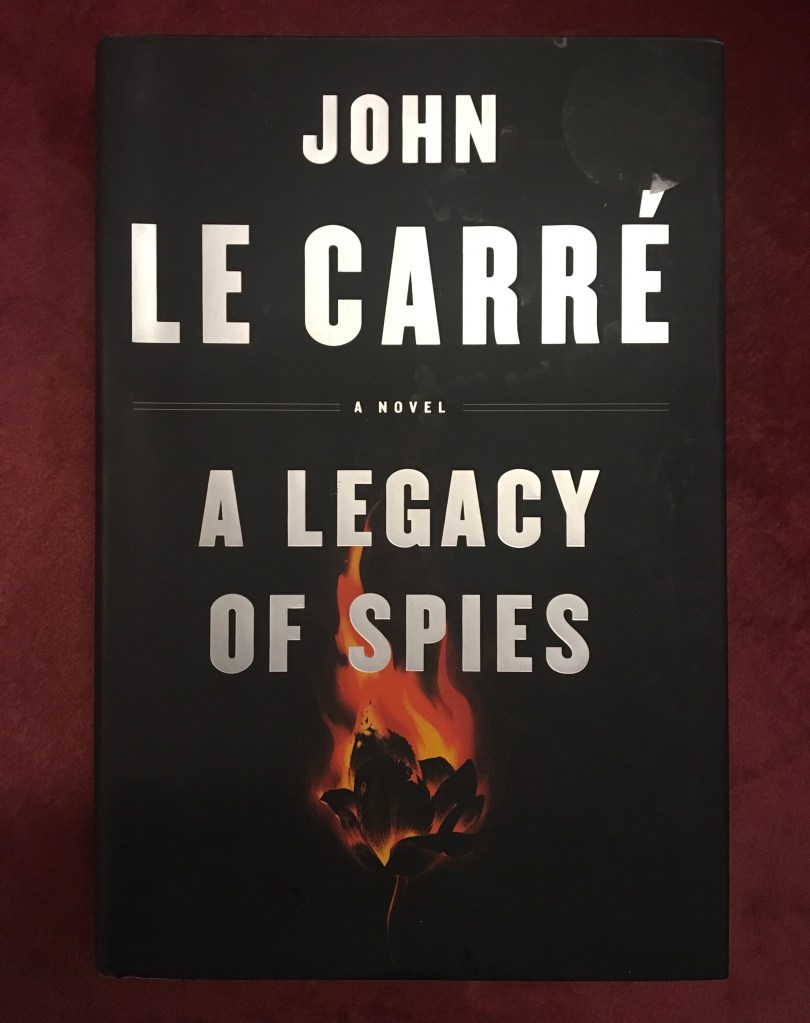
What did I find at the sale? I usually don’t look for anything specific, but I am a John LeCarré fan, the pen name of David Cornwell. I wanted a copy of his last novel, A Legacy of Spies. I found it to my delight. LeCarré’s signature contribution to the literature of espionage had always been to emphasize the moral ambiguity of the people and agencies engaged in it, a necessary corrective to the standard narratives of the good fighting the evil. The world of espionage has never resembled Narnia. LeCarre writes very well, too, though I don’t think his women characters are as well defined as his men.

As the Cold War ended, LeCarré was one of the first writers to recognize that the new arena might showcase contests by powerful multinational corporations and oligarchs using nationalism as an ideology—if one was even needed.

I also found a James Burke book. I have always enjoyed his BBC TV series, Connections and The Day the Universe Changed. Burke writes about the history of science and technology in an engaging way, emphasizing historical connections that most of us do not always see for ourselves. Though he writes for the layman, he never talks down to the reader.

The development of the stirrup serves as a good example. It was developed in China and spread across Asia into Europe in late Roman times. The stirrup improved the horse as a weapons platform and consequently led to breeding larger horses, which could carry more heavily armed riders. The use of the long bow in the Hundred Years War made it possible to pierce heavily armored knights, as the French found out to their great chagrin at the battle of Agincourt. By then, however, the development of large horses had also made it possible to plow the heavy soils of Northern Europe, and, along with other factors, contributed to the wealth that fueled the expansion of the Renaissance in the North. In the Mediterranean, thin soils never required as much plowing power. Sadly, many of those large breeds have been replaced by mechanization and are now disappearing at an alarming rate.

Finally, I found a French language book by the companion of Jacques Brel in his last years of life, Maddly Bamy. I thought that it might be biographical, but, after I had read a bit, the metaphysical bent put me off. I can’t say that I finish every book I start.

After the yard work, as the day drew to a close and the air became chilly, my wife and I went inside. I searched in my Italian cookbooks for a polenta recipe similar to the one my grandmother made. I didn’t find it, but tomorrow I will resume the search. I have more Italian cookbooks to consult—many thanks to the book sales.

Faire le plein en Andorre

Descente à Foix

Au Canada? À Ceuta? La recherche de carburant bon marché ne connaît pas de frontière. Actuellement ce sont les Canadiens qui traversent la frontière américaine pour le chercher, mais je me souviens de l’époque, dans les années 1980, quand je faisais la navette quotidiennement pour épargner quelques sous. J’emmenais les enfants souvent pour profiter de ce qu’offrait de mieux la ville de Niagara Falls, en Ontario.

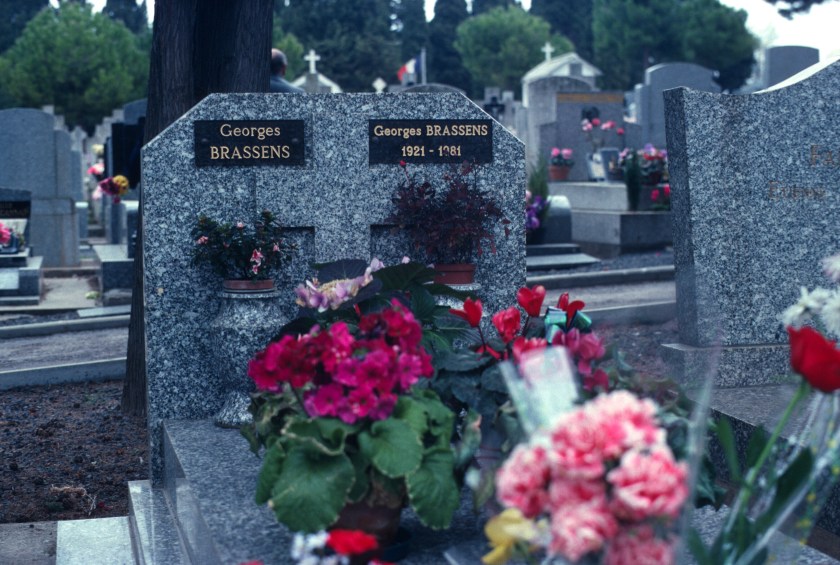
Ma femme m’accuse souvent de ne pas ranger les choses, et…. elle a bien raison. En écrivant le blog, mes souvenirs entraînent d’autres sans logique évidente. Parfois c’est au hasard, et parfois c’est par dessein, des miettes à suivre avant qu’elles ne soient dévorées par le Temps. Dans un commentaire il y a quelques jours, un lecteur a cité le jeu de mots de Groucho Marx: « Time flies like an arrow, fruit flies like a banana. » Pour ma part, même si j’apprécie moi aussi le mot de Groucho Marx, je tiens plus à cette image de Brassens:

…le temps est un barbare

Dans le genre d’Attila

Aux cœurs où son cheval passe

L’amour ne repousse pas

Aux quatre coins de l’espace

Il fait le désert sous ses pas…

Et je retiens dans ma vieillesse les vers de Marvell, que j’ai lus pour la première fois dans la classe de mon professeur à Exeter, Mr. Molloy :

But at my back I always hear

Time’s wingèd chariot hurrying near;

And yonder all before us lie

Deserts of vast eternity.

Déserts de l’éternité, déserts sans horizon. Mais si les souvenirs me fournissent souvent un refuge, ce dernier ne repose pas toujours sur une fondation solide. Brassens nous rappelle que les temps passés n’étaient pas toujours jolis.

Si le temps est un barbare, c’est un barbare polisson et tricheur. Et le futur, qui cache tant de surprises pour les jeunes, n’est guère mieux que le passé.

Quand vous, cher lecteur, parcourrez les articles du blog, sachez que je fais de mon mieux pour ne pas raconter des bêtises dans mes souvenirs. Si mes photos ont souvent des horizons lointains, ce sont des horizons encore circonscrits par ma vie. Et j’en suis bien content face à ce que le temps offre.

Auteur : David Brooks

Révision : Jim Erickson

De vieilles diapositives

En aidant ma femme à faire le ménage de notre grenier l’autre jour, je suis tombé sur des boîtes de diapositives couleurs que j’avais oublié d’entreposer avec mes autres souvenirs photographiques. Je les avais prises avec du film GAF, le produit d’une société qui a fait faillite il y a belle lurette, un produit qui même à cette époque-là était d’une qualité douteuse. Kodak et Fuji dominaient le marché grâce à des produits et des services bien supérieurs. Dès mes premiers pas en photographie, je me suis dirigé vers le Kodachrome. Très lent, l’ISO du Kodachrome variait entre 25 et 50 et même avec une lentille super rapide, la photographie en lumière ambiante s’avérait difficile. Mais, quelles belles couleurs! Ce n’est pas tout le monde qui l’appréciait, mais je trouvais que, tant pour les paysages que pour les personnes, le Kodachrome donnait des résultats formidables. Et quelle durabilité!

Bien entendu, presque personne ne prend des diapositives de nos jours. Ma fille, photographe professionnelle, n’en prend plus depuis bien des années. Sur mon bureau se trouve un vieux rouleau pas encore développé et qui ne le sera jamais. Dans un tiroir dort un appareil Olympus OM-1 d’un ami, le dernier des nombreux appareils 35 mm que j’ai utilisés. Alors qu’autrefois faire des photos à partir d’une diapositive pouvait s’avérer complexe et laborieux, la photographie numérique permet, même aux amateurs, un éventail d’effets que l’on obtenait avec difficulté à l’époque du film.

J’ai des milliers de diapositives et de négatifs et je suis en train de numériser tout ce qui me semble important. De plus, lors du décès de ma mère, j’ai hérité d’encore d’autres négatifs noirs et blancs.

Dans les négatifs de ma mère, on voit des amis de la famille et des proches que je n’ai jamais connus ou que je ne sais plus reconnaître. Je les garde dans l’espoir que d’autres membres de la famille pourront identifier les gens dans les photos, mais avec le décès de mes tantes et oncles, il y a de moins en moins de personnes pour aider. Il est évident que j’aurais dû m’occuper plus sérieusement de l’histoire familiale, chose que je regrette, car il aurait été plaisant d’y travailler avec mon oncle Al et ma tante Mary qui sont tous les deux décédés récemment.

Aujourd’hui je fouille dans mes vieilles diapositives du Maroc, me demandant pourquoi je les ai prises, ce qu’elles représentent et, parfois, où elles ont été prises! Celles que je regarde en ce moment sont étiquetées, parfois de façon cryptique, mais utiles tout de même. Une pile de roches représente l’une des tours à escalader sur la crête ouest du Jbel Toubkal. Néanmoins, beaucoup de mes diapos n’ont pas d’étiquette. Pendant que je prépare un billet sur un voyage en auto-stop à travers le Sahara jusqu’en Afrique de l’Ouest, je me demande exactement où j’étais. Aujourd’hui, grâce au GPS et aux horloges numériques, on est à même de géocoder une photo pour en obtenir l’emplacement exact et connaître l’heure exacte de la journée où elle a été prise. Je me fiais à la mémoire pour ce qui était à l’époque un voyage inoubliable, mais la mémoire commence à défaillir.

Je dois recourir à la mémoire, de plus en plus défaillante avec le passage des ans. Parfois ma manie de collectionner vient m’aider. Il y a quelques jours j’ai retrouvé une carte postale d’un Algérien que j’avais connu quand je traversais le Sahara. Ce voyage à travers le désert par les oasis algériennes a été merveilleux, exotique, et pourtant, en ce qui a trait au segment algérien, je me sentais encore chez moi en raison de sa proximité culturelle avec le Maroc. Hier je suis retourné à ces souvenirs algériens et j’ai retrouvé une vieille lettre qu’un ami marocain m’avait écrite au moment où je quittais le pays en 1971.

J’ai également collectionné des cartes postales de plusieurs endroits. J’ai retrouvé un paquet de cartes achetées en Iran qui m’aident à identifier des paysages ou des sites du pays. J’avais étudié l’histoire et la culture iraniennes, mais il y a longtemps. Je pense peut-être écrire un billet sur un long et intéressant voyage que j’y ai fait. Pourtant, il y a des limites à ce qu’on peut se rappeler. J’ai beaucoup de diapos de sites isolés au Maroc dont je peux identifier seulement la région, et quelques autres de personnes dont les noms m’échappent maintenant.

Aujourd’hui mes diapos GAF paraissent pâles et floues, ce qui est malheureux, puisque certaines ont été prises dans des situations insolites. Chercher des singes dans les montagnes près de Chaouen au Maroc, chasser des champignons dans les forêts de liège autour de cette ville, et faire un pèlerinage au sommet du Jbel Alam avec la famille d’un des mes étudiants marocains qui y allait pour vénérer Moulay Abdesslam Ben Mechich ne sont que trois exemples qui me viennent immédiatement à l’esprit.

J’ai cueilli des champignons avec des amis français. Les Marocains ne mangent pas de champignons, mais les cueillir et les manger est typiquement français. Les journaux français annoncent toujours la saison des champignons et La Dépêche de Toulouse a prédit une saison exceptionnelle cette année. De retour en ville avec nos cèpes et nos oranges, la mère de mon ami Gilles, qui était en visite, les a sautés dans le beurre. Je n’ai jamais mangé de meilleurs champignons.

La mémoire n’est pas fiable et est souvent tempérée par le temps. Georges Brassens, mon chansonnier et parolier préféré, en anglais ou en français, a composé une chanson ironique intitulée Le temps passé où il nous rappelle de façon humoristique que le temps, en plus de guérir des blessures, tend à nous faire voir le passé à travers des lunettes roses. Je suis d’accord avec Brassens quand il dit que nous devrions voir les cicatrices et sentir la douleur, même longtemps après les faits. Quand le Temps s’approche de nous, pour emprunter une image à la Brassens, mieux vaut faire preuve de prudence.

Les diapos m’aident à rafraîchir la mémoire. Comme ceux qui suivent mon blogue le savent, elles sont la charpente autour de laquelle je construis mes billets. Si je n’ai pas beaucoup publié dernièrement, c’est en partie dû au fait que j’ai arrêté de numériser. Mais les diapos, les photos et les vieilles cartes postales ne sont pas les seules façons dont ma mémoire est stimulée.

Ali, au centre, à Michlifen lors de sa sa première visite à Ifrane. Aujourd’hui il y enseigne.

Il y a quelques jours, j’ai vécu une expérience aussi authentique qu’émotive. Un vieil ami marocain de mes années comme volontaire du Corps de la paix, m’a appelé de Tanger. C’était sa lettre que j’avais retrouvée hier. Il se préparait à parler du Corps de la Paix à un groupe de jeunes, et il cherchait des expériences personnelles de choc culturel et des idées sur les volontaires de ma génération, c’est-à-dire, ceux et celles qui ont servi dans les années 1960.

À l’université, quand je considérais le service au Corps de la paix, il y avait dans ma résidence un ancien volontaire qui avait servi, je crois, dans un village andéen. Je lui ai demandé s’il avait vécu un choc culturel. Il venait du Montana, un État ayant des comtés aussi gros que certains pays et des populations aussi petites que celles des écoles secondaires américaines. « Pas du tout , m’a-t-il répondu, moi, j’ai vécu un choc culturel quand j’ai dû fréquenter une école secondaire au Dakota du Nord parce qu’il n’y avait pas d’école dans mon comté. Je n’avais jamais vu un match de football et ne savais même pas dans quel sens courir. Il n’y avait tout simplement pas assez de jeunes dans mon coin du Montana pour former une équipe. »

Quant à moi, je ne me souviens pas de beaucoup de choc culturel, mais quand j’y pense, je suis étonné de mon manque de sensibilité à l’occasion. J’étais jeune, il est vrai, mais c’est une excuse par laquelle je ne me défendrai pas. La réflexion vaut bien plus pour les jeunes que pour les aînés.

Parler avec quelqu’un avec qui on n’a pas parlé depuis près de 50 ans est une expérience étrange. Malgré le passage des années, c’était le même Ali, je le voyais comme mes diapos le dépeignaient, comme un jeune lycéen, explorant le monde et se démenant pour y trouver sa voie. Aujourd’hui, il est professeur d’université et très compétent dans son domaine. Je suis à la retraite, en attente de Dieu, pour ainsi dire.

La réminiscence était merveilleuse. Le temps que j’ai passé au Maroc était spécial et aujourd’hui j’ai peu de gens avec qui je peux partager ces années, parmi eux surtout de vieux amis du Corps de la Paix avec qui j’ai maintenu le contact, quoique sporadique, à travers les années et quelques adeptes du blog qui ont grandi à l’étranger ou qui ont beaucoup voyagé.

Dans les années 1960, je venais de terminer l’université et je n’étais pas beaucoup plus âgé qu’Ali. Tous les deux, nous contemplions un monde dans lequel nous entrions plus intensément, tout en essayant de le comprendre. En quelque sorte, nous étions encore des enfants, lui, fréquentant le nouveau lycée et pensant à son avenir, moi, emmitouflé dans un cocon douillet fourni par le Corps de la Paix, essayant de prévoir mes prochains pas.

Aujourd’hui certains volontaires qualifient le service au Maroc de « posh corps » (posh = luxueux, huppé) . Le pays vante une infrastructure de transport et de communications bien développée, utilise le français comme langue seconde et se trouve à seulement quelques fuseaux horaires des États-Unis. Les volontaires ont le loisir de voyager en Europe et aux États-Unis. Même s’il reste beaucoup de pauvres au Maroc et certaines régions sont négligées par le gouvernement, il y a aussi une classe moyenne de plus en plus importante, et le tourisme a pris de l’expansion de sorte que la présence des étrangers est plus notable que jamais. Oui, le Maroc n’est pas le Bangladesh, ni un vestige d’Asie centrale de l’ancienne Union soviétique, ni le Sierra Leone. Mais posh ?

Pour certains, le qualificatif confortable semblerait plus approprié. Ma première journée au Maroc à la suite d’un long vol par les Açores et par Lisbonne, était chaude et ensoleillée. Nous avons atterri à l’aéroport de Salé, utilisé à l’époque pour les vols internationaux. De l’aéroport, après un petit tour en autobus, nous sommes arrivés à notre hébergement temporaire, le Grand Hôtel, en face des bureaux du Corps de la paix, rue Van Vollenhoven, une rue rebaptisée zenqat Moulay Rachid avant mon départ du Maroc. Quinze ans après l’indépendance, le Maroc se décolonisait toujours. La Ville nouvelle, construite pendant les années 1920 et 1930, ressemblait à l’architecture que j’avais vue dans le sud de la France. Les vitrines et les étalages étaient très français, ainsi que les restaurants. Père Louis avait une petite table où le propriétaire se tenait durant les repas, tout comme bien des restaurants en France. Je m’y sentais tout à fait chez moi.

Je me souviens d’une fois où un volontaire, John, a été confronté par une membre du personnel qui avait servi en Afghanistan; quand cette dernière lui a demandé s’il considérait son service au Maroc comme de grandes vacances, John a répondu sarcastiquement : « Oui, c’est bien le cas de le dire, et quelles belles vacances! » La vérité, c’est que John a fait de son mieux à une époque où les programmes du Corps de la Paix laissaient beaucoup à désirer. Le Maroc n’était pas l’Afghanistan, l’expérience du Corps de la Paix à travers laquelle elle voyait les pays en développement. Nous tous, nous voyons le monde à travers une lentille façonnée par notre expérience, même si notre vue s’élargit en vieillissant.

À mon époque, les volontaires n’avaient pas le droit de voyager en Europe ou retourner aux États-Unis à moins de s’engager pour un deuxième tour de service. L’Algérie nous était fermée et le prix des billets d’avion pour d’autres pays d’Afrique dépassait le budget du commun des volontaires. Certains volontaires ont été affectés à des petits endroits reculés.  J’ai toujours admiré les femmes qui travaillaient dans les foyers féminins, des centres d’économie familiale ruraux. Elles faisaient preuve d’énormément de débrouillardise, supportant des conditions difficiles dans des endroits très petits et parfois isolés.

Parfois des volontaires se créaient leurs propres problèmes. À Oujda, deux volontaires qui partageaient une maison étaient rendus au point où ils avaient tracé une ligne dans la cour, la divisant en deux territoires exclusifs, où l’autre n’était pas le bienvenu, et pendant des semaines, les deux ne se parlaient pas. Plus tard, les deux ont assumé des postes de personnel au sein du Corps de la Paix et ont développé une amitié solide.

Parfois la maladie, quoique rare, intervenait cruellement. Une volontaire à Nador est tombée gravement malade et ne réussissait pas à contacter le médecin du Corps de la Paix, un surfeur et poète qui ne se souciait pas trop des volontaires sous sa responsabilité. Elle a dû compter sur l’aide médicale d’un médecin juif d’Oujda. Elle a appelé le médecin qui lui a demandé de le rejoindre à l’aéroport dans une heure d’où il l’a ramenée personnellement à sa clinique où elle a passé quelques semaines en convalescence.

On permettait qu’on voyage en Espagne, à cause de son passé arabe, mais, même si j’ai visité tous les sites mauresques auxquels je pouvais facilement me rendre en Espagne, je crois toujours que l’interdiction de voyager en Europe et les restrictions en Espagne étaient oiseuses. On pourrait justifier des visites en France en soutenant que le passé récent du Maroc était français. Le Maroc moderne est en fait une création de la France. De toute façon, des volontaires, surtout ceux qui avaient des parents fortunés, ignoraient les restrictions et n’ont jamais été punis.

Le Corps de la Paix avait de bonnes intentions et voulait vraiment que les volontaires connaissent mieux le Maroc, mais la plupart avait beaucoup d’occasions de voyager à l’intérieur du pays, profitant d’un bon réseau de transport et la présence de volontaires un peu partout au pays. Mais lors de leurs longues vacances d’été, la majorité ressentait le besoin de faire une pause et de s’éloigner.

L’Algérie était perçue comme un État hostile. Le Maroc venait de mener une guerre contre l’Algérie le long de la frontière sud-est et le gouvernement américain craignait de devoir traiter avec l’Algérie si des ressortissants américains s’y mettaient dans le pétrin. Dans l’ouest de l’Algérie, le dialecte ressemble beaucoup à l’arabe marocain et la communication n’est pas difficile. Des villes comme Tlemcen sont liées à l’histoire marocaine en tant qu’anciennes régions d’empires marocains.

Quand j’ai enfin visité l’Algérie, les Algériens que j’ai rencontrés m’ont traité de la même façon que les Marocains : avec curiosité, courtoisie et hospitalité. Dans leur lutte pour l’indépendance, les États-Unis n’avaient pas appuyé la France, ce qui fait qu’ils n’avaient pas de ressentiment à notre égard. Les relations tendues résultaient surtout de la division du monde en deux blocs hostiles et l’expression d’idéologies de la guerre froide. Mes connaissances algériennes avaient des disques de l’Armée rouge dans leur collection de disques — à cause des échanges avec l’Union soviétique — dont ils se moquaient allègrement. Les Russes n’étaient pas cool. James Brown et les Beatles étaient cool.

Nous étions plusieurs à nous moquer des « super volontaires », ceux et celles très performants que le personnel du Corps de la paix vantaient, les citant en exemple de ce que nous tous devrions être. Nous considérions certains d’entre eux comme des faux jetons. Compte tenu de nos conditions, la plupart d’entre nous faisions de notre mieux. Certains postes étaient plus faciles que d’autres. Enseigner l’anglais langue seconde était un jeu d’enfant. Le Corps de la paix savait former et surveiller des enseignants. Les lycées marocains avaient une structure administrative à laquelle on greffait facilement un enseignant, et les élèves marocains, assoiffés de connaissances et désireux d’apprendre, étaient un plaisir à enseigner et ils se prenaient d’amitié pour les Américains qui passaient pour moins formels et plus sympathiques que les Français.

À d’autres volontaires on a donné des jobs inexistants. Quand on se trouve dans une administration gouvernementale rigide, comment crée-t-on un job quand les attentes sont faibles et le soutien tout autant? Certains volontaires ont résolu le problème, mais bien d’autres ont abandonné. En effet, certains de nos collègues marocains avaient, eux aussi, abandonné et se contentaient de recevoir un salaire régulier et passaient la journée assis, à lire le journal et à fumer.

À mesure que la première décennie avançait, le Corps de la paix se concentrait plus sur des programmes axés sur des professions : architectes, vétérinaires, forestiers, et ainsi de suite, ce qui assurait que le volontaire avait un emploi en rapport avec sa formation. Dans les faits, certains architectes ne faisaient que concevoir des résidences pour des cadres supérieurs.

Je me souviens d’un membre du personnel qui administrait un programme d’architectes. L’un des volontaires se plaignait de ce qu’on l’importunait pour qu’il conçoive des châteaux d’eau dans une sorte de déguisement historique. Le membre du personnel a pris le train pour Fès pour le visiter. De passage à travers les plaines du Gharb, il dessinait tous les châteaux d’eau qu’il voyait. Tous avaient, bien sûr, une conception pratico-pratique, sans couleur locale, tout à fait fonctionnels. Face à tous les besoins du Maroc, pourquoi perdre son temps à concevoir des châteaux d’eau de fantaisie?

Mais les programmes étaient populaires dans les universités américaines et le Corps de la Paix a développé des rapports institutionnels avec certaines qui étaient bénéfiques aux individus et aux institutions, si pas nécessairement au Corps de la Paix et au Maroc.

Tout était plus petit et plus simple qu’aujourd’hui, ce qui explique peut-être pourquoi il est si facile de regarder en arrière et de trouver du plaisir à revivre ces jours. En tant qu’étrangers, les volontaires menaient des vies privilégiées, mais n’étaient pas riches. Ceux d’entre nous qui vivaient à des altitudes élevées n’étaient jamais au chaud en hiver. Nous restions en groupe serré moins que les coopérants français qui s’y trouvaient en plus grand nombre et très souvent avaient des voitures. Et nous ne socialisions pas beaucoup avec des expatriés américains non plus.

À la différence des Français, nous n’étions pas les propagateurs d’une culture supérieure, une culture que les Marocains fortunés et instruits respectaient, de sorte que nous ne regardions pas de haut les habitants locaux, même si certains Marocains instruits pouvaient regarder de haut ceux d’entre nous qui ne parlaient pas bien français. Nous nous moquions parfois de certaines coutumes marocaines, mais pas de la manière méchante des militaires américains. On ne lançait pas d’épithètes injurieuses aux nationaux, car les Marocains, aussi humbles soient-ils, étaient les porteurs d’une culture exotique et d’une fière religion. Pour la majorité d’entre nous, les Marocains ordinaires étaient un sujet de fascination et nous les admirions pour leur ardeur au travail, leur foi et leur courage. Nous voulions les rendre heureux et les aider si possible.

Certains d’entre nous avaient choisi de s’exiler d’une guerre que nous croyions malavisée et injuste. Les draft boards (conseils de révision) nous surveillaient de près, et le Corps de la Paix offrait un sursis temporaire ou de dernière chance. Même certains de nos administrateurs étaient des exilés. Richard Holbrook, lié à des ministres démocrates comme Dean Rusk et Clark Clifford, a essayé, avec succès, de survivre à la présidence de Nixon. Peu intéressé au Maroc, d’après tout ce que je voyais, le président Carter l’a nommé secrétaire d’État adjoint aux affaires asiatiques. Je le trouvais égocentrique et superficiel. Il m’avait confié un jour que l’une de ses ambitions consistait à conduire sur chaque route asphaltée du Maroc. Plus tard il s’est racheté à mes yeux en négociant la fin des guerres des Balkans qui ont suivi la désintégration de la Yougoslavie, pour ensuite mourir tragiquement dans un accident de la route.

Pour nous les volontaires, le défi consistait à trouver notre place dans cette société. À notre arrivée, personne d’entre nous n’était musulman, quoique un ou deux se soient convertis, de sorte que nous étions exclus de la vie religieuse, l’un des pôles autour duquel tourne la société marocaine. Nous étions des étrangers et les Marocains, autrefois gouvernés par les Français et les Espagnols, traitaient avec les étrangers de la manière à laquelle ils étaient habitués. Ils nous catégorisaient selon leurs visions particulières du monde. Les enseignants s’intégraient sans problème. Certains étaient en formation, des stagiaires. Nous étions chrétiens ou juifs. Nous étions des espions. Nous étions des touristes. Les femmes étaient des épouses potentielles ou une conquête possible. Les volontaires avaient peu de contrôle sur la perception que les Marocains avaient à leur égard, mais où et comment ils vivaient pouvait avoir une influence. Certains vivaient sobrement, d’autres vivaient leurs fantasmes. Certains étaient scandaleux. Mais grâce au travail et à leur implication dans la vie du voisinage, beaucoup de volontaires ont développé des amitiés qui ont survécu à leur terme de service. Quelques-uns sont retournés au Maroc pour visiter leurs collègues de travail après leurs années de service. Et quelques-uns se sont mariés avec des Marocains.

Ali, avec le professeur Dick Moench, une étudiant de premier cycle de Binghamton, et un guide, visitant les écuries du sultan Moulay Ismaïl à Meknès. Moulay Ismaïl était l’un des sultans les plus colorés du Maroc.

J’ai connu Ali comme lycéen à Sefrou pendant mon séjour au sein du Corps de la Paix. En 1973 je suis retourné au Maroc pour vivre un programme d’expérience étrangère chapeauté par une université. Les étudiants du programme restaient dans un établissement touristique dilapidé, qu’ils aimaient tout de même beaucoup. Leur professeur restait dans un hôtel modeste à Rabat. J’ai trouvé un volontaire du Corps de la paix qui vivait à Salé et avait de la place de sorte que, pour épargner de l’argent, j’ai emménagé chez lui tout en payant une partie du loyer. Ali partageait un petit logement sombre à Rabat avec d’autres étudiants; je l’ai donc invité à emménager avec nous et il a pu profiter d’un grand appartement propre jusqu’à ce que je quitte à l’été. Je me souviens du nom du volontaire mais pas de ce qu’il faisait comme volontaire. Son passe-temps semblait consister à accueillir des touristes étrangers qui voyageaient à bas prix, leur offrant un gîte dans l’espoir d’obtenir des faveurs sexuelles, ce que je trouvais scandaleux.

Je n’ai rien entendu d’Ali pendant de nombreuses années jusqu’à ce que je reçoive, tout à fait inopinément, un appel de sa part. Il vivait à Binghamton et fréquentait la State University of New York, où il poursuivait des études supérieures en littérature comparative. Son appel fut une grande surprise et sa voix légèrement différente. Il avait étudié à Manchester, en Angleterre et son accent du nord d’Angleterre se superposait à son accent fondamentalement américain acquis de son professeur de lycée qui venait de Yakima, dans l’État de Washington. J’ai convenu de le rencontrer sous peu à Binghamton où j’essayais de lancer mes études de doctorat.

C’était une période difficile de ma vie et je n’y ai jamais donné suite. Il n’a pas rappelé, à ce que je me souvienne, et quelques années plus tard j’ai su par l’intermédiaire d’un ancien enseignant du Corps de la Paix qui demeurait à l’époque à Seattle que je l’avais profondément blessé. Aujourd’hui j’en suis plus navré que jamais; c’était impardonnable, mais je n’y peux rien. Alors, quand nous nous sommes parlé vingt ans plus tard, j’étais nerveux. Mais, en fin de compte, il s’agissait de deux très vieux amis qui se souvenaient d’épisodes partagés de leur jeunesse, vécus il y a 50 ans. Beaucoup a changé, mais pas tout.

Merci, Ali, pour ton amitié.

Ali et Gaylord, à l’aéroport du Saïs.

Auteur : David Brooks

Traduction : Jim Erickson

L’amour en temps de guerre

Chaouen au crépuscule, 1977.

Ici aux États-Unis, Netflix vient de sortir une série espagnole, Love in Times of War (L’amour en temps de guerre), qui se déroule au Maroc dans les années 1920 durant l’insurrection du Rif menée par Abdelkrim. Tournée au Maroc, une bonne partie de la série est située dans l’enclave espagnole de Melilla.

Peu connue en dehors du Maroc, sauf en Espagne, la rébellion du Rif fut un désastre militaire total pour les Espagnols et un épisode de l’histoire marocaine qui met en lumière la résistance berbère dans le nord, un sujet peu appréciée par le makhzen, soit le gouvernement marocain. Le Rif demeure une région où le gouvernement reste impopulaire et où il dirige d’une main de fer.

La guerre du Rif a été marquée par la corruption et l’incompétence et menée par des conscrits espagnols si pauvres qu’ils vendaient parfois leurs armes contre de la nourriture et des vêtements. À l’encontre du bon sens, les Espagnols avaient établi une série de forts s’étendant vers l’ouest à partir de Melilla, à travers les collines sèches et les montagnes escarpées du Rif. Bon nombre de ces forts se trouvaient dans des endroits sans sources d’eau permanentes. Au cours de l’été chaud de 1921, les Rifains, après avoir averti les Espagnols de ne pas avancer plus loin dans leur territoire, ont attaqué simultanément le long du front et ont coupé le réapprovisionnement à chacun des forts. La déroute de la bataille d’Anoual a été immortalisée par Arturo Barea dans le roman, The Track (La Ruta), qui fait partie d’une trilogie La forja de un rebelde. Plus de 13 000 soldats espagnols y ont perdu la vie, et pendant longtemps l’armée espagnole s’est trouvée confinée à Melilla. Après la Guerre civile espagnole, Barea a demandé l’asile en Grande-Bretagne où sa femme et ses amis l’ont aidé à traduire en anglais son roman autobiographique. Petite anecdote historique : À la suite de la traduction, Barea a perdu le texte espagnol de son œuvre; l’actuelle édition de sa trilogie, La forja de un rebelde, est elle-même une traduction de la version anglaise.

Au cours de seulement deux batailles de la guerre du Rif, les Espagnols ont subi environ 30 000 pertes. Le désastre suivant serait celui de Chaouen.

Porte de la ville de Chaouen.


Lors de la retraite de Chaouen en 1924, le mauvais temps et la crainte que l’armée se trouverait prise dans les montagnes sans provisions pour l’hiver, les Espagnols ont essayé de se retirer à Tétouan à travers d’étroites vallées montagneuses par des chemins en mauvais état.

Chaouen durant la saison des pluies.

Le temps était pluvieux et le chemin s’est transformé en boue. Les Rifains attendaient que les soldats de la colonne espagnole se trouvent disposés en file indienne pour ensuite les attaquer tout le long de la route sur une soixantaine de kilomètres.

Route entre Chaouen et Tétouan.

Ce qui s’est soldé par un massacre pour les Espagnols s’est avéré une victoire majeure pour Abdelkrim. Au milieu de cette débâcle se trouvait un officier du nom de Francisco Franco. En effet, on pourrait considérer cette guerre au Maroc espagnol comme l’incubateur de la Guerre civile espagnole.

Vue du Rif à partir de Jbel Alam. La route Chaouen-Tétuan se voit dans la vallée en bas.

Le succès d’Abdelkrim a mené également à sa perte. Les Français, trouvant qu’Abdelkrim était devenu une menace à leurs intérêts, interviennent massivement, matent la rébellion, et poussent Abdelkrim à l’exile.

J’ai eu mon premier contact avec le Rif au début de mon service au Corps de la Paix. Comme la province de Fès s’étend vers le Nord, mon emploi m’amenait souvent dans la région pré-Rif.

Vue du pré-Rif à partir des ruines d’une vieille forteresse près de Moulay Bouchta.

Rendu à l’hiver de 1968, je partageais une maison dans la medina (vieille ville) de Sefrou avec un autre volontaire, Gaylord Barr. Ce dernier avait apporté une caméra 8mm de chez lui, mais comme il trouvait qu’elle ne répondait plus à ses besoins, il avait décidé d’acheter un appareil SLR 35mm. Pour ma part, je prenais des diapositives couleurs et Gaylord voulait faire pareil. Nous avons donc décidé de faire de l’auto-stop de Fès à Ceuta, un port franc où il pouvait l’acheter hors taxes. Au nord de Fès, la route partait en ligne droite le long du flanc ouest du Rif, en passant par la région vallonnée du pré-Rif, où je travaillais occasionnellement, pour passer ensuite à Tétouan par Chaouen.

Maisons typiques du pré-Rif.
Vue du Rif à partir du pré-Rif. Route au nord de Fès.

Nous avons fait le trajet d’un seul trait, une promenade angoissante pendant une nuit bien sombre et orageuse.

En hiver, on réussissait à rester au chaud et au sec dans les maisons, mais les routes se transformaient en boue là où elles n’étaient pas asphaltées.

Des éboulis occasionnés par le tremblement de terre récent jonchaient le long de la route, ainsi que les habituelles coulées de boue causées par les pluies hivernales. De surcroît, le conducteur avait bu!

Dans la photo, on dégage un autocar dans le pré-Rif, incident courant dans les années 1960. L’érosion et les abondantes pluies hivernales ravageaient les routes.
Au cœur du Rif, près de Ketama. On y cultive tant de marijuana que partout dans le sud de l’Espagne on décèle du pollen de marijuana dans les échantillons d’air.
Vue de Chaouen à partir de la route Tétouan-Fès.

Le trajet était effrayant, mais nous sommes arrivés à Tétouan sains et saufs et Gaylord s’est acheté son nouvel appareil à Ceuta. Malheureusement, il l’a perdu dans le train en traversant l’Algérie en 1971. Gaylord était bon photographe; malheureusement, la plupart de ses diapositives marocaines semblent avoir été perdues.

Aujourd’hui, deux minuscules villes espagnoles, Ceuta et Melilla, se trouvent sur le continent africain, protégées par de multiples clôtures de barbelés à lames, par des caméras et par des gardiens.

Le port de Ceuta.

Si vous décidez de regarder Love in Times of War, vous pourriez réfléchir sur le drame qui se déroule actuellement à l’extérieur de Melilla. Un Camerounais a raconté au réalisateur David Kestenbaum sa tentative de se rendre en Europe. National Public Radio vient de diffuser l’histoire de ce migrant africain qui essayait de traverser les clôtures et les barrières dans l’espoir d’obtenir le statut de réfugié.

Auteur : David Brooks

Traduction : Jim Erickson

Que c’est triste…

« Pourtant que la montagne est belle, comment peut-on s’imaginer, en voyant un vol d’hirondelles, que l’automne vient d’arriver ? »

J’ai pensé à ces paroles de Jean Ferrat hier après-midi, quand j’étais en train de tondre la pelouse. Nous sommes déjà à la mi-septembre, et après une aube brumeuse, il fait un soleil brillant avec beaucoup d’humidité. Nous voici une semaine avant le début de l’automne. Les hirondelles sont parties depuis un mois, ainsi que presque tous les oiseaux migrateurs, et le silence se fait entendre à ma femme, mais non plus à moi, affligé d’une surdité progressive. Curieusement, les plus petits des migrateurs, les colibris, sont encore là, fréquentant les fleurs de nos jardins. Il leur faut ajouter des quantités impressionnantes de graisse avant d’entreprendre leur migration vers l’Amérique centrale.

Ferrat a composé La Montagne à la suite d’un séjour à la campagne, qui, faute d’emplois, se vidait après la Seconde Guerre mondiale. Chansonnier politique, je me rappelle vivement un professeur de stage à La Pocatière nier son importance avec trois mots, «c’est un rouge. »

La chanson française me fascine depuis longtemps. J’hésite à l’avouer, sachant que mes compatriotes exprimeront des objections collectives et violentes, mais je ne peux pas y résister : la langue française facilite la poésie, d’une manière presque impossible en anglais.

En anglais, certains compositeurs ont réussi à mettre des paroles en musique. Je pense au poème de William Blake, Jérusalem, qui est, dans les faits sinon de statut officiel, l’hymne national de l’Angleterre. Aux Etats-Unis, bien des compositeurs ont écrit de la musique pour accompagner Stopping by the Woods on a Snowy Evening, de Robert Frost. Voilà deux exemples qui me viennent tout de suite à l’esprit. Je suis sûr qu’il y en a bien d’autres.

Mais, regrettablement, nous les anglophones n’avons pas de Brassens, chansonnier et poète, capable de nous faire rire et pleurer en même temps. Qui d’autre aurait pu transformer un poème du seizième siècle en chanson populaire, appréciée jusque dans les quartiers ouvriers de Paris. Et ainsi, bien d’autres chansons, et à plusieurs reprises?

L’entrée du cimetière Le Py

Je suis fier de raconter ma visite à l’Espace Georges Brassens à Sète (Supplique pour être enterré à la plage de Sète) au mois de mars 1991, pas longtemps après son ouverture. Un des guides m’a flatté en disant que j’étais le premier anglophone à lui rendre visite. Je l’ai fait rire en demandant si Brassens était vraiment enterré à la plage de Sète, et après la visite, je suis allé directement au cimetière rendre mon hommage personnel à Tonton Georges.

Son tombeau est le troisième à droite.

Je n’ai pas pu m’endormir sous un pin parasol à la plage, mais, de temps en temps, quand il fait un temps méditerranéen, je m’installe sur ma terrasse avec un Ricard à la main, et je bois à la santé de cet homme qui m’a fait découvrir la beauté de sa langue maternelle d’une manière que n’ont pas su faire mes professeurs avec leurs analyses de textes interminables ! En plus de la beauté de sa poésie, ses pensées universalistes et humaines auront toujours des leçons pour ceux qui écoutent attentivement.

Le tombeau de Georges Brassens en 1991. Aujourd’hui, Püpchen, à laquelle il a fait sa « non-demande » en mariage, est à son côté

Texte : David Brooks

Révision : Jim Erickson

Bouiblane et Moussa ou Salah (version française)

Dans les années 1960, aucun chemin asphalté ne menait au pied du mont Bouiblane. Aujourd’hui il en existe peut-être un, au moins un  tronçon, et il est possible que les pentes aient été aménagées pour le ski. Je crois que les Français y faisaient du ski au temps du protectorat. En 1968, que l’on venait de Sefrou ou de Taza, on y arrivait par des pistes de montagne. Des ruisseaux envahissaient les pistes, des éboulis les bloquaient et, durant les mois de froid, la neige les rendait glissantes, augmentant le danger de déraper et de dévaler des pentes bien abruptes.

En passant d’Oujda à Taza, Bouiblane est visible à partir des plaines de la Basse Moulouya ainsi que, bien entendu, du ciel.

2019-01-20-0023
À partir de Taza, la longue crête du Bouiblane est particulièrement évidente. Vue aérienne.

Bouiblane est visible également de la région de Fès. Je pouvais le voir de ma terrasse à Sefrou. C’était mon Kanchenjunga et Sefrou peut-être mon Darjeeling. Non pas la présence menaçante du Kanchenjunga des sœurs du Narcisse noir¸ mais une présence constante et rassurante. La montagne interpellait, et c’était impossible de résister à la tentation de la voir de près. À partir d’un belvédère à Ahermoumou, on avait une belle vue, mais au prix d’un tour en voiture.

Jbel Bouiblane et Moussa ou Salah vus d’Ahermoumou.

Monter l’escaler jusqu’à la terrasse de ma maison était pas mal plus facile. Au crépuscule des belles journées d’hiver, les pentes du Bouiblane rosissaient peu à peu pendant que les crécerelles vivant dans les murailles de la ville faisaient quelques autres acrobaties avant de regagner leurs trous pour la nuit.

Bouiblane au crépuscule à partir de la terrasse de ma maison à Sefrou.

Et nous voilà partis, Gaylord Barr et moi, un certain week-end d’hiver. On m’avait prêté l’une des jeeps Willys dont disposait le Corps de la Paix.

Arrêt pour parler avec des cultivateurs en route vers Sefrou.

À proprement parler, je ne devais pas l’utiliser pour le tourisme, et en général je me soumettais de bon gré à cette contrainte. Pour faire la navette entre Sefrou et mon emploi au ministère de l’Agriculture à Fès, par exemple, je prenais des bus et des taxis. La jeep aurait facilité ces déplacements, mais la plupart du temps je lisais et profitais du temps de la navette. Après coup, cependant, je regrette de ne pas l’avoir utilisée plus pour visiter mon coin du Maroc. Je n’ai jamais été à Erfoud ou à Merzouga pour voir les dunes, mais j’en ai vu pas mal en traversant le Sahara algérien après avoir quitté le Corps de la paix.

Nous sommes partis, Gaylord et moi, sans itinéraire précis. Je crois que nous savions qu’il se trouvait une station forestière ou un vieux chalet de ski à Taffert; c’était sans doute mentionné dans le Guide Bleu. De toute manière, nous avions apporté de la nourriture et des sacs de couchage et tout allait assez bien jusqu’aux 15 ou 20 derniers kilomètres où nous avons commencé à trouver de la neige sur la route. La jeep avait des pneus hors route qui n’allaient pas très bien dans la neige. Au tournant d’une longue courbe, la jeep a commencé à déraper et à glisser vers le bord du chemin où une pente abrupte nous attendait. Heureusement j’ai pu reprendre la maîtrise de la voiture et à partir de là nous avons ralenti de beaucoup. Nous avons commencé à nous demander comment on allait rentrer chez nous s’il neigeait toute la nuit. Nous n’avions pas de prévision de la météo, mais les cieux étaient clairs et, geste insensé, nous avons continué notre chemin. Certes, on aurait été bien gênés de rester pris là.

Peu de temps après l’incident routier, le chemin est devenu moins accidenté et suivait la crête de la montagne. Nous avons accueilli un monsieur du coin que nous avons amené jusqu’à Taffert où, après nous avoir remerciés, a enrobé ses pieds et ses sandales de guenilles pour ensuite se diriger en haut de la montagne vers le col à l’extrémité ouest du Bouiblane que l’on appelle Tizi Bouzabel. Un chemin de terre le traverse et je m’imagine qu’une fois le col franchi, il a trouvé moins de neige et un chemin plus facile. Le soleil se couchait, le temps se refroidissait, nous lui avons souhaité bonne chance et il n’a pas perdu de temps, franchissant le col avant le coucher du soleil.

Gaylord et le chien d’un berger à Taffert.

Il y avait un gardien à Taffert, mais le bâtiment, quoique solide, était dilapidé et il n’y avait pas de feu pour tempérer le froid. D’après moi, le bâtiment ne servait pas souvent à l’époque. Je ne me souviens pas d’électricité, non plus.

2019-01-17-0033
Vue à partir des cèdres de Taffert peu avant le coucher du soleil.

Après le souper, donc, nous nous sommes endormis dans nos sacs de couchage.

Le lendemain matin le ciel était gris et couvert et la montagne, couverte de neige, paraissait quelque peu menaçante. Les conditions de la route nous préoccupaient toujours, de sorte que nous sommes partis de bonne heure pour rentrer chez nous. Le trajet s’est fait sans problème, mais nous avons conduit prudemment.

Le prochain voyage était avec Louden et sa femme, Ginny et leur chien, Pigpen. Nous avons à peine dépassé Ahermoumou.

morocco m atlas route de bouiblane copy
La piste était boueuse et enneigée et les ruisseaux débordaient les chaussées, ce qui nous obligeait à passer à gué. Face à des chutes de neige plus importantes, nous avons abandonné la partie. Pigpen a bien aimé le voyage, un changement de rythme par rapport à sa cour à Rabat.

La jeep, Louden, Ginny et leur chien Pigpen.

Ce voyage a ouvert la voie pour le suivant. Don Brown, à l’époque un administrateur, et ancien volontaire du Corps de la Paix à Oujda, avait toujours voulu escalader le Bouiblane qu’il avait déjà vu à maintes reprises dans ses voyages à Oujda. Cette fois, nous avions une jeep plus récente. Le groupe était constitué de quatre personnes : Louden, un volontaire, John Paulas, Gaylord et moi. C’était le printemps et nous sommes partis de très bonne heure.

Louden et Don, arrêt en piste. Bouiblane à l’horizon.

Aucun problème à nous rendre à Taffert, à part quelques éboulements.

Un éboulement mineur, Louden, Gaylord et John.
2019-01-19-0005
Je ne me souviens pas si nous avons commencé immédiatement nos randonnées.

2019-01-18-0035
Le refuge de Taffert

Le refuge à Taffert.

Je crois que Don, Louden et John voulaient se rendre au sommet de Moussa ou Salah. Pour une raison ou une autre, Gaylord et moi avons décidé qu’une randonnée plus courte serait plus logique. A mon avis, nous soupçonnions qu’il n’y avait pas assez de temps. Nous avons donc escaladé la petite cime à la gauche du Tizi Bouzabel. Notre effort nous a valu de très belles vues.

La très longue crête sommitale de Bouiblane.
Regard vers le sud-est, Jbel Bou Naceur, le point culminant de l’extrémité est du Moyen Atlas.

Les autres ont découvert à la dure que la crête de Bouiblane constituait une montée aussi longue que pénible qui ne les rendait qu’au col entre Bouiblane et Moussa ou Salah.

2019-01-18-0026
Au début de la randonnée.

Louden qui se dirige vers la crête.

2019-01-19-0004
Sur la crête.

Sur la crête.

2019-01-18-0022
La crête

Champ de neige le long de la crête principale.

2019-01-20-0002
Louden et sa bota (outre à vin)

2019-01-18-0034
Des nuages s’accumulent vers la fin de la journée. Moussa ou Salah est encore bien loin.

De là ils pouvaient voir clairement que le sommet de Moussa ou Salah était plus haut, mais il se faisait très tard et ils étaient fatigués. Ils ont donc rebroussé chemin, penauds. Le lendemain, comme le temps était brumeux à Taffert, nous sommes rentrés par la piste de Sefrou.

Gaylord et Don à Taffert.

La table était donc mise pour deux autres tentatives par Louden et John, les deux par la piste de Taza. Si Louden lit ce blogue, il en précisera peut-être les détails, mais je crois que l’un des deux m’a dit qu’ils ont fait cette montée au clair de lune. Ce n’est qu’une escalade d’environ trois ou quatre heures de sorte qu’ils auraient peut-être vu un lever de soleil, ce qui aurait été génial. C’est toujours formidable de se trouver sur une grosse montagne au lever ou au coucher du soleil. Dans les Alpes, c’est souvent l’objectif afin de se trouver en bas à l’abri des rochers que la chaleur du soleil d’après-midi fait débouler à partir des champs de neige. Si vous entendez le son que ces projectiles font, vous ne l’oublierez jamais.

Les gens du Maine attendent le premier lever de soleil des 48 États contigus à partir du Mont Cadillac, ou, plus rarement, du Mont Katahdin. J’ai eu le bonheur de voir un coucher de soleil à partir du Toubkal, mais au prix d’une descente à travers une brume froide et humide.

Tadat, à partir de l’épaule du Toubkal.

J’ai également vu un coucher de soleil en descendant la crête ouest de l’Angour, et un autre du sommet du Tichoukt. L’un des mes couchers de soleil préférés a été du sommet du Midi de Bigorre qui m’a permis une très très longue randonnée au clair de lune à une station de ski dans la Mongie. Heureusement pour mon compagnon et moi, la nuit était chaude et la réceptionniste était surprise que nous soyons arrivés à la station de ski presque déserte sans voiture! Nous avions essayé de faire de l’auto-stop, mais peu de voitures traversaient le Col du Tournalet cette nuit-là et personne ne s’intéressait à embarquer des auto-stoppeurs dans l’obscurité.

Coucher de soleil du Pic du Midi de Bigorre, août 1965.

En mai 1970, j’ai enfin eu l’occasion d’escalader Moussa ou Salah lorsqu’un groupe de personnel et de volontaires ont pris deux jeeps pour y aller du côté de Taza.

Taza se situe dans la vallée entre le Rif au nord et le Moyen Atlas au sud; ce site constitue une route d’invasion historique du Maroc.

La promenade en voiture à la base de la montagne a souvent offert de belles vues.

Moussa ou Salah vu de la piste de Taza.
Moussa ou Salah vu de la piste de Taza, mai 1970.
Moussa ou Salah et Bouiblane au crépuscule.

Après avoir campé la nuit, nous nous sommes mis à escalader le lendemain matin. Les vues du sommet de Moussa et Sala n’avaient rien de spécial, Sur le sommet nous avons aperçu un cairn. S’agit-il du site d’inhumation d’un saint local?

Cairn ou tombe au sommet avec Bou Naceur en arrière-plan.
Crête du sommet du Bouiblane; dans la vallée, Tizi Bouzabel et forêt de cèdre à Taffert. J’aurais dû intituler ce billet « Maintenant j’ai observé le Bouiblane des deux côtés… »

Je crois que John Paulas et des stagiaires du Corps de la Paix ont plus tard escaladé le djebel Bou Naceur, visible à partir du sommet de Moussa ou Salah, sans doute en été. Comme il n’y a pas beaucoup d’eau dans les montagnes marocaines en été, cette ascension a dû s’avérer longue, chaude et sèche.

Le Maroc est tellement un beau pays!

Bouiblane and Bou Naceur from the summit of Tichoukt

Texte : David Brooks

Traduction : Jim Erickson

Kim

My wife and I have been watching a six-part biopic about Sir Edmund Hillary, who with Tenzing Norgay, were the first climbers to reach the summit of Mount Everest, known to the Nepalese as Chomolungma, Mother Goddess of the World. Over the years, I became aware of Hillary’s charitable activities in Nepal, but never learned much about the man. The film paints a multidimensional portrait of an interesting individual.

Early in the film, young Hillary discovers climbing, and steals a library book about the Shipton expedition to Nanda Devi. I had never read it, though I had it on the shelf. I pulled it and began reading.

Mt. Nanda Devi at Dawn. Photo by Sumod K Mohan, en.wikipedia.org.

My edition, which incorporates an account of a later expedition by Tillman, has an introduction by the late American climber, Charles Houston, who accompanied Tillman in 1936 on the first successful expedition to summit.

Back in the nineteen thirties, approaches to remote mountains were sometimes difficult. Nana Devi was particularly well guarded by a ring of peaks that surrounds the base, and encloses a unique area that is known as the Sanctuary, protected today as a national park. I was struck by Houston’s description:

It was Kipling country…the stage for the Great Game, played for a century by Russians and British for control of India. We believed that Kim had sat on the rim of the Nanda Devi Sanctuary.

From Introduction, Nanda Devi, Exploration and Ascent.

Houston, late in life, became the first Country Director for the Peace Corps programs in India.

I can’t resist adding this post script. An article appeared today in the New York Times concerning Nanda Devi. In the 1950s, the American C.I A. attempted to plant an espionage device high on the mountain in order to spy on China. Caught in a storm, the climbing team abandoned the device high on the mountain where it remains today. The fear, of course, is that the mountain’s melting glaciers will eventually release the device and its plutonium into the Ganges watershed, home to millions of Indians.

The Common Toad

2018 has been a banner year for toads. There are always toads on our property, but this year I have seen far more than any other year. There must have been especially good conditions when the toads bred, the tadpoles hatched, or the tiny toads crept out of the water, or, perhaps, all three. Toads bring to mind Shakespeare and Orwell. In ninth or tenth grade we read As You Like It, and we were forced to commit to memory the Duke Senior’s speech:

Sweet are the uses of adversity,

Which, like the toad, ugly and venomous,

Wears yet a precious jewel in his head;

And this our life, exempt from public haunt,

Finds tongues in trees, books in the running brooks,

Sermons in stones, and good in every thing.

As You Like It Act 2, scene 1, 12–17

Carly, the little cat, is interested in the toad.

The toad has no magical stone, of course, whatever its reputation in Renaissance England, but exile to Arden Forest brought the peace and tranquility that permitted the duke to appreciate nature. I still am able to recite this speech from memory, and other bits of poetry and prose forced on me by the pedagogy of the era. I have no complaints about this, because my appreciation of the selections has grown over the years.

The toad also appears in one of my favorite of all books, The Wind in the Willows, in the form of the self-indulgent, headstrong, and irrepressible Mr. Toad. In this quintessentially English child’s story, written by a Scot, Kenneth Grahame. Mr. Toad provides both excitement and comic relief, as his excesses draw him and his friends into constant danger. Unlike many others who fit this description, Toad is kindhearted, and by no means a bad egg.

The animals, searching for the lost baby otter, discover Pan, the Piper at the Gates of Dawn. Arthur Rackham, illustrator.

Orwell in his essay Some Thoughts on the Common Toad, chose to recognize the toad as the herald of springtime, though here in America we are more likely to hear spring’s arrival in the songs of the tiny frogs, we call spring peepers.

One of many.

In the summer between ninth and tenth grades, I was fortunate to attend a summer session at Andover. English and math were the subjects I studied, and my English teacher was a young guy named Kraft. Trying to improve our writing, Mr. Kraft introduced us to Orwell through his essay, Politics and the English Language. In those days, everyone with a political point of view read it, except perhaps, for totalitarians. Orwell decried the muddle that careless usage creates, and the obfuscation of meaning in political language in particular. Ever since reading this essay, in which Orwell suggests some common sense rules for clear writing, I have strongly recommended it to adults and students alike.

The essay is a cautionary note, and I think that in present day America, everyone ought to give it a read. Political debate today uses words and expressions that are charged with passion, but otherwise almost meaningless. I leave it to the reader to pick his or her own favorites. There is no dearth.

Agapita

The Alhambra, in the twilight.

When I was a young teenager, before I went off to prep school, I attended a junior high school. American educators have fiddled about with various schemes for the schooling of younger teens and middle schools, grades six through eight, were popular for a long time, but in my day, where I lived, the junior high had grades seven through ten, though shortly after I left, the tenth graders were moved to the high school across the street. The baby boom generation was at hand, and soon students were literally hanging out the windows as the school district tried to juggle them into the rapidly shrinking available spaces.

Language studies began in eighth grade, when students were given four 10-week courses in Latin, German, Spanish, and French. The idea was that students could use a smattering of each to decide which they would like to pursue as they continued their studies. Those going to college usually took three or four years of a language. A year or so after I went away, Russian was added as an alternative, but only at the high school. The Soviet Union had launched Sputnik, and a knowledge of Russian was considered desirable. Today, by way of contrast, the same school district sadly  offers only one language, Spanish. Administrators find this convenient for a number of reasons, some not related to education at all, and that is just the way it is.

I elected to study Spanish in ninth grade, probably because I thought it was closest to Italian, which is part of my family heritage. In retrospect, Latin might have helped more with Italian than Spanish, but since I still have not studied Italian, I have no way to say for certain. At the prep school I attended, students with three years of Latin could take a one-year Italian course.

spain toledo mosque-1
Mosque, Toledo

Italian would have been a great offering, as there were many Italian immigrants in my home town, but New York State did not encourage Italian studies. Latin was seen as a basis for scientific studies, as was German, whereas French and Spanish were world languages. Latin also had some interest for Catholics since the Mass was still in Latin. Second and third generation kids of Italian immigrants would have probably taken Italian and profited greatly by connecting to their relatives as well as to the culture and history of Europe. The option just wasn’t there, so I thought Spanish was a good second choice.

My ninth-grade Spanish teacher was Mrs. Supkowski. Then, as now, few students had the benefit of a language teacher with native fluency, but I was the exception. Mrs. Supkowski’s first name was Agapita, she was of Spanish descent, and she was fiercely proud of Spain and the Spanish-speaking world.

Kids playing in a public square, Toledo.

At the time, Hispanic culture was integrated into the language curriculum much as was the teaching of the language itself: rote learning. More active methods were just beginning to appear. Culture was taught as facts that one needed to know to succeed on the statewide tests. Luckily, I had a teacher who infused those facts with a dose of pride and passion.

The Arab heritage of Spain was part of the mix. How could it not be? The Spanish language and culture was influenced for centuries by Arab rule. A high percentage of Spanish words, some 4,000 words or 8% of the vocabulary in a standard Spanish dictionary derive from Arabic.

The United States was not invading Arab lands in those days, and Arabic was not high on the learning agenda, though it gained steam as the Cold War continued. I had little idea who the Arabs were. Apart from my Lebanese and Syrian neighbors, with whose children I played, I had never met an Arab. Local Arabs were mostly Christian, too, which made them seem less foreign, I suppose.

spain toledo knitting-1
Woman knitting before cathedral doors. Toledo.

In Spanish class, we learned about the Alhambra. We all knew The Legend of Sleepy Hollow, at least via Walt Disney, and the story of Rip Van Winkle, but Tales of the Alhambra was something new, romantic and magical. Its author, Washington Irving, is one of the earliest American writers, the first to earn his income from writing, and popular in England. He was also a New York writer. Though his literary reputation has debentures somewhat dismissed by time, Tales is still worth reading, and can be downloaded from various sources. Take care to get an unabridged version. Washington Irving was, among other things, an American diplomat in Spain. He traveled to Granada and actually lived in the Alhambra, in his time a derelict ruin.

img_4626-1
Washington Irving

We learned about El Cid, presented as a national and religious hero, and a movie version of his life, with Charlton Heston and Sophia Loren appeared about that time. A truly terrible movie, El Cid was presented as a romantic spectacle. Today the internet movie databases seem to rate it highly, but even in my callous youth I thought that the Arabs were caricatures and the movie had little historical basis. It might have been worse. It might have been turned into a musical. Perhaps that’s in the works. In the meanwhile, I’d recommend reading the medieval romance or Corneille’s play, though both distort history.

Berber horsemen, Sefrou, Morocco.

We learned that the Reconquista was glorious and led to the discovery of America, the riches of which funded El Siglo de Oro. There was little said about the expulsion of the Jews and Arabs and the Inquisition, nor the enslavement of aboriginal peoples. We learned the factoids that the educators wanted us to learn. If I have learned anything in my life, it has been that received wisdom about history should be met with skepticism. Indeed, it was Washington Irving, in his biography of Columbus, who propagated the idea that Europeans thought that the earth was flat!

The Fountain of the Lions. Alhambra.

Aside from the above, in our Spanish class we may have learned about the Mezquita and the Giralda, but they were just answers to multiple choice questions.

Now in the last decades, there has been a growing tendency on the part of some to see the world as a conflict between western Christian civilization, and eastern Islamic fundamentalism. Some of this is simply a cheap way to justify nasty wars fought for other reasons. Some of this is simple pandering to the American religious right. Some of it is sensationalism. A lot of it is intellectual laziness. Some of it is prejudice. But, certainly, all of it is hogwash.

spain toledo transito inscription-1
Transito Synagogue

In Spain, the Reconquista has been a subject of romanticism, religion, nationalism, and imperialism, appropriated by whatever interest could use it. In the Arab world, the history of Spain is another nakba ( النكبة), a disaster, a place where the crusaders won, and a golden age was ended. For the Spanish, it has been the reaffirmation of their Catholic heritage. For the Jews, just another tragedy with which they have had to deal. Today some people in northern Morocco cities such as Fes and Tetuan claim to have still the ancient keys to their ancestors’ homes in Spain, Al-Andalus. Clearly, history has given the event many facets.

I have just finished reading a book by a scholar, who encourages us to look a bit more deeply into the complexity of this history. In his book, Kingdoms of Faith, Brian Catlos, a professor at the University of Colorado, argues that the history of Spain should be viewed closely through the prism of the complex society that lived there, and the multiple, sometimes conflicting, motivations of those who ruled the region. No paradise for dhimmis, no battlefield for fundamentalists, no saintly or nationalist cradle for the Spanish, the political dynamics of medieval Spain were influenced by complex interactions between groups motivated by a multitude of interests, some local, some remote, some religious, and many secular.

Maimonides, medieval Jewish philosopher. Cordoba.

In the modern world of nation states, we often ascribe anachronistic points of view to those who lived in the age of kingdoms and empires, forgetting how recent the notion of the nation state is. Furthermore, some writers talk about intellectual concepts such as civilization, as if they have a concrete reality. The fact is that many armies have gone to war, but not one civilization. Rome was a republic, and, later, a military dictatorship that ruled an empire, but Roman civilization did not conquer Gaul. Caesar’s armies did. Once conquered, Gaul slowly adapted many Roman technologies and ideas, but it was not conquered by them, except, perhaps, in the figurative sense.

spain burial 1-1
Detail from the Burial of the count of Orgaz.

Anthropologists and historians have a difficult time even defining a civilization, agreeing only that a civilization must have most of the several attributes, but not necessarily all, that help define the concept. A written language is one of the defining attributes of a civilization, but the Incas, who ruled a huge empire, had no written language. Was there an Inca civilization? The Incas had public works, monumental architecture, organized religion, a bureaucracy, cities, and so on.

Interestingly, there was an article on the impact of African migrants trying to get into Ceuta the other day. Ceuta is one of two enclaves on the Mediterranean coast of Morocco, and, as Spanish territory, an easy way to get to the Spanish mainland. It is dear to my heart as I went there often.

morocco ceuta-1
Port of Ceuta. At twilight.

Morocco claims Ceuta and Melilla, the other enclave, as part of Morocco. The Spanish response is pertinent: Spain claims that there never was any Morocco in the past so the claims were never Moroccan. The idea here is that Morocco was not a nation state until the twentieth century. Before then, it was a territory loosely ruled by a series of dynasties.

I don’t wish to argue with anyone about either Moroccan or Spanish sovereignty. During my time in Morocco, near the end of Franco’s dictatorship, Gibraltar, a British colony, faced a land and sea blockade by Spain. Britain had taken it by warfare, a couple of hundred years earlier, and Spain wanted it back. Gibraltar’s population, of course, had no desire to be part of Franco’s Spain. Ironically, today the status of Gibraltar is threatened by Brexit.

The name Morocco (Maroc, Marruecos) is of European origin, deriving from Marrakesh, a city founded in the Middle Ages, in the midst of the battles for Spain. The Arabic name (المملكة المغربية) is translated as the Kingdom of Morocco, though it reads literally as the kingdom of the West. Under the French protectorate, the postage and currency referred to the Cherifian Empire. In Arabic it is also called the Farthest West (el Maghreb el Aqsa) to distinguish it from the other parts of the areas of northwest Africa also part of the Maghreb. Today Morocco is a modern nation state. A thousand years ago it was not. Nor was Spain. We should not look back with modern preconceptions.

Al-Andalus, Arab Spain, was organized in severa similar and overlapping ways, as were the Christian areas of Iberia. The societies that comprised the territories were complex and fluid, dependent on many factors.

In a sense, the situation was a bit like the rule of Crusader states in the 11th-century Middle East. Religion may have given an impetus to the Crusaders, but once in the Middle East, they carved out kingdoms and fiefdoms, and settled in as best they could, often adopting eastern customs. The Arabs did the same in Spain, but their stay was far longer and more successful, and their imprint on society consequently much greater.

spain pyrenees brecha g-1

The Song of the Cid, like The Song of Roland, is a medieval romance, not a history. The Cid (the word comes from the Arabic word for lord) is represented as a crusader fighting for Catholicism and Spain. In fact, he was a soldier of fortune, who fought for whoever paid him, and for what he could obtain for himself. He was not a chivalrous paragon of virtue. Indeed, he wasn’t much different from the many Arab rulers for whom he fought.

Colonnade along the Court of the Lion. Alhambra.

Catlos describes Al-Andalus, from its origins till its fall, as a region of political entities and actors motivated by far more than religion. I think this is a needed corrective. He writes well, with as much detail as he can, and paints an interesting picture of Al-Andalus, a place at the intersection of many cultures, contested for centuries, not just by Christians and Muslims, but by Muslims and Muslims, with alliances that often crossed religious and sectarian, boundaries. Sometimes he is repetitious. He uses current and popular vocabulary, which I sometimes found attractive and other times jarring. He does not glorify violence. Combat was a way of settling disputes, and cruelty was acceptable for both whoever had power or wanted it. The Muslim and Jewish cultural achievements are indisputable, and he gives them their proper place

I recommend it.

spain toledostreet woman-1
Back street in Toledo.

Le nomadisme

Voici en version française mon billet sur le nomadisme, grâce à l’aide de mon vieil ami, Jim Erickson, traducteur professionnel et ancien volontaire.

Fantasia à Sefrou. Hommes de tribu locaux.

Dernièrement dans son blogue The Other Side of the Mountains, Bravo a donné des comptes rendus de trois livres portant sur les nomades, livres qu’il trouvait stimulants et d’intérêt général. Le nomadisme semble être un mode de vie en voie d’extinction, ce qui, aux yeux des romantiques, est fort regrettable. Je soupçonne que les nomades d’aujourd’hui, à l’instar des chasseurs et des cueilleurs, ont été repoussés vers des milieux plus extrêmes, ce qui a occasionné un changement de leur mode de vie et pas nécessairement pour le mieux. Au Sahara, certains groupes se sont joints à des mouvements de résistance comme le Polisario, ainsi qu’aux insurrections fondamentalistes.

Mon expérience du nomadisme consiste en mes randonnées dans le Moyen Atlas, des excursions dans d’autres régions du Maroc et un voyage en camion à travers le Sahara (ce qui méritera plus tard un billet à part). J’ai rencontré des nomades, bu du thé avec eux dans leurs tentes et le long de chemins en Algérie et parlé avec eux dans les forêts de cèdre du Maroc. Je ne prétends pas avoir une expertise spéciale en la matière et mes observations restent superficielles. Mais je peux affirmer que le nomadisme a joué un rôle essentiel dans l’histoire du Maroc.

Avant l’époque contemporaine, le Maroc était divisé en deux parties : le bled el-makhzen et le bled es-siba, autrement dit les terres du gouvernement sous le contrôle du sultan, et les terres d’insolence, celles au-delà du contrôle du sultan. Les lignes de démarcation dépendaient de la force relative du gouvernement et des tribus. Quand le sultan était fort, les tribus évitaient le conflit avec le gouvernement. Quand les tribus étaient fortes, le gouvernement se trouvait confiné aux capitales traditionnelles, soit Fès, Marrakech et Meknès, mais même ces villes n’étaient pas toujours sécuritaires. Les murailles autour des villes marocaines étaient fonctionnelles jusqu’à ce que le protectorat français ait sécurisé le pays au début du vingtième siècle. Les canons étaient rares et difficiles à déplacer sur des pistes en terre, de sorte que les villes fortifiées pouvaient fermer leurs portes et résister un certain temps.

Pâturages d’été, Daya Ifreh. Le Moyen Atlas.

Abreuvage des moutons, Daya Affourgagh. Le Moyen Atlas.

Les sultans marocains déplaçaient leurs cours d’une capitale à l’autre, menaçant et punissant les tribus qui n’avaient pas payé leurs tributs. À cet égard, ils étaient très semblables aux rois français de la Renaissance qui voyageaient constamment à travers leurs territoires. À Chambord, François I avait fait construire à l’intérieur d’un domaine de chasse immense un palais de 490 pièces dans la vallée du Loire, mais il n’y est resté que trois fois de son vivant. Avant l’époque des armées permanentes, il fallait faire sentir sa présence partout et en tout temps.

Aile du château de Chambord, construit par François I.

Les membres de tribus qui défiaient l’autorité du sultan n’étaient pas tous des nomades. Jusqu’aux premières décennies du XXe siècle, des tribus du Djala et du Rif ont menacé Fès et les Glaoui contrôlaient pratiquement Marrakech jusqu’à l’indépendance marocaine en 1956.

Mais les tribus nomades posaient une menace plus sérieuse. Très mobiles, elles pouvaient frapper rapidement et avec force. Pour le sultan qui comptait sur une petite armée, elles constituaient une difficile cible mouvante.

Dans le Moyen Atlas, de grandes tribus comme les Beni M’guild et les Beni M’tir pratiquaient une transhumance analogue à celle des éleveurs des régions montagneuses de l’Europe et du Moyen Orient.

Enclos de bétail à l’intérieur de cônes volcaniques sur les plateaux du Moyen Atlas

.

Moutons qui paissent dans la forêt de cèdres près d’Ifrane.

Les tribus passaient l’hiver dans les basses terres libres de neige, où les pluies saisonnières fournissaient de l’herbe fraîche pour leurs troupeaux. À l’été, elles amenaient leurs troupeaux aux forêts de cèdre des hauts plateaux où l’air était frais, où il y avait des lacs pour abreuver leurs animaux et où la verdure durait jusqu’à la fin de l’été. Dans certains cas, elles descendaient aussi dans le bassin de la Moulouya entre les montagnes du Haut et du Moyen Atlas.

Des tentes sur les versants sud de Jbel Ayachi. En arrière-plan : vallée de la Haute Moulouya et le Moyen Atlas.

Dans les basses terres au pied des montagnes, les tribus nomades imposaient leur autorité sur les villes et les villages où elles passaient du temps en hiver et où elles pouvaient se réapprovisionner en aliments de base, schéma bien connu chez les nomades.

Pâturage des chameaux, la Haute Moulouya entre Missour et Midelt.

Sur la frontière sud du désert, les nomades touaregs asservissaient habituellement les villages et les oasis appartenaient dans les faits aux grandes tribus nomades.

Marché à Agadez, Niger. Nobles touaregs avec leurs chameaux

La puissance des tribus s’est imposée lorsque le sultan était faible. Le Maroc illustre bien les rouages de la théorie d’Ibn Khaldoun sur l’ascension et la chute des dynasties arabes. Au Maroc, des insurrections de tribus ont donné naissance aux dynasties almoravide, almohade, mérinide, ainsi qu’à l’actuelle dynastie alaouite. À mesure que le pouvoir central chancelait face aux défis, la force des tribus se consolidait au point de pouvoir le renverser et créer une nouvelle dynastie. Dans le cas du Maroc, les dynasties était principalement berbères, mais après plusieurs générations de vie urbaine, les dirigeants berbères se faisaient assimiler et arabiser, semblable à ce qui est arrivé aux dirigeants mongols en Chine. Les dynasties perdaient graduellement leur légitimité, leur pouvoir s’érodait, et elles devenaient la proie de nouveaux groupes de nomades qui à leur tour formaient leurs propres dynasties. Dans son ouvrage El-Muqaddima, Ibn Khaldoun décrit le cycle dynastique et s’en sert pour expliquer l’histoire et y donner un sens.

Nous associons le nomadisme au désert, mais la plus grande partie du Maroc traditionnel n’était pas du désert. Ce n’est qu’en quittant les hauts plateaux limitrophes des flancs sud du Haut Atlas que l’on trouvait sur une grande échelle les nomades qui se servaient du chameau. Les nomades du Moyen Atlas étaient plutôt des cavaliers, ce qui les rendait d’autant plus redoutables.

Hommes de tribu locaux. Sefrou, 1968.

Aujourd’hui les plaines des basses terres sont consacrées à l’agriculture, souvent à l’échelle industrielle. Les forêts montagneuses servent toujours à un pâturage intensif et les troupeaux montent et descendent toujours les pentes selon la saison, mais c’est le gouvernement central qui détient le pouvoir.  Les villages sont sous le contrôle des autorités civiles et les forêts sous celui des agents forestiers du gouvernement.

Dans le sud de l’Algérie et dans le nord du Niger, des groupes fondamentalistes font la guerre et le cargo du camionnage transsaharien est principalement celui d’êtres humains, des migrants qui essaient de fuir la guerre et la pauvreté. Que d’eau a coulé sous les ponts depuis 50 ans!

image-9
Homme touareg, Tamanrasset.

Touaregs et chameaux à Tamanrasset. En arrière-plan, le massif du Hoggar.

Noble touareg. L’Algérie avait proscrit le duel, mais au Niger les Touareg portaient des épées et vraisemblablement les utilisaient.

Old slides

Helping my wife clean out the attic the other day, I came across some boxes of color slides that I had forgotten to store with the rest of my photographic souvenirs. They were on GAF film, a product made by a corporation that has long since gone out of business, and one, that even in its day, was of dubious quality. Kodak and Fuji dominated the market with far superior products and services. I thank my early interest in photography for steering me to Kodachrome. Very slow, the ISO of Kodachrome ranged from 25 to 50, and, even with a super fast lens, available light photography was difficult. But, oh, the color! Not everyone liked it, but I thought it did a fantastic job with both scenery and people. And how it has lasted!

Of course, almost no one shoots slide film these days. My daughter, a professional photographer, hasn’t shot it in ages. On my desk I have an ancient undeveloped roll which I will never have developed. In a drawer is a friend’s Olympus OM-1, the last of the many 35mm cameras that I have used. And while making prints with a slide could be a complicated and laborious process, digital photography allows even an amateur a range of effects that one could only obtain with difficulty in the film age.

I do have thousands of slides and negatives, however, and I am working my way through the digitization of all that seem to me important. When my mother died, I inherited more old black and white negatives, too.

My mother’s negatives are often of family friends and relatives whom I never knew or can no longer recognize. I keep them in hope that other family members will be able to identify the people in the photos, but with my aunts and uncles all gone, there fewer and fewer people to help. It is obvious that I should have taken family history more seriously, and I regret that I did not, because I think it would have been enjoyable to work at it with my Uncle Al and Aunt Mary, who both passed away recently.

Today I am going through old slides of Morocco, and wondering why I took them, what they represent, and, sometimes, where they are! The batch that I am looking at now have labels, which are sometimes cryptic, but still a help. A pile of rocks becomes one of the towers to be climbed on the west ridge of Jbel Toubkal. Nevertheless, many of my slides have no labels. As I put together a blog post on a hitchhiking trip across the Sahara Desert to West Africa, I find myself wondering just where I was. Today, with GPS and digital clocks, one can geocode the photo for an exact location and have the exact time of day that it was taken. I relied on memory for what was then an unforgettable journey, but the memory is failing.

I have to resort to memory, which grows faultier as the years go by. Sometimes my packrat nature helps. A few days ago I found a postcard from an Algerian whom I met crossing the desert. The trip through Algerian oases across the desert to Niger and the West African coast was wonderful, exotic, yet close enough to Morocco in the Algerian segment that I felt at home for half the way. I went back to that trove yesterday and found an old letter from a Moroccan friend, penned as I was leaving the country in 1971.

I also collected postcards from many places. I found a package of cards, purchased in Iran, that help me identify views or places in that country. I studied Iranian history and culture, but that was long ago. Maybe I can put together a post on a long and interesting trip that I made there. Still, there are limits to what one can recall. I have many slides from out-of-the-way places in Morocco which I can only identify by region, and a number with people whose names now escape me.

My GAF slides today look faded and blurry, which is unfortunate, since some were taken in situations that were unusual. Looking for monkeys in the mountains around Chauen, Morocco, mushroom hunting in the cork oak forests surrounding that city, and a pilgrimage to the top of Jbel Alam with the family of a Moroccan student of mine who went to venerate Moulay Abdesslam Ben Mechich are just three examples that come to mind immediately.

I mushroom hunted with French friends. Moroccans do not eat mushrooms, but collecting and eating them is typically French. The newspapers in France always announce the mushroom season; La Dépêche, in Toulouse, recently predicted that it would be a great season this year. When we got back to town with our cèpes and oranges, my friend Giles’s mother, who was visiting, sautéed them in butter. I have never eaten better mushrooms.

Memory is not trustworthy and it is often tempered by time. Georges Brassens, my favorite song writer in French or English, entitled an ironic song Le temps passé, reminding us in a humorous way that time, more than healing wounds, also makes us see the past through rose-colored glasses. I think I agree with Brassens that we should see the scars and feel the pain, even after many years. When Father Time sidles up, to use a Brassensian image, one should take care.

The slides help refresh my memory. As anyone following my blog knows, they are the scaffold that I build my posts around. The fact that I haven’t published much lately is due in part to the fact that I haven’t been digitizing. But slides and photos and old postcards are not the only way my memory has been refreshed.

Ali, center, at Michiliffen. It was his first visit to Ifrane. Today he teaches there.

A couple of days ago, I had a truly emotional experience. An old Moroccan friend from Peace Corps days called me from Tangiers. It was his letter I came across yesterday. About to speak to a group of young people about the Peace Corps, he was looking for personal experiences with culture shock and insights about the nature of volunteers at the time I served, that is, the 1960s.

In college, when I was contemplating Peace Corps service, there was a returned volunteer in my dorm who had served in an Andean village, I think. I asked him if he had experienced culture shock. He was from eastern Montana, a place with counties as big as countries and populations as small as American high schools. “Heck, no,” he replied, “I had culture shock when I had to go to a high school in North Dakota, because there was no school in my county. I had never seen football played, and didn’t even know which way to run. There just weren’t enough kids around in my part of Montana to field a team!”

I don’t remember much culture shock myself, but looking back I am sometimes shocked at how insensitive I was at times. True, I was young, but that is an excuse with which I will not defend myself. Reflection is far more valuable for youth than the elderly.

Talking with someone with whom you haven’t spoken in almost 50 years is a strange experience. Ali sounded the same despite the passage of years. I saw him the way my slides depict him, as a young lycée student, exploring the world, and struggling to make his way in it. Today, he is a university professor and accomplished at what he does. I am retired, waiting for God, so to speak.

Reminiscing was wonderful. The time I spent in Morocco was special, and today I have few people with whom to share it, mostly the old Peace Corps friends with whom I have kept contact over the years, albeit sporadically, and a few blog followers who have grown up abroad or traveled extensively.

In the 1960s days, I was fresh out of college and not much older than Ali. We were both looking at a world which we were soon to enter more seriously, and wondering what to make of it. We were also still children of sorts, he attending the new lycée and thinking about his future, myself, wrapped in a snug cocoon provided by the Peace Corps, trying to decide what to do next.

Today some volunteers refer to service in Morocco as the “posh corps.” The country has a well-developed transportation and communications infrastructure, uses French as a second language, and is only a few time zones removed from the United States. Volunteers are free to travel to Europe and the United States. If many Moroccans are still poor and some regions neglected by the government, there is also a growing middle class, and tourism has expanded, so foreigners are more prevalent than ever. Yes, Morocco is not Bangladesh nor some central Asian remnant of the former Soviet Union nor Sierra Leone. But “posh?”

Comfortable for some seems more appropriate. My first day in Morocco, after a long plane flight via the Azores and Lisbon, was warm and sunny. We landed at the Salé airport, then used for international flights. From the airport it was just a short drive into Rabat, and to our temporary lodging at the Grand Hotel, opposite the Peace Corps office on rue Van Vollenhoven, a street name changed to zenqat Moulay Rachid before I left Morocco. Morocco was still decolonizing itself. The new town, built in the 1920s and 1930s in art nouveau style, resembled architecture I’d seen in the south of France. The store fronts and displays were very French. The eateries were French. Père Louis still had a little desk or stand where the owner would stand during meals, just like many restaurants in France. I felt totally at home there.

I remember how one volunteer, John, when confronted by a staff member who had served in Afghanistan and who asked him if he considered his service in Morocco as being all one big vacation, replied sarcastically, “Yes, and a great, wonderful vacation, at that!” The truth was that he served as best he could at a time when Peace Corps programming left a lot to be desired. And Morocco was not Afghanistan, the Peace Corps experience through which she saw the developing world. We all see the world through an optic defined by our experience, though the view widens as we age.

In my day, volunteers could not travel to Europe or return home unless we enlisted for a second tour of service. Algeria was officially off limits and air travel to the rest of Africa was beyond the average volunteer’s budget. Some volunteers were posted to tiny spots. I always admired the women who went to foyers féminins, rural home economics and extension centers. They showed tremendous resourcefulness, putting up with difficult conditions in very tiny and sometimes remote places.

Sometimes volunteers created their own problems. In Oujda, two volunteers who shared a house arrived at a point where they drew a line down the courtyard, dividing it into exclusive territories where the other was not welcome, and would not speak to each other for weeks. Later, both worked in staff positions for the Peace Corps, and developed a strong friendship.

Sometimes sickness, though rare, would intervene dramatically. A volunteer in Nador, seriously ill and unable to contact the Peace Corps doctor, a surfer and a poet, with healthy charges about whom he did not worry overly, had to rely on a Jewish doctor in Oujda for medical assistance. She called him, he told her to meet him at the airport in an hour, and personally flew her back to his clinic, where it took her a couple of weeks to recover.
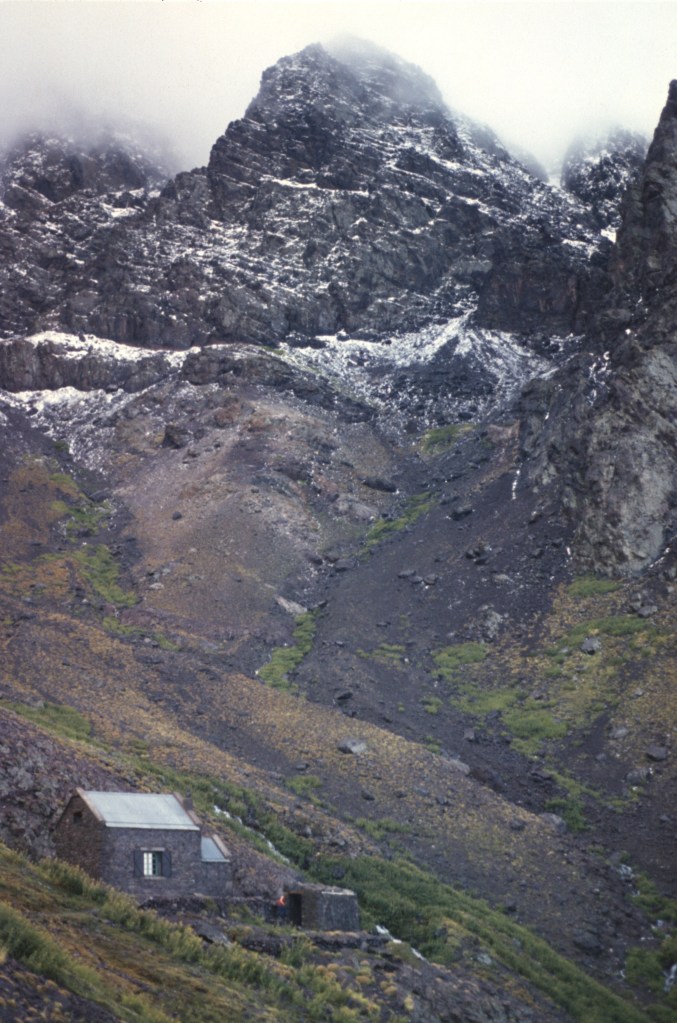
Travel to Spain was allowed, because of its Arab past, but, though I visited every major Moorish site to which I could easily travel in Spain, I still think that the ban on Europe and the restriction to Spain was silly. You could have easily argued that Morocco’s recent past was French, so visits to France should have been permitted. Modern Morocco has been created by the French. In any case, volunteers, especially ones with wealthy parents, ignored it and were never punished.

Peace Corps had good intentions. It really wanted volunteers to get to know Morocco better, but most had plenty of opportunity to travel, with good transportation and volunteer friends spread around the country, and most felt they needed a break when they had a long summer vacation.

Algeria was considered a hostile state. Morocco had just fought a war with Algeria along the southeastern border. The U.S. government probably feared dealing with Algeria if American nationals got into trouble there. In fact, in western Algeria, the dialect was very similar to Moroccan Arabic, and communication is not difficult. Cities like Tlemcen were tied to Moroccan history as former parts of Moroccan empires.

The Algerians I met when I finally traveled there treated me just as Moroccans did: with curiosity, courtesy, and hospitality. In the struggle for independence, America had not supported France. There were no hard feelings there with the Algerians. Strained government relations were mainly a result of the division of the world into hostile blocs and the expression of Cold War ideologies. My Algerian acquaintances had Red Army records in their collection— because of trade with the Soviet Union—of which they openly made fun. The Russians were not cool. James Brown and the Beatles were cool.

Many of us laughed about the “super vols,” highly performing volunteers that Peace Corps staff occasionally touted, painting them out as examples of what we should be. We considered some of them phonies. Most of us did as well as we could given the conditions. Some jobs were easier than others. Being a TEFLer was a relative piece of cake compared to others. Peace Corps knew how to train and monitor teachers, Moroccan lycées had administrative structures into which a teacher could be placed and Moroccan students, avid for knowledge and eager to learn, were generally a pleasure to teach and took to Americans, who were far less formal and far more friendly than the French.

Other volunteers were given jobs that didn’t exist. When you are placed in a rigid, government administration, just how do you create a job when there are few expectations for you and little support? Occasionally, volunteers solved the problem, but many more gave up. Indeed, some of our Moroccan colleagues had also given up, content to receive a regular paycheck, and sit most of the day and read the paper and smoke.

As the first decade evolved, Peace Corps programming focussed on more professional areas: architects, veterinarians, foresters, and so forth. What this did was insure that the volunteer did have some kind of employment related to his training. In fact, some architects did little more than design homes for officials.

I remember a staff person who administered an architects program. One of the volunteers had complained that he was being pestered to design water towers in some kind of historical disguise. The staff person, took the train to Fes to see him. As he rode along through the plains of the Gharb, he sketched every water tower he saw along the way. All were, of course, functional designs, with no local color, but form following function. Why waste time on a water tower with all of Morocco’s needs?

But the programs were popular with universities back in the States, and Peace Corps developed institutional relationships with some that were beneficial to individuals and institutions, if not necessarily to the Peace Corps and Morocco.

Everything was smaller and simpler than it is today. Maybe that is why it is so easy to look back and enjoy those days. Volunteers lived privileged lives as foreigners, but were not wealthy. Those of us who lived at higher elevations were never warm in the winter. We did not band together as much as the French coopérants did, who were there in much larger numbers, and who very often had cars. Nor did we socialize with other expatriates very much.

Unlike the French, we were not purveyors of a superior culture, a culture respected by wealthy, educated Moroccans, so we did not look down on the locals, though educated Moroccans may have looked down on those of us who did not speak French well. We sometimes made fun of Moroccan ways, but not in the nasty manner that the American military did. We did not call Moroccan’s “Mo’s” or any other derogatory term. Moroccans, no matter how humble, were the bearers of an exotic culture and a proud religion. For most of us, ordinary Moroccans were a subject of fascination and we admired them for their hard work, faith, and fortitude. We wanted to make them happy, and help them if we could.

Some of us were self-imposed exiles from a war we felt unwise and unjust. Draft boards were breathing down our necks. Peace Corps offered a temporary respite or last chance. Even some of our administrators were exiles. Richard Holbrook, tied to Democratic patrons like Dean Rusk and Clark Clifford, tried to wait Nixon out. He succeeded, too. Never much interested in Morocco, as far as I could ever see, he later was appointed an Under Secretary of State for Asian Affairs by President Carter. I thought him self-centered and shallow. One ambition of his, he confided to me, was to have driven every paved road in Morocco. He redeemed himself in my eyes by brokering an end to the Balkans wars that followed the breakup of Yugoslavia, then died, tragically, in a road accident.

The problem for us volunteers was how to fit in. None of us arrived a Muslim, though one or two converted, so we were excluded from religious life, one of the poles around which Moroccan life revolved. We were foreigners, and Moroccans, once administered by the French and Spanish, dealt with foreigners in the ways to which they were accustomed. They categorized us according to their particular world views. Teachers fit in perfectly. Others were doing training, stages in French. We were Christians or Jews. We were spies. We were tourists. If we were women, maybe marriage material, more likely a potential conquest. Volunteers had little control over how they were perceived, though where and how they lived had a bearing. Some lived sober lives, some lived out fantasies. Some were outrageous. But through work and neighborhood life, many volunteers developed friendships that outlasted their service. Some returned to Morocco to see co-workers after their service. And some did marry Moroccans.

Ali, with Professor Dick Moench, a Binghamton undergraduate student, and a guide, visiting Sultan Moulay Ismail’s stables in Meknes. Moulay Ismail was one of Morocco’s most colorful sultans.

I knew Ali as a lycée student in Sefrou while in the Peace Corps. In 1973 I went back to Morocco with a university sponsored foreign living experience. The students in the program lived in a run-down tourist facility in Salé, and they loved it. The professor with them stayed in a modest hotel in Rabat. I found a Peace Corps volunteer living in Salé who had some extra room so, in order to save money, I moved in paying a share of the rent. Ali was sharing a tiny, dark place in Rabat with other students, so I asked him if he wanted to move in too, and he got to live in a big, uncluttered apartment until I moved out that the summer. I remember the volunteer’s name, but not what he did. His pastime seemed to be picking up foreign tourists, traveling on the cheap, and offering accommodation in hope of sexual favors. I thought that scandalous myself.
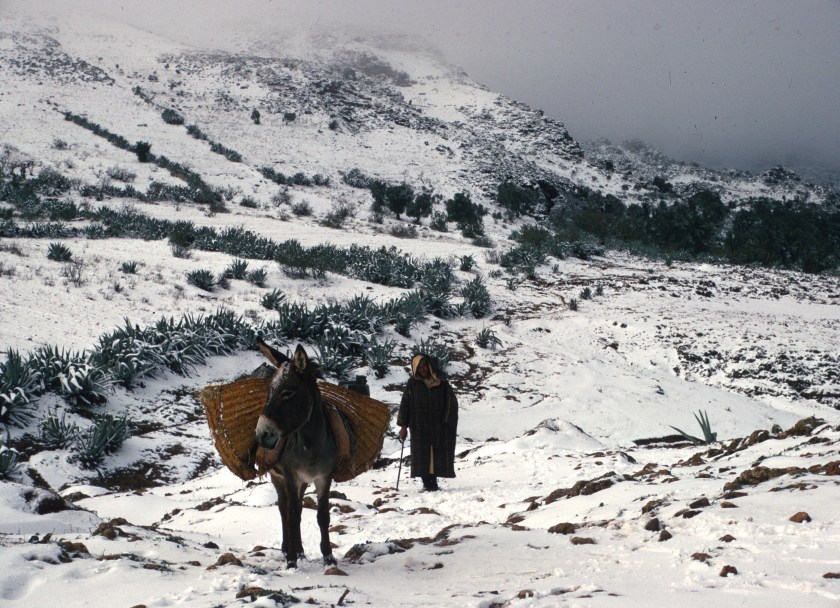
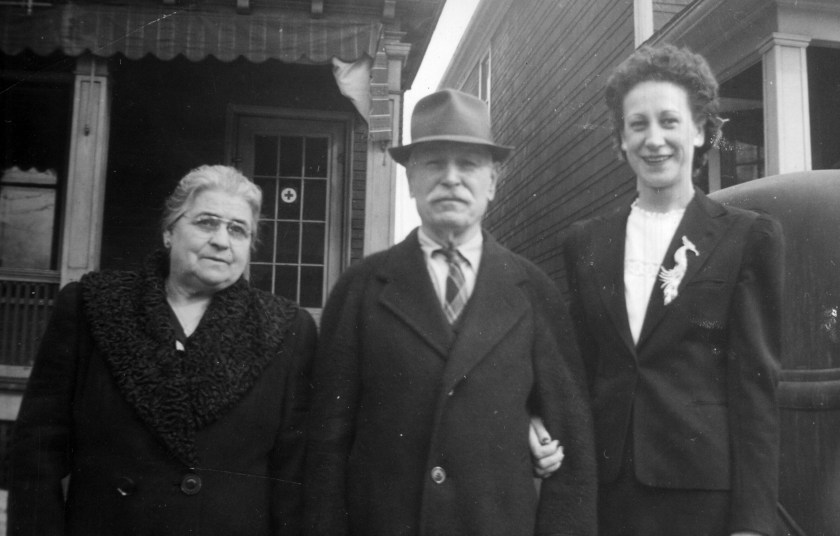
I did not hear from Ali again for many years until I received a call out of the blue. He was living in Binghamton, attending the State University of New York where he was pursuing a graduate degree in comparative literature. His call was a surprise and his voice a bit different. He had studied in Manchester, England, and its northern accent overlaid his truly American one, learned from his lycée professor from Yakima, Washington. I agreed that I would meet him soon in Binghamton, where I was trying to jumpstart my Ph.D. Studies.

It was at a difficult time in my life, and I never followed through. He didn’t call again that I recall, and a few years later I heard from his old Peace Corps teacher, then living in Seattle, that I had hurt him deeply. I am more sorry than ever today. It was unforgivable, but I cannot undo it. So when we talked again, 20 years later, I was nervous. As it turned out, it was just two very old friends remembering shared parts of their youth, lived 50 years earlier. Much has changed, but not everything.

Thanks, Ali, for your friendship.

Ali invited his English teacher, Gaylord Barr, to visit his father and family near Oujda. Gaylord treated him to his first plane flight.

Displaying Photos

I hope that everyone reading this blog can see all the attached photos with their captions. I have not been optimizing my media, and I apologize to you if photos load slowly or perhaps not at all. Please let me know if you have experienced any difficulty.

Dave

Nomads

Berber horsemen, Sefrou. Morocco.

In his blog, Bravo, the Other Side of the Mountains, recently reviewed three books on nomads, which he found interesting and of wider interest. Nomadism seems to be a dying way of life, and through romantic eyes, one to be much regretted. I suspect that nomads today have, like hunters and gatherers, been pushed yet farther into extreme environments, and nomadic lifestyles have changed, and not necessary for the better. In the Sahara, they have also become involved in resistance movements such as the Polisario as well as fundamentalist insurgencies.

My experience with nomadism consists of my rambles in the Middle Atlas, excursions in other regions of Morocco, and a trip by truck across the Sahara (eventually to be a post of its own). I have met nomadic people, drunk tea with them in their tents and along desert roads in Algeria, and talked with them in the cedar forests of Morocco. I do not claim any special knowledge, and my observations are casual. But nomadism played a critical role in Morocco’s history.

Before modern times, Morocco was divided into two parts, bled el-makhzen and bled es-siba, which translate into the land of the government, controlled by the sultan, and the land of insolence, land beyond the sultan’s control. The lines of demarcation varied according to the relative strength of the government or the tribes. When the sultan was strong, the tribes avoided trouble with the government. When the tribes were strong, the government was confined to the traditional capitals, usually Fes, Marrakesh, and Meknes in modern times, and even these cities were not safe. The walls around Moroccan cities were functional until the French authority secured the country in the twentieth century. Cannons were scarce and difficult to transport on dirt tracks, and walled cities could close their gates and hold out until help arrived.

Summer pastures at Daya Ifreh, Middle Atlas.

Herds drinking in springtime, Daya Afrougah, Middle Atlas, just above Sefrou.
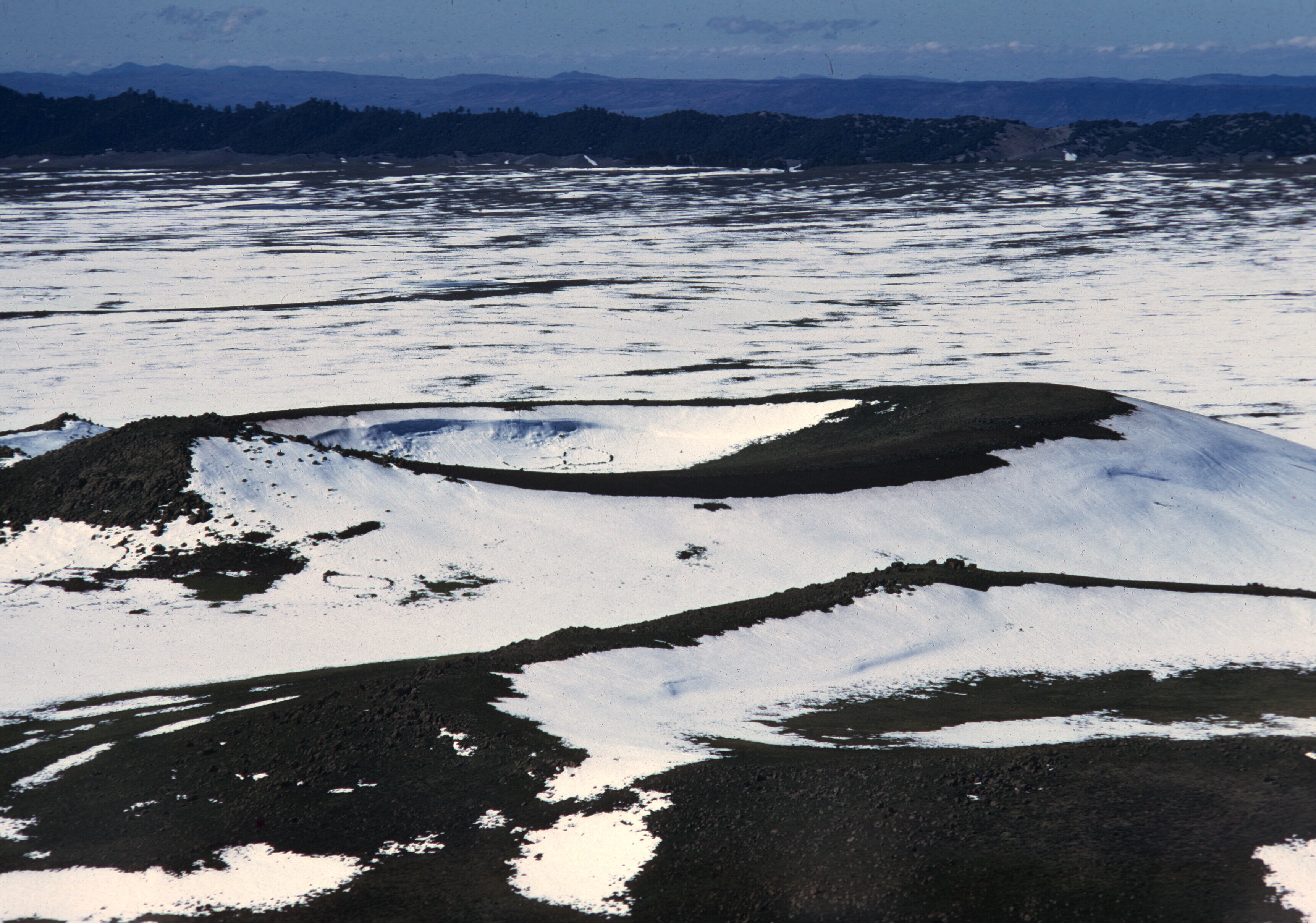
The Moroccan sultans moved their courts from capital to capital, threatening or punishing tribesmen who had not paid their taxes. In this sense, they were much like the French kings of the Renaissance who constantly traveled through their territories. Francis I stayed in Chambord, a Loire Valley palace with 490 rooms which he built amid an immense hunting estate  on which he set foot only three times during his life. Before standing armies, one had to show the flag everywhere and often.

france chambord 1
Wing of the château of Chambord, built by Francis I.

Not all the tribesmen who challenged the sultan’s authority were nomads. As late as the first decades of the twentieth century, Fes was threatened by tribes of the Jbala and the Rif, and Marrakesh was virtually controlled by the Glaoui until Moroccan Independence in 1956.

But the nomadic tribes posed a more serious threat. Mobile, they could strike quickly and in force. For the sultan, they proved to be a difficult moving target for a small standing army.

In the Middle Atlas, large tribes such as the Beni Mguild and the Beni Mtir practiced a transhumance analogous to that of pastoralists of the mountainous regions of Europe and the Middle East.

morocco middle atlas volcanoes
Livestock pens inside volcanic cones on the Middle Atlas plateaus.

morocco middle atlas herd
Sheep grazing in the cedar forests near Ifrane.

They wintered in the snow-free lowlands, where seasonal rains produced fresh grass for their herds. In the summer, they took their flocks to the cedar forests of the high plateaus where the air was cool, where there were lakes for watering the flocks, and where the green vegetation persisted into the late summer. In some cases, they also descended into the Upper Moulouya basin, between the High and Middle Atlas mountain ranges.

morocco high atlas jaffartents
Tents on the south slopes of Jbel Ayachi. Upper Moulouya valley and Middle Atlas in distance.

In the lowlands at the foot of the mountains, the nomadic tribes controlled towns and villages where they spent time in the winter and could resupply themselves with staples. This pattern is a familiar one.

Upper Moulouya River basin, herdsman.
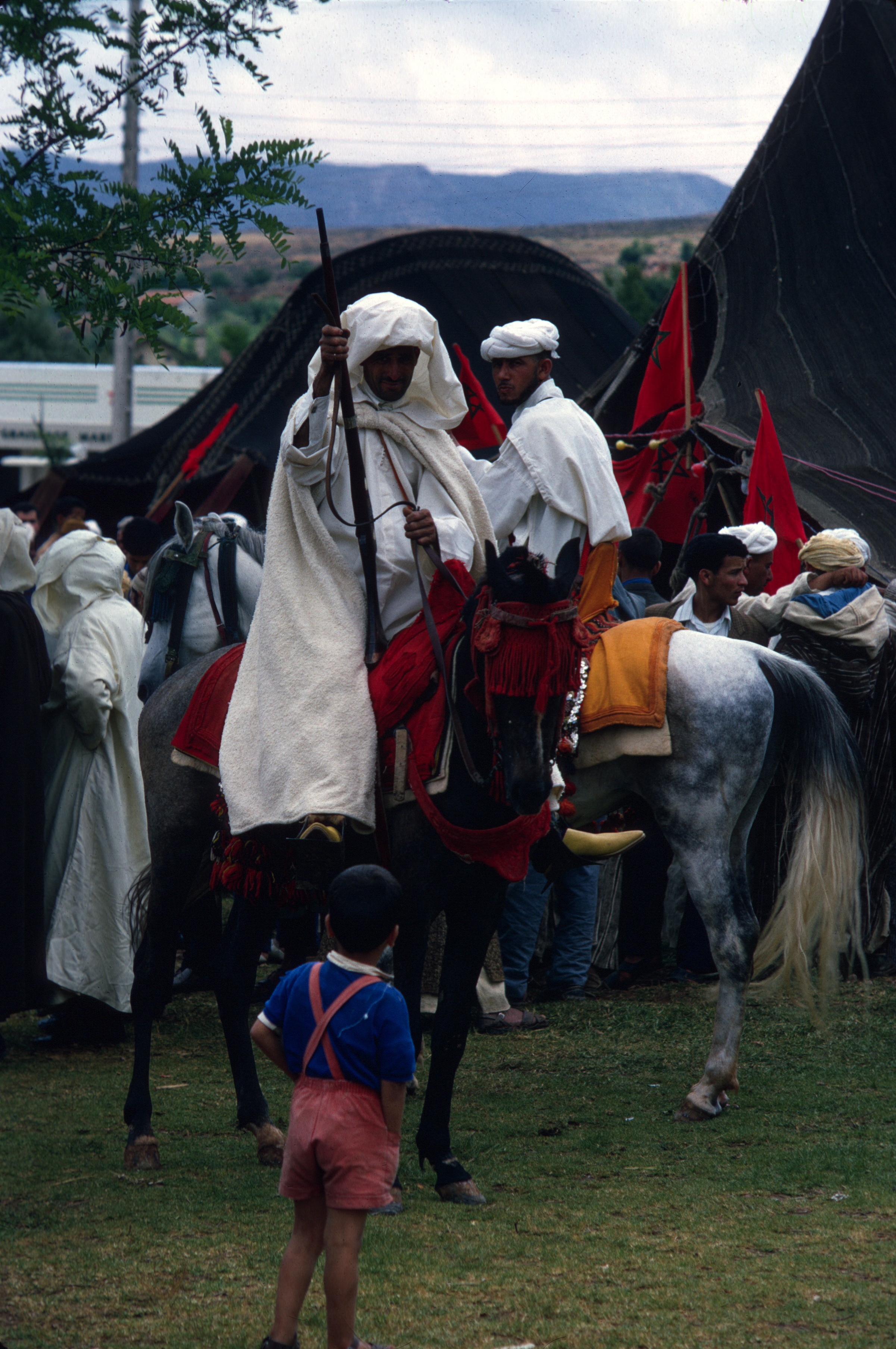
On the southern border of the desert, Tourag nomads traditionally enslaved villages, and Saharan oases were often the virtual property of large nomadic tribes.

Market, Agadez, Niger. Touareg noblemen with their camels.

The power of the tribes asserted itself when the sultan was weak. Morocco illustrates the mechanics of Ibn Khaldun’s theory of the rise and fall of Arab dynasties. In Morocco, tribal-based insurrections resulted in the creation of Almoravid, Almohad, Merinid, and the current Alouite, dynasties. As the central power faltered in the face of challenges, the tribes grew strong enough to overthrow it, and create a new dynasty. In Morocco’s case the dynasties were mostly Berber, but after several generations of urban life, the Berber rulers were assimilated and Arabized, a process not dissimilar to what happened to the Mongol rulers of China. The dynasties gradually lost legitimacy, their power eroded, and they fell prey to new nomadic groups which then formed their own dynasties. Ibn Khaldun in his Muqqadama, describes the dynastic cycle and used it to explain and give meaning to history.

We associate nomadism with the desert, but most of traditional Morocco was not desert. Only after leaving the high plateaus bordering the southern slopes of the High Atlas was camel nomadism found on a large scale. The Middle Atlas nomads were horsemen, and all the more formidable as such.

Sefrou, local tribesman during the Cherry Festival, 1968.

Today the lowland plains are given over to agriculture, often on an industrial scale. The mountain forests are still grazed intensively, and flocks still move up and down, but power lies with the central government. Villages are controlled by civil authorities, and the forests by government forestry officers.

In southern Algeria and northern Niger, fundamentalist groups wage war, and the chief cargo of trans-Saharan trucking is human, migrants trying to escape warfare and poverty. How very different from 50 years ago.

africa sahara touareg man
Touareg man, Tamanrasset.

algeria sahara tamanrasset nomads
Touareg with camels. Tamanrasset. Hogan massif in distance.

Touareg nobleman in the market in Agadez, Niger. 1971. Algeria outlawed duels, but in Niger, the nobles still carried swords and presumably used them.